


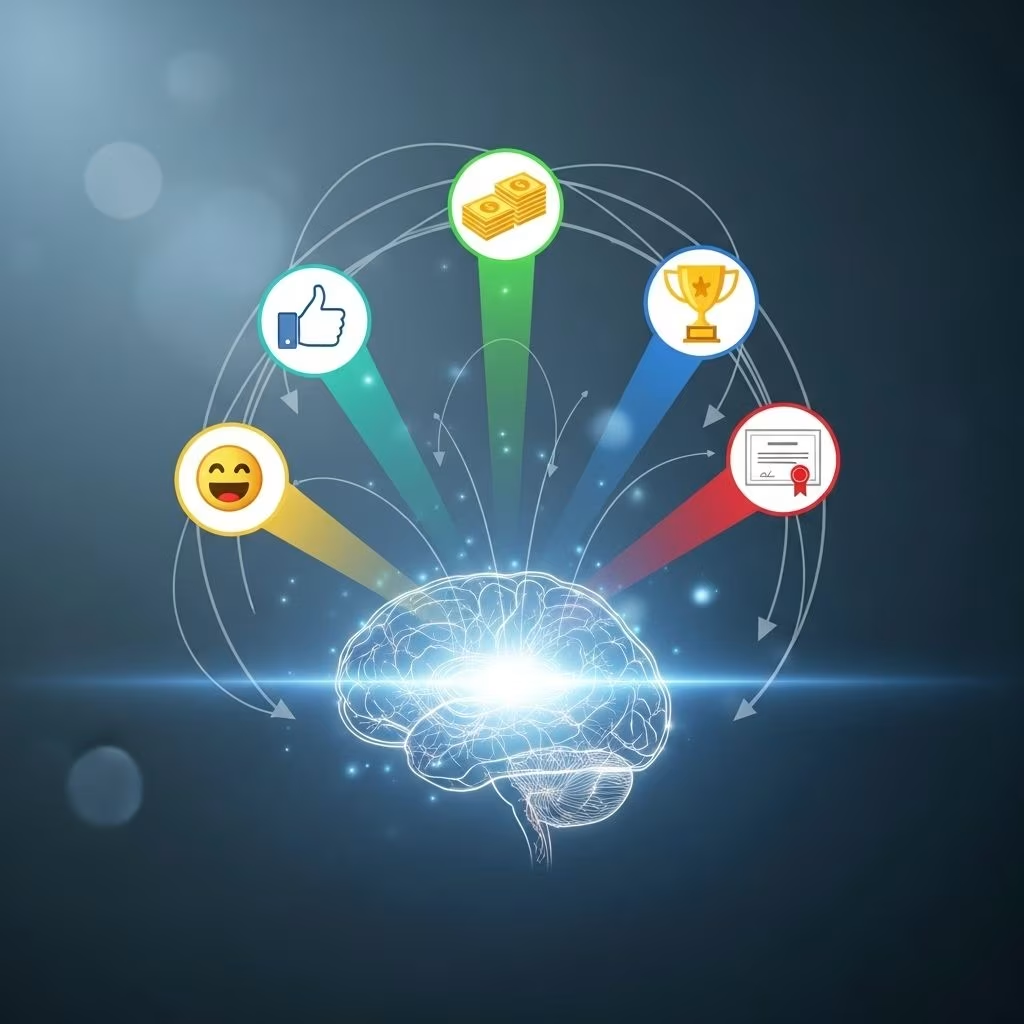
Secondary reinforcement is an essential concept in behavioral psychology, especially within the framework of operant conditioning. This principle explains how certain stimuli, initially neutral, become powerful motivators for behavior after being associated with primary reinforcers. Understanding secondary reinforcement provides critical insight into motivation, learning, and behavior modification across numerous domains, including education, therapy, and everyday life.
What is Secondary Reinforcement?
Secondary reinforcement refers to a stimulus that acquires reinforcing qualities only after being paired with a primary reinforcer. Unlike primary reinforcers, which inherently satisfy biological needs—such as food, water, or warmth—secondary reinforcers gain their motivating power through learned associations and conditioning. A common alternative term for secondary reinforcement is conditioned reinforcement.
- Secondary reinforcer: Gains its value through association with primary reinforcers (e.g., money, praise, tokens).
- Primary reinforcer: Naturally satisfying stimuli fulfilling basic needs (e.g., food, water, sleep).
For example, money itself does not satisfy a biological need, but it becomes a powerful motivator because it can be exchanged for necessities like food and shelter.
Secondary Reinforcement in Context: Operant vs. Classical Conditioning
Behaviorists recognize two main forms of conditioning:
- Classical conditioning: Learning based on associations between two stimuli, often outside conscious control (e.g., Pavlov’s dogs associating a bell with food).
- Operant conditioning: Learning shaped by consequences, where behaviors are either reinforced (increased likelihood) or punished (decreased likelihood), and the individual can influence outcomes.
Secondary reinforcers play a central role in operant conditioning, where positive reinforcement increases the likelihood of a behavior by adding something desirable, and negative reinforcement increases behavior by removing something unpleasant.
Primary vs. Secondary Reinforcers: Key Differences
| Aspect | Primary Reinforcer | Secondary Reinforcer |
|---|---|---|
| Definition | Inherently satisfying; fulfills biological needs | Learned value; requires pairing with primary reinforcer |
| Examples | Food, water, warmth, shelter | Money, praise, grades, tokens |
| Origin of Effectiveness | Natural, universal | Conditioned, depends on individual learning |
| Loss of Effectiveness | May lose potency when need is met (e.g., a satiated animal) | Potentially durable; often motivates behavior over time |
| Application | Immediate response, basic survival | Complex behaviors, social and educational settings |
While primary reinforcers have immediate, powerful effects, secondary reinforcers are preferred in teaching and lasting behavior modification due to their versatility and capacity for long-term influence.
How Secondary Reinforcement Works: Conditioning Process
A secondary reinforcer starts as a neutral stimulus. Through repeated pairing with a primary reinforcer, it gains motivating power. The process typically unfolds as follows:
- Pairing: A neutral stimulus is consistently presented together with a primary reinforcer.
- Conditioning: Over time, the individual associates the neutral stimulus with the reward provided by the primary reinforcer.
- Reinforcing Effect: Eventually, the conditioned stimulus can reinforce behavior on its own.
For instance, trainers may use a clicker (initially neutral) paired with treats (primary reinforcer) for dogs. After several repetitions, the sound of the clicker alone becomes rewarding and reinforces the desired behavior.
Common Examples of Secondary Reinforcers
- Money: Universally recognized as the most powerful secondary reinforcer for humans. Money can be exchanged for virtually any biological need or desired object, motivating people across all cultures.
- Praise: Hearing words like “Good job!” or “Great shot!” encourages repeated behavior in children, students, and even adults, once associated with affection, approval, or rewards.
- Grades: In academic settings, grades motivate students to learn and perform, serving as a proxy for achievement, recognition, and future opportunities.
- Tokens and Stickers: Used in classrooms or therapeutic settings, tokens or stickers can be exchanged for privileges, treats, or extra playtime\n.
- Social Approval: Compliments, smiles, or acceptance within a group can reinforce desired behaviors once linked with feelings of belonging or esteem.
Secondary Reinforcers in Everyday Life
Secondary reinforcement underpins many systems we interact with daily. Examples include:
- Workplaces: Employees are motivated by paychecks, bonuses, and promotions, which are abstract until paired with rewards (money, status, access to resources).
- Education: Grades and certificates drive effort and achievement, ultimately linked to future primary reinforcers like career opportunities.
- Retail and Loyalty Apps: Points, coupons, or reputation rankings in apps gain value only when associated with discounts or special treatment.
Real-World Applications: Token Economy Systems
One of the most structured uses of secondary reinforcement is the token economy. This system allocates tokens (such as chips, stickers, or points) when desirable behavior is displayed. Tokens can then be exchanged for rewards meeting primary needs or desires.
- Educational Settings: Teachers may reward students with tokens for participating, completing homework, or cooperating. These tokens are later redeemable for extra recess, snacks, or special privileges.
- Therapeutic Environments: In mental health facilities and rehabilitation centers, token economies shape behavior and encourage progress.
- Correctional Institutions: In prisons or juvenile centers, tokens can incentivize compliance with rules and positive social interactions.
Research has shown token economies to be effective in modifying behavior among children with autism, reducing disruptive actions while increasing socially appropriate behaviors. In such programs, children receive tokens for desirable behavior and lose tokens for negative actions, providing clear, consistent feedback and incentives.
Key Advantages of Secondary Reinforcers
- Flexibility: Can be adapted to various contexts and tailored to individuals or groups.
- Durability: Unlike primary reinforcers, secondary reinforcers can remain motivating over extended periods, long after the original need is met.
- Scalability: Useful in complex environments (schools, organizations, therapy), where primary reinforcement may be impractical.
- Complex Behavior Shaping: Enable development of sophisticated behavior patterns, preparing individuals for future rewards rather than immediate satisfaction.
Potential Limitations and Considerations
- Dependence on Association: Without effective pairing with primary reinforcers, secondary reinforcers lose value and motivational power. For example, money is useless to those who do not understand its purchasing power or cannot use it to acquire necessary resources.
- Cultural and Individual Variation: Secondary reinforcers are shaped by social norms, individual preferences, and prior experiences.
- Loss of Effectiveness: Overuse or poorly designed reinforcement systems may render secondary reinforcers less motivating or even meaningless.
Secondary vs. Primary Reinforcement: Real-World Decision Making
Deciding which type of reinforcement to use depends on context:
- Immediate Needs: For basic needs and initial learning, primary reinforcers (food, water) are necessary.
- Long-Term Goals: Secondary reinforcers are preferred for sustained motivation, educational achievement, and behavior modification in complex social environments.
Educators, parents, managers, and therapists often rely on secondary reinforcers to motivate and structure behavior over time, because these can be tailored, delayed, and accumulated, making them ideal for shaping complex actions and long-term habits.
Frequently Asked Questions (FAQs)
What is the difference between primary and secondary reinforcement?
Primary reinforcement relies on innate biological needs (food, water), while secondary reinforcement depends on learned associations with those needs (money, praise, tokens).
Is money a secondary reinforcer?
Yes. Money is the most common and powerful secondary reinforcer for humans, motivating behavior by enabling access to primary reinforcers and other conditioned rewards.
Are grades and praise secondary reinforcers?
Yes. Grades and praise gain their value by association with recognition, success, or approval, and thus reinforce behaviors even though they do not directly satisfy biological needs.
What role do secondary reinforcers play in education?
Secondary reinforcers such as grades, praise, and tokens motivate students to learn, participate, and develop desirable habits. They support behavior modification programs and long-term achievement.
Can secondary reinforcers lose their effect?
Yes. If the association with primary reinforcers breaks down or becomes unclear, secondary reinforcers lose motivational power. Effective reinforcement systems require ongoing maintenance and adaptation.
Summary Table: Primary vs. Secondary Reinforcers
| Feature | Primary Reinforcer | Secondary Reinforcer |
|---|---|---|
| Biological Basis | Yes | No |
| Requires Learning | No | Yes |
| Examples | Food, Water, Warmth | Money, Praise, Grades, Tokens |
| Application Scope | Simple, immediate needs | Complex, long-term behaviors |
| Durability | Short-lived after needs met | Long-lasting if association maintained |
Key Takeaways
- Secondary reinforcement is crucial for teaching complex behaviors and motivation beyond immediate biological needs.
- It works through conditioned associations with primary reinforcers.
- Common secondary reinforcers include money, praise, grades, tokens, and social approval.
- Token economies and behavior modification programs use secondary reinforcement for long-term success.
- Secondary reinforcers are flexible but depend on clear, maintained associations to remain effective.
References
- APA Dictionary of Psychology: Secondary Reinforcement
- Social Sci LibreTexts: Primary and Secondary Reinforcers
- Study.com: Secondary Reinforcer Definition & Examples
- Fiveable: Secondary Reinforcement Key Terms
- YouTube: Primary vs Secondary Reinforcers, Explained
- Alleydog: Secondary Reinforcer Definition
References
- https://www.youtube.com/watch?v=WnOAzlD0uBc
- https://fiveable.me/key-terms/ap-psych/secondary-reinforcement
- https://study.com/academy/lesson/secondary-reinforcers-examples-definition-quiz.html
- https://socialsci.libretexts.org/Bookshelves/Psychology/Introductory_Psychology/General_Psychology_for_Honors_Students_(Votaw)/18:_Operant_Conditioning/18.04:_Primary_And_Secondary_Reinforcers
- https://dictionary.apa.org/secondary-reinforcement
- https://study.com/academy/lesson/video/secondary-reinforcers-examples-definition-quiz.html
- https://www.alleydog.com/glossary/definition.php?term=Secondary+Reinforcer


