


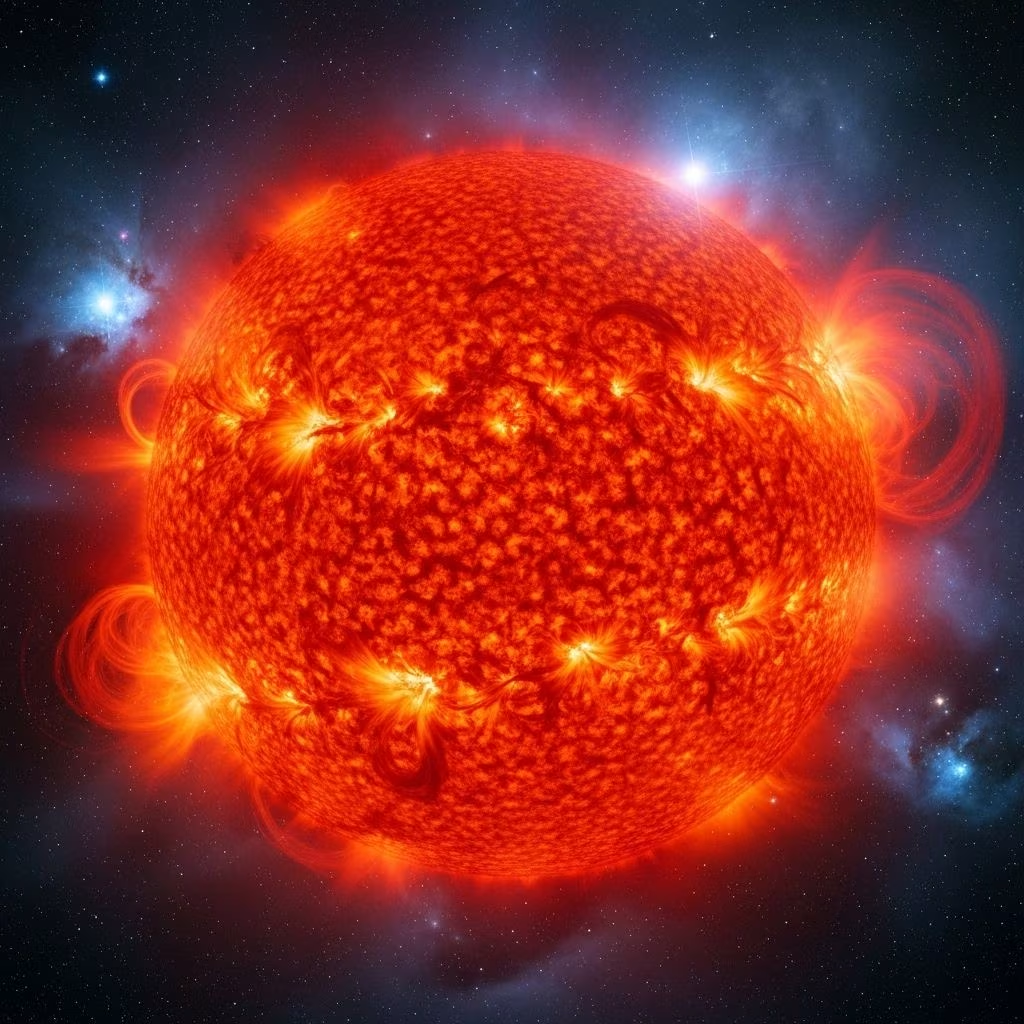
Betelgeuse: The Enigmatic Red Supergiant in Orion
Betelgeuse (α Orionis) is among the most fascinating and well-studied stars in the night sky. Residing as the shoulder of the Orion constellation, its dramatic changes in brightness, immense size, and proximity have captivated astronomers and stargazers for centuries. Today, Betelgeuse is under intense scrutiny due to recent unexpected dimming events and its looming, spectacular future as a supernova.
Quick Facts: Betelgeuse at a Glance
- Type: Red supergiant star
- Constellation: Orion (Alpha Orionis)
- Brightness: Usually 10th brightest star in the night sky
- Distance from Earth: Estimated 400–600 light-years
- Radius: 640 to 900 times that of the Sun
- Mass: 10–20 times the mass of the Sun
- Age: Less than 10 million years
- Expected Fate: Will eventually explode as a supernova
The Place of Betelgeuse in Orion and Our Sky
Betelgeuse occupies a prominent spot in the sky as Orion’s shoulder, making it one of the easiest red stars to observe with the naked eye. This distinctly reddish star stands out not just for its color but also for the variability in its brightness, which over historical and modern times has made it a focal point of astronomical mystery and excitement.
As the alpha star of Orion, Betelgeuse is only surpassed in brightness within its constellation by Rigel. It is especially notable for being the brightest star in the night sky at near-infrared wavelengths, allowing astronomers to study its structure and surface features in detail.
The Immense Scale of Betelgeuse
Betelgeuse is classified as a red supergiant, a phase in stellar evolution where a massive star swells to enormous dimensions as it moves toward its final fate. If Betelgeuse replaced our Sun at the center of the Solar System, its outer surface would engulf Mercury, Venus, Earth, and even Mars. Estimates for its radius range from 640 up to 900 solar radii, reflecting both the difficulties in pinpointing its exact size and the star’s pulsating, unstable outer layers.
Its mass, between 10 and 20 times that of the Sun, has driven it through a fast and turbulent stellar lifespan. Betelgeuse is less than 10 million years old—quite young compared to the Sun’s 4.6 billion years—but massive stars like Betelgeuse burn through their nuclear fuel rapidly, aging much more quickly.
| Property | Betelgeuse | The Sun |
|---|---|---|
| Radius | 640–900 solar radii | 1 solar radius |
| Mass | 10–20 solar masses | 1 solar mass |
| Brightness (Absolute Magnitude) | −6.0 | +4.83 |
| Life Span | < 10 million years | 10 billion years |
| Distance from Earth | ~400–600 light-years | 1 astronomical unit |
Betelgeuse’s Variable Brightness
One of Betelgeuse’s most intriguing traits is its semiregular variability. Its apparent magnitude fluctuates between +0.0 and +1.6, making it the first-magnitude star with the widest known range in brightness. The main period of this variability is around 400 days, linked to pulsations within its vast, unstable outer envelope. In addition, astronomers have noted cyclical brightening and dimming on a roughly six-year period, an unsolved mystery until very recently.
The “Great Dimming” of Betelgeuse
The world’s attention turned sharply to Betelgeuse between late 2019 and early 2020, during what astronomers dubbed the “Great Dimming.” Over a span of a few months, Betelgeuse lost about two-thirds of its luminosity, reaching the faintest levels ever recorded for the star. This phenomenon fueled speculation that Betelgeuse was nearing its end, as its expected fate is to explode in a blaze of supernova glory. If Betelgeuse had gone supernova, it would have shone in the daytime sky, appearing as bright as the half-moon for months, though life on Earth would remain unaffected.
- Timeline of the Great Dimming:
- Fall 2019: Rapid onset of fading
- February 2020: Brightness hits lowest level
- May 2020: Star returns to typical brightness
The cause of this dramatic event was debated. Some astronomers pointed to massive starspots (cool patches on Betelgeuse’s surface), while others proposed a dust cloud ejected by the star itself had obscured our view. Later study confirmed the latter: a titanic blast of stellar material had been flung from Betelgeuse, cooled, and condensed into a cloud, briefly obscuring the star from our vantage point.
Explaining the Six-Year Brightness Cycle
Betelgeuse is also known for a mysterious, periodic variation in brightness that recurs roughly every six years. For decades, this baffled astronomers, with many theories proposed but none confirmed.
Recent breakthrough observations have finally identified a likely cause: Betelgeuse possesses a secret, close-orbiting companion star. This newly-sighted companion star moves in a very tight orbit, periodically influencing Betelgeuse’s outer layers and causing the observed variations in brightness. The discovery of this companion resolves a mystery that has lasted for over 1000 years in astronomical records.
- The companion is expected to be cannibalized by Betelgeuse in a few thousand years, adding to the star’s complex life story.
Betelgeuse’s Movement and Past
Betelgeuse is classified as a runaway star, having been ejected from its birthplace in the Orion OB1 association—the same stellar nursery where the stars of Orion’s Belt originated. It is currently hurtling through the interstellar medium at approximately 30 km/s, plowing up a massive bow shock front that measures over four light-years wide.
The Fate of Betelgeuse: Awaiting a Supernova
Having already exhausted the hydrogen fuel at its core and moved through successive stages of fusion, Betelgeuse’s days are numbered. Astronomers estimate that within the next 100,000 years—a mere blink in cosmic time—it will explode as a supernova.
When it does, Betelgeuse will blaze so intensely that it will rival the brightness of the half-moon in Earth’s sky for weeks or even months. Despite the drama, this event will not threaten life on Earth, but will offer an unprecedented cosmic spectacle and an invaluable opportunity for scientific study.
Ongoing Scientific Mysteries and Research
While recent discoveries have clarified some of Betelgeuse’s mysteries—including the cause of its six-yearly dimming and the source of the Great Dimming—many questions remain. Betelgeuse serves as a cosmic laboratory for understanding the lives and deaths of massive stars and the conditions that lead to supernovae. Ongoing research focuses on:
- The dynamics and structure of Betelgeuse’s outer layers
- Interactions with its close companion star
- Mass loss and dust formation mechanisms
- Predicting the exact timeline and signals preceding supernova outbursts
Did You Know? Betelgeuse in Culture & History
- Betelgeuse’s name comes from Arabic, often interpreted as “the hand of Orion.”
- Appearance in pop culture: Betelgeuse has inspired everything from movies to science fiction novels and music.
- Astronomy’s oldest records: Historical observations of Betelgeuse date back nearly 2,000 years.
Frequently Asked Questions (FAQs)
Q: Why does Betelgeuse change its brightness?
A: Betelgeuse is a variable star whose brightness changes due to pulsations in its extended outer layers and interactions with a close-orbiting companion star. Occasional dramatic dimming, like the ‘Great Dimming,’ can be caused by ejected dust clouds that temporarily obscure the star.
Q: Will Betelgeuse become a supernova soon?
A: Betelgeuse will eventually go supernova, but this is most likely to happen within the next 100,000 years, not imminently. Its life is short on cosmic timescales because massive stars burn fuel rapidly.
Q: How far is Betelgeuse from Earth?
A: Betelgeuse lies between 400 and 600 light-years from Earth. The range of estimates reflects challenges in measuring its distance due to its great size and the dynamics of its outer layers.
Q: What would happen if Betelgeuse went supernova?
A: The explosion would produce a spectacular show, briefly making Betelgeuse one of the brightest objects in the night sky; it could even be visible during the day. Earth’s biosphere would not be harmed due to our distance from the star.
Q: What caused the ‘Great Dimming’ of Betelgeuse?
A: The Great Dimming was caused by a vast cloud of dust generated and expelled by Betelgeuse itself, which cooled and blocked a portion of the star’s light from our view.
Summary: The Last Act Before a Cosmic Finale
Betelgeuse is more than just a red spot in the sky—it is a living cosmic drama. From starspots and expelled dust clouds to secret companions and its destiny as a supernova, Betelgeuse embodies the complex, violent processes in the universe’s most massive stars. As our understanding grows, so does our appreciation for the spectacular finale that awaits, perhaps even within the time of civilization’s memory.
References
- https://www.space.com/astronomy/astronomers-crack-1-000-year-old-betelgeuse-mystery-with-1st-ever-sighting-of-secret-companion-photo-video
- https://www.space.com/betelgeuse-red-giant-dimming-star-eruption.html
- https://en.wikipedia.org/wiki/Betelgeuse
- https://science.nasa.gov/universe/what-is-betelgeuse-inside-the-strange-volatile-star/
- https://www.britannica.com/place/Betelgeuse-star
- https://astrobackyard.com/the-star-betelgeuse/
- https://www.star-facts.com/betelgeuse/
- https://www.astronomy.com/science/betelgeuses-long-lost-companion-emerges-from-the-shadows/
- https://www.skyatnightmagazine.com/space-science/star-betelgeuse
- https://science.nasa.gov/image-detail/betelgeuse-location-and-size/
- https://starwalk.space/en/news/betelgeuse-star-will-be-supernova
- https://cosmosmagazine.com/space/astronomy/betelgeuse-companion-star-confirmed/
- https://vaonis.com/blogs/travel-journal/betelgeuse-supernova-mysterious-star
- https://www.popularmechanics.com/space/deep-space/a65507137/betelgeuse-companion-star/
- https://theplanets.org/stars/betelgeuse-star/


