


How Big Is Saturn?
Saturn is the Solar System’s showpiece, not just for its shimmering rings, but for its sheer size and unique structure. As the second largest planet after Jupiter, Saturn dwarfs Earth and offers rich topics for educators, students, and astronomers alike. But what makes Saturn so massive, and how can we grasp its true scale? This deep-dive article explores Saturn’s size from multiple perspectives, including its diameter, volume, mass, shape, and comparison to Earth and other planets.
Saturn at a Glance: Key Physical Characteristics
| Feature | Value |
|---|---|
| Type | Gas Giant |
| Equatorial Diameter | 120,536 km (74,898 miles) |
| Pole-to-Pole Diameter | 108,728 km (67,560 miles) |
| Mass | 5.683 × 1026 kg (95 Earth masses) |
| Volume | 827,130,000,000,000 km³ (about 764 Earths) |
| Average Density | 0.687 g/cm³ |
| Number of Moons | 146 (confirmed) |
| Average Distance from Sun | 1.43 billion km (890.7 million miles) |
| Orbital Period (Year) | 29.5 Earth years |
| Day Length | About 10.7 hours |
Understanding Saturn’s Colossal Size
Saturn is renowned for its vastness, but the numbers alone can be difficult to visualize. Let’s break down its dimensions and see how it measures up against Earth and other Solar System giants.
The Diameter of Saturn
The equatorial diameter of Saturn is about 120,536 km (74,898 miles), making it nearly 9.5 times the diameter of Earth.
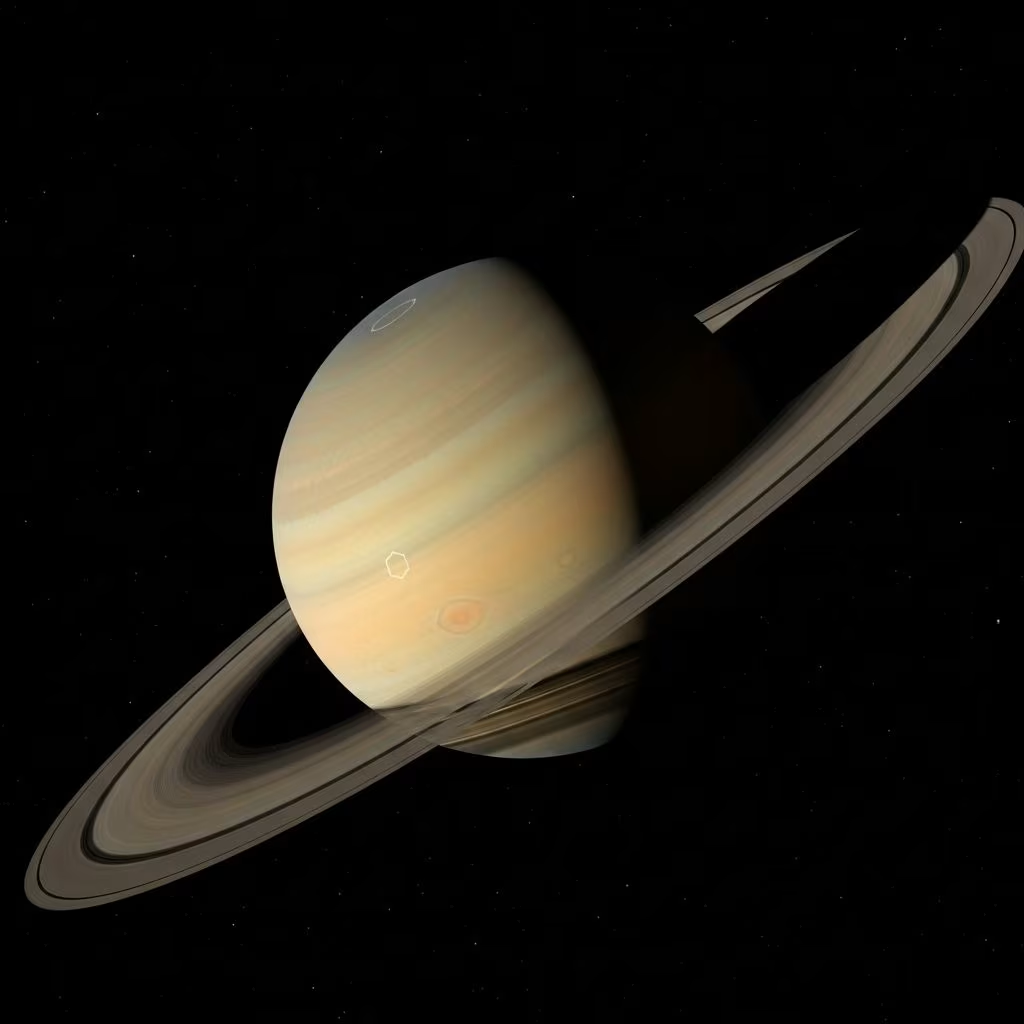
Saturn’s polar diameter is smaller, at about 108,728 km (67,560 miles), due to the planet’s rapid rotation. This rotation causes Saturn to bulge at its equator and flatten at the poles, a phenomenon called oblate spheroid shape.
- Equator bulge: Saturn’s rapid 10.7-hour rotation squashes it at the poles, making it appear noticeably flattened in telescope images.
- Comparison with Jupiter: Saturn’s equatorial diameter is 84% that of Jupiter, the Solar System’s largest planet.
- Comparison with Earth: Earth’s mean diameter is roughly 12,742 km (7,918 miles), so Saturn is almost 9.5 times wider.
The Volume of Saturn
Saturn’s immense diameter translates into a gigantic volume — about 827 trillion km³. That means 764 Earths could fit inside Saturn if it were hollow!
The Mass of Saturn
Though huge in volume, Saturn is mostly made of gases — primarily hydrogen and helium — making it only about 95 times as massive as Earth (5.68 × 1026 kg). Compared to Jupiter, Saturn has less than one-third the mass, despite being about 84% of its diameter.
Saturn’s Low Density: The Planet That Could Float
Saturn is the least dense planet in the solar system, with an average density of just 0.687 g/cm³. This means that, if you could find a lake large enough, Saturn would actually float on water. This remarkable property is due to its composition of lightweight gases.
Why Is Saturn So Big?
Saturn’s immense mass and diameter are the byproduct of its formation history and location in the solar system.
- Formation: Like other gas giants, Saturn formed roughly 4.5 billion years ago from the solar nebula — a massive, swirling cloud of gas and dust left over after the birth of the Sun.
- Gas Accretion: As a proto-planet, Saturn had enough mass to gravitationally attract vast amounts of hydrogen and helium, building up its enormous size.
- Location: Being farther from the Sun than inner, rocky planets, Saturn’s region in the protoplanetary disk was colder, enabling the condensation and accretion of lighter elements and ices.
A Closer Look: Saturn vs. Earth
| Feature | Earth | Saturn |
|---|---|---|
| Diameter | 12,742 km | 120,536 km (equator) |
| Volume | 1 (by definition) | 764 |
| Mass | 5.97 × 1024 kg | 5.68 × 1026 kg |
| Number of Moons | 1 | 146 |
| Mean Density | 5.51 g/cm³ | 0.687 g/cm³ |
Saturn’s diameter is almost 10 times Earth’s and its volume is over 760 times greater. However, its low density means it is just 95 times more massive than Earth, despite its enormous volume.
Saturn’s Iconic Rings: Structure and Scale
No discussion of Saturn’s size is complete without mentioning its spectacular ring system — the most complex and extensive of its kind in the Solar System.
- Main Rings: Seven major rings, labeled in the order discovered as A, B, C, D, E, F, G.
- Total Span: Saturn’s rings extend from just 6,630 km above the planet’s clouds to over 120,000 km out.
- Thickness: Surprisingly thin for their tremendous width, most rings are just about 10–30 meters (30–100 feet) thick.
- Composition: Made primarily of billions of particles of ice and rock, ranging from dust grains to mountains in size.
Comparing Saturn’s Rings to Other Planets
- While Jupiter, Uranus, and Neptune also have ring systems, none are as massive, bright, or complex as Saturn’s.
Saturn Compared to Other Planets
Among all planets in the Solar System, Saturn is second only to Jupiter in size and mass. Here’s a quick comparison with its gas giant siblings:
| Planet | Equatorial Diameter (km) | Volume (Earths) | Mass (Earths) |
|---|---|---|---|
| Jupiter | 142,984 | 1,321 | 318 |
| Saturn | 120,536 | 764 | 95 |
| Uranus | 51,118 | 63 | 14 |
| Neptune | 49,528 | 58 | 17 |
Saturn is twice as wide as Uranus and much more massive, though less dense.
Exploring Saturn’s Unique Shape
Saturn doesn’t have a solid surface. Instead, it is a giant ball of gas compressed by its own immense gravity. The planet’s rapid rotation rate of about 10.7 hours per day causes significant flattening at the poles, making Saturn the most oblate of the major planets.
- Oblate Spheroid: The effect is most pronounced on Saturn, making the difference between the equatorial and polar diameters over 10,000 km.
- Visible to Amateur Astronomers: The flattened poles can be detected in photographs using backyard telescopes during favorable observation periods.
Saturn’s Position and Orbit
Saturn is the sixth planet from the Sun, orbiting at an average distance of about 1.43 billion km (890.7 million miles). One Saturnian year lasts around 29.5 Earth years, completing a full trip around the Sun in nearly three decades. However, Saturn spins so fast on its axis that a day on Saturn is just about 10.7 hours long.
- Long years, short days: Saturn’s orbit is much farther out than Earth’s, but its fast spin results in a brief day-night cycle.
Temperature and Conditions on Saturn
Because it’s much farther from the Sun, Saturn is a cold world. Temperatures in the upper clouds range between –189°C to –139°C (about –308°F to –218°F). Its core, however, is thought to reach temperatures much hotter — possibly over 11,700°C (21,000°F) due to gravitational compression and helium rain deep within the planet.
Saturn’s Moons: The Miniature Worlds Within Its Orbit
Another testament to Saturn’s size is its 146 confirmed moons (as of 2025), the most of any planet in our Solar System. These range from tiny moonlets just 100 meters across to Titan, the second-largest moon in the Solar System and larger than the planet Mercury!
- Most notable moons: Titan, Enceladus, Rhea, Dione, Tethys, and Mimas
Saturn Size Frequently Asked Questions (FAQs)
Q: How many Earths can fit inside Saturn?
A: Saturn’s enormous volume means that roughly 764 Earths could fit inside the ringed planet.
Q: Why is Saturn so much less dense than Earth?
A: Saturn is made primarily of hydrogen and helium gases, unlike Earth’s rocky composition. This makes Saturn less dense — low enough to float on water.
Q: How does Saturn’s size compare to Jupiter’s?
A: Jupiter is the only planet larger than Saturn. Saturn’s diameter is about 84% that of Jupiter, but Jupiter has more than three times Saturn’s mass.
Q: Is Saturn the largest planet with rings?
A: Yes, Saturn not only has the largest and most complex ring system, but it is also the largest planet with visible rings from Earth, even though the other gas giants also have fainter ring systems.
Q: Are Saturn’s rings bigger than the planet itself?
A: Saturn’s main rings stretch up to 282,000 km (175,000 miles) in diameter — more than twice the diameter of the planet itself.
Fun Facts About Saturn’s Size
- If Saturn were the size of a soccer ball, Earth would be around the size of a marble next to it.
- Saturn appears slightly squashed or oblate through telescopes — a visual clue to its rapid spin.
- The total mass of Saturn’s massive rings is only a fraction of one of its larger moons, despite their apparent size and brightness.
- If you weighed 100 pounds on Earth, you’d weigh only about 107 pounds on Saturn’s cloud tops due to its low gravity compared to its size.
Frequently Asked Questions (FAQs)
Q: What is the equatorial diameter of Saturn?
A: Saturn’s equatorial diameter is about 120,536 km (74,898 miles).
Q: What is Saturn made of?
A: Primarily hydrogen and helium, with traces of methane, water vapor, ammonia, and other gases.
Q: How many rings does Saturn have?
A: Seven major ring groupings (A through G), with many smaller ringlets making up the stunning appearance.
Q: How long is a day on Saturn?
A: About 10 hours and 40 minutes.
Q: What is the temperature on Saturn?
A: Extremely cold in the cloud tops, from –189°C (–308°F) to –139°C (–218°F), but vastly hotter deep inside the core.
References
- https://science.nasa.gov/saturn/facts/
- https://nssdc.gsfc.nasa.gov/planetary/factsheet/saturnfact.html
- https://en.wikipedia.org/wiki/Saturn
- https://www.britannica.com/place/Saturn-planet
- https://coolcosmos.ipac.caltech.edu/ask/106-How-big-is-Saturn-
- https://lco.global/spacebook/solar-system/saturn/
- https://www.asc-csa.gc.ca/eng/astronomy/solar-system/saturn.asp
- https://study.com/learn/lesson/saturn-facts-rings-temperature-size.html
- https://www.universetoday.com/articles/how-big-is-saturn
- https://www.universetoday.com/articles/saturn-fact-sheet
- https://www.livescience.com/space/saturn/saturn-facts-about-the-ringed-planet
- https://kids.britannica.com/kids/article/Saturn/353745
- https://en.wikipedia.org/wiki/Saturn_(planet)
- https://engineering.purdue.edu/vossmod/saturn.php
- https://www.rmg.co.uk/stories/space-astronomy/planet-saturn
- https://scaleofuniverse.com/en/universe/saturn
- https://historyinnumbers.com/places/space/solar-system/planet-saturn/
- https://www.edinformatics.com/math_science/solar_system/saturn.htm


