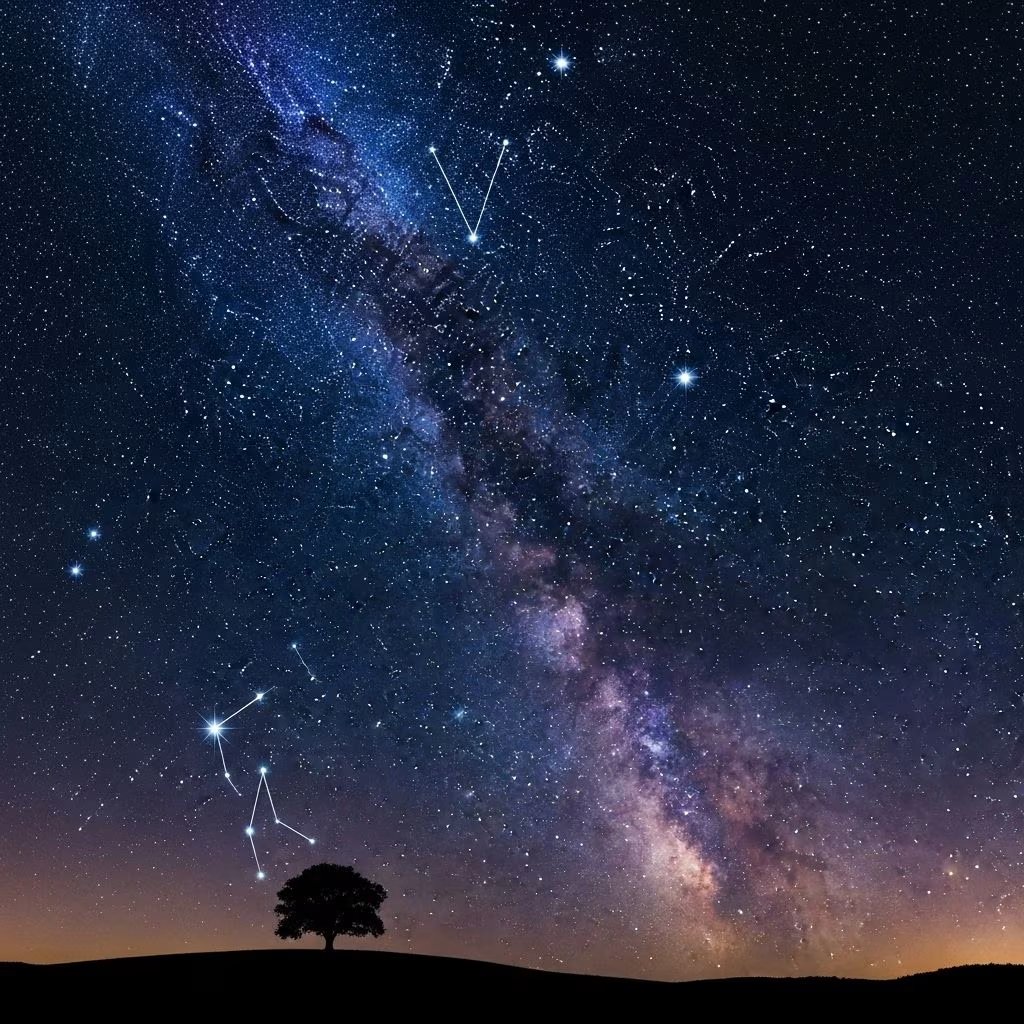
The night sky has fascinated people for centuries. Stretching above us is a tapestry filled with shining points of light—stars arranged in intricate patterns called constellations. These celestial groupings are far more than simple curiosities; they serve as maps, mythological storytelling canvases, and practical guides for navigation. This article explores what constellations are, why humans created them, how many exist, and how you can spot the most famous ones in the modern sky.
What Are Constellations?
Constellations are groups of stars that appear to form recognizable patterns or shapes as viewed from Earth. While the stars within a constellation may be thousands of light-years apart, from our vantage point they seem clustered together to create images of animals, mythological figures, objects, and symbols.
- Constellations helped ancient cultures map the heavens and measure the passage of time.
- In modern astronomy, constellations serve as official regions of the sky, each containing specific stars and deep-sky objects.
- Constellations are not physical groupings—stars within them are not usually closely related in space, only appearing so from Earth due to line-of-sight.
The Origin and Role of Constellations
The earliest records of constellations date back thousands of years, with different cultures around the world inventing their own star patterns and associated myths.
- Ancient Greeks, Babylonians, Chinese, Indigenous Australians, and Native Americans all contributed unique constellation stories.
- Constellations were practical tools, helping navigators and farmers predict seasons and find direction.
- Many constellations are tied to legends from Greek and Roman mythology, such as Orion the hunter, Andromeda the princess, and Ursa Major (the Great Bear).
How Many Constellations Are There?
Modern astronomers officially recognize 88 constellations. In 1922, the International Astronomical Union (IAU) formalized these boundaries, defining precise regions of the sky each constellation inhabits.
| Total Constellations | Hemisphere | Examples |
|---|---|---|
| 88 | Both Northern and Southern | Orion, Ursa Major, Scorpius, Crux |
Of the 88 constellations, some are visible only in the Northern Hemisphere, others only in the Southern, and a few straddle the celestial equator and can be seen from both.
Why Do We See Constellations?
Constellations are a product of perspective. The actual distances between stars can be immense, but from Earth, they appear as if mapped onto a sphere (the “celestial sphere”).
- Different cultures recognized different patterns; the modern set largely derives from Greek tradition.
- As Earth orbits the Sun, we see different constellations at different times of year.
- Their regular appearance helped ancient peoples develop calendars and navigation systems.
Famous Constellations of the Northern Hemisphere
Several constellations stand out due to their brightness, distinctive shapes, or mythological stories:
Ursa Major (The Great Bear)
One of the most iconic constellations, Ursa Major is best known for the Big Dipper asterism—a group of seven bright stars forming a dipper or plough. The two stars at the end of the Big Dipper’s “bowl” point almost directly to Polaris, the North Star, helping navigators determine true north.
- Visible year-round in much of the Northern Hemisphere.
- Contains several notable deep-sky objects, including the Pinwheel Galaxy (M101).
Ursa Minor (The Little Bear)
Contains the Little Dipper—a smaller dipper-shaped grouping of stars. Polaris, the present North Star, sits at the tip of its handle, marking the celestial north pole.
Orion (The Hunter)
Straddling the celestial equator, Orion’s distinctive “belt” of three stars makes it easy to identify, especially on winter nights. Orion includes:
- Bright red star Betelgeuse (his shoulder).
- Blue-white giant Rigel (his foot).
- The Orion Nebula (M42), a stellar nursery below his belt.
Cassiopeia (The Queen)
Recognizable by its distinctive “W” or “M” shape, this constellation is visible year-round in the northern sky and serves as a handy reference for finding Perseus and Andromeda.
Draco (The Dragon)
Winds between Ursa Major and Ursa Minor, Draco is a long, snaking constellation whose body contains the ancient star Thuban, which was once the North Star.
Cepheus (The King)
Lies near Cassiopeia; its house-shaped pattern represents King Cepheus, part of a legendary family that includes Andromeda, Perseus, and Cassiopeia.
Other Notable Constellations
- Pegasus: Features the “Great Square” asterism and links to the legend of the flying horse. Located near Andromeda.
- Andromeda: Home to the Andromeda Galaxy (M31), a spiral galaxy visible to the naked eye in dark skies.
- Hercules: Known for the Great Hercules Cluster (M13), a bright globular star cluster.
- Cygnus (The Swan): Contains the Northern Cross asterism and the bright star Deneb.
Constellations in the Southern Hemisphere
The Southern sky features famous constellations not visible from northern latitudes:
- Crux (The Southern Cross): Among the best-known southern constellations; helps locate the south celestial pole.
- Centaurus: Contains the closest star system to our Sun—Alpha Centauri.
- Carina: Home to Canopus, one of the brightest stars in the sky.
- Pavo: The Peacock, seen in southern spring and summer.
- Phoenix: Symbolizes the mythical firebird.
Seasonal Constellations and How to Spot Them
Different constellations peak in visibility during different times of the year. Here’s how to find several major constellations by season:
| Season | Easy-to-Find Constellations |
|---|---|
| Winter (Northern Hemisphere) | Orion, Taurus, Gemini, Canis Major, Auriga |
| Spring | Leo, Virgo, Bootes |
| Summer | Scorpius, Sagittarius, Hercules, Lyra, Cygnus |
| Autumn | Pegasus, Andromeda, Pisces, Aquarius |
Not all constellations are visible year-round. As Earth orbits the Sun, the night sky shifts, causing certain star patterns to disappear and new ones to take their place.
How to Find Constellations: Beginner Tips
- Start with easily recognizable asterisms like the Big Dipper or Orion’s Belt to orient yourself.
- Use constellation maps or mobile astronomy apps to identify what’s visible in your location and season.
- Find a dark area away from city lights for the best stargazing experience.
- Be patient—give your eyes 20–30 minutes to fully adjust to the dark.
Constellations and Modern Astronomy
While constellations no longer serve as precise scientific tools, they remain essential for:
- Identifying regions of the sky for amateur astronomers.
- Cataloging and locating deep-sky objects (such as galaxies, nebulae, and star clusters) by their constellation.
The Mythology and Cultural Impact of Constellations
Many constellations have stories rooted in mythology and folklore. Ancient Greeks imagined heroes, gods, and monsters among the stars, crafting tales to explain natural phenomena or the stars’ motions. These stories became intertwined with those of neighboring cultures, and many constellations carry names from Latin, Greek, or Arabic traditions.
- For example, Orion’s pursuit of the Pleiades (the Seven Sisters) is a tale told across diverse civilizations.
- Other cultures, such as China and Indigenous groups worldwide, developed entirely different constellations and star lore based on their traditions.
Famous Asterisms: Patterns Within Constellations
An asterism is a recognizable pattern of stars within a constellation or spanning several constellations. The Big Dipper and Orion’s Belt are classic examples. These shapes are not officially constellations themselves but often serve as easier starting points for finding larger constellations.
Why Do Some Constellations Change?
The patterns described by constellations slowly change over astronomical timescales.
- Stars move relative to one another (proper motion), but the change is imperceptible over a human lifetime.
- Precession—the slow wobble of Earth’s rotational axis—also slightly changes the sky’s appearance over thousands of years (for example, the identity of the North Star changes).
How Did the Modern Constellations Get Their Names?
Most northern constellations carry names rooted in Greco-Roman mythology, thanks to the influence of Greek astronomers like Ptolemy. Southern constellations, not visible from Europe, were mostly named during the Age of Exploration, with names reflecting tools, exotic animals, and scientific instruments—such as Telescopium (the Telescope), Dorado (the Dolphinfish), and Pavo (the Peacock).
Constellations and Stargazing: Essential Tools
- Star charts and planispheres: Rotating maps that help you identify which constellations should be visible based on time and location.
- Mobile stargazing apps: Use your phone’s sensors to match your sky view, labeling stars and constellations in real time.
- Binoculars and telescopes: Allow you to see faint stars, nebulae, and star clusters within constellations.
Table: Quick Facts About 10 Prominent Constellations
| Constellation | Brightest Star | Hemisphere | Best Season |
|---|---|---|---|
| Ursa Major | Alioth | Northern | Spring |
| Ursa Minor | Polaris | Northern | All year |
| Orion | Rigel | Both | Winter |
| Cassiopeia | Shedar | Northern | Autumn/Winter |
| Crux | Acrux | Southern | Spring |
| Lyra | Vega | Northern | Summer |
| Scorpius | Antares | Both | Summer |
| Pegasus | Enif | Northern | Autumn |
| Cygnus | Deneb | Northern | Summer |
| Centaurus | Alpha Centauri | Southern | Spring |
Frequently Asked Questions (FAQ)
What is the difference between a constellation and an asterism?
A constellation is an officially recognized area of the night sky, while an asterism is a recognizable pattern of stars that may be part of one or more constellations (such as the Big Dipper in Ursa Major).
Are the stars in a constellation physically close to each other?
Not usually. Stars in a constellation can appear near each other in our sky, but they are often separated by many light-years in reality. Their apparent closeness is due to the line-of-sight from Earth, not true proximity.
How can I learn to recognize constellations?
Start by learning the most prominent and easily identifiable patterns, such as the Big Dipper or Orion’s Belt. Use star charts, astronomy books, or mobile apps to help guide you and practice spotting constellations regularly.
Why do different cultures have different constellations?
Cultures worldwide interpreted the patterns of stars according to local legends, customs, and priorities. As a result, many star patterns have multiple names and stories, with some entirely unique to specific regions.
Are new constellations discovered today?
No. The list of 88 official constellations was fixed by the International Astronomical Union in 1922. However, new stars, star clusters, and deep sky objects within those regions are still being catalogued.
Tips for Stargazing Success
- Go out on a clear, moonless night, away from city lights for optimal viewing.
- Learn the positions of a few bright stars first, then use those as references to find the surrounding constellations.
- Allow your eyes to adjust to the darkness for at least 20 minutes before searching for faint stars and patterns.
- Bring a red-light flashlight to preserve night vision when checking star charts.
- Enjoy the patience and wonder that come from learning to read the sky—each outing brings new discoveries.
References
- https://www.space.com/23309-constellations-night-sky-star-patterns-images.html
- https://www.go-astronomy.com/constellations.htm
- https://www.constellation-guide.com/constellations-in-the-sky-tonight/
- https://theskylive.com/sky/constellations/
- https://www.centreofexcellence.com/35-constellations-northern-hemisphere/
- https://www.astronomy.com/observing/learn-the-constellations/
- https://www.lpi.usra.edu/education/skytellers/constellations/
- https://www.artofmanliness.com/skills/manly-know-how/15-constellations-every-man-should-know/
- https://spaceplace.nasa.gov/constellations/en/
- https://www.spacecentre.ca/constellations-the-patterns-in-our-sky/
- https://www.smorescience.com/easy-constellations-to-find/
- https://en.wikipedia.org/wiki/Constellation
- https://study.com/academy/lesson/major-constellations-facts-names.html
- https://www.youtube.com/watch?v=5UWeTQmG8
- https://www.skyatnightmagazine.com/advice/constellations
- https://www.youtube.com/watch?v=wWSJAG-5Llc
- https://www.spacecentre.ca/2023/05/26/constellations-the-patterns-in-our-sky/
- https://www.timeanddate.com/astronomy/night/