Polaris: The Guiding Light of the Northern Sky
Polaris, also known as the North Star, has illuminated both the northern sky and humanity’s understanding of navigation for centuries. Found in the constellation Ursa Minor, Polaris stands almost directly above Earth’s northern axis, making it a celestial anchor for travelers, navigators, and astronomers alike. This article unpacks the scientific, historical, and practical significance of Polaris, diving deep into its unique position, stellar properties, cultural impact, and why its role as the pole star is both enduring and dynamic.
North Star Basics
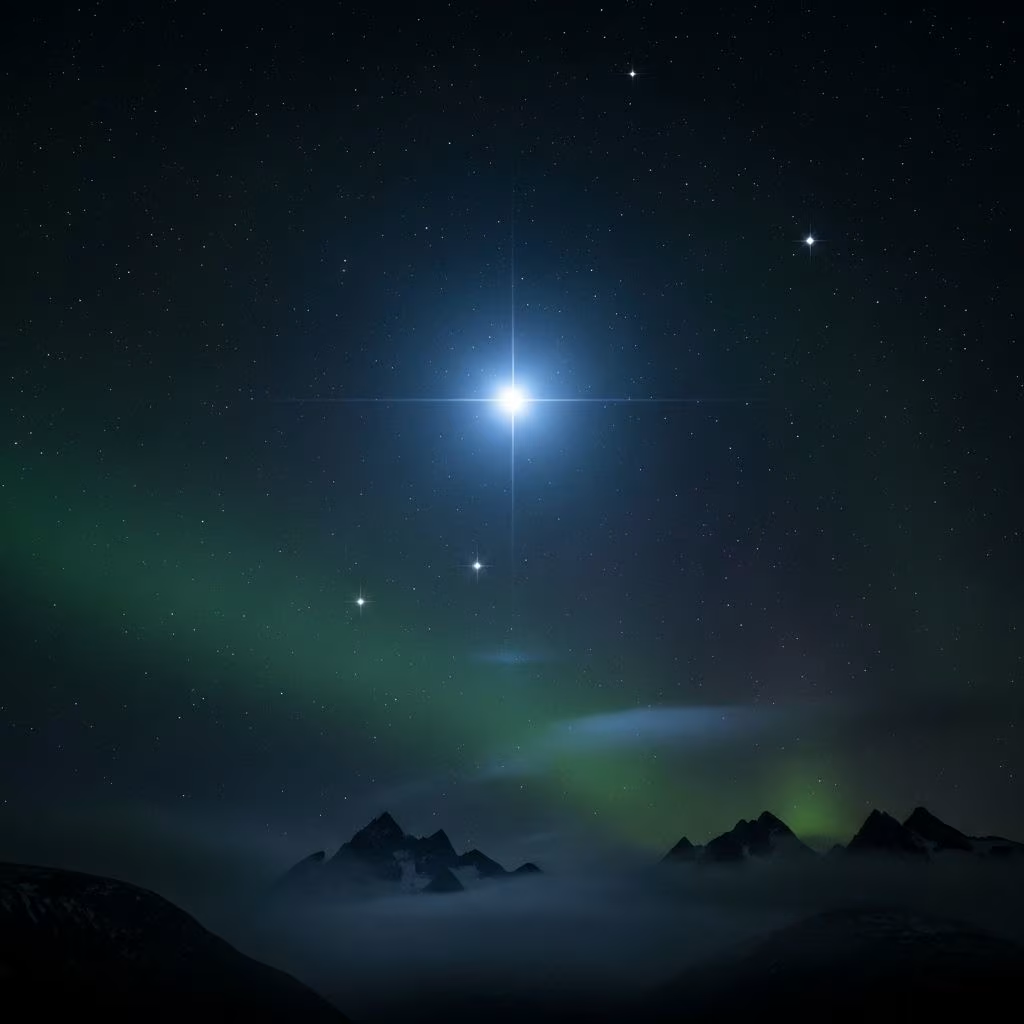
The star Polaris is designated Alpha Ursae Minoris (α UMi), residing at the tip of the Little Dipper’s handle. To the naked eye, Polaris appears as a bright but unremarkable speck, yet this single point of light holds extraordinary importance in astronomy and navigation.
- Constellation: Ursa Minor
- Other Names: North Star, Pole Star, Polaris
- Coordinates: Right Ascension 2h 31m 49s, Declination +89° 15′ 51″
- Brightness (Apparent Magnitude): Ranges from 1.86 to 2.13, making it the 48th brightest star in the night sky
- Distance: Approximately 446 light-years (136.9 parsecs)
- Stellar Type: Cepheid variable, yellow supergiant with two close companions, forming a triple star system
Stellar Properties of Polaris
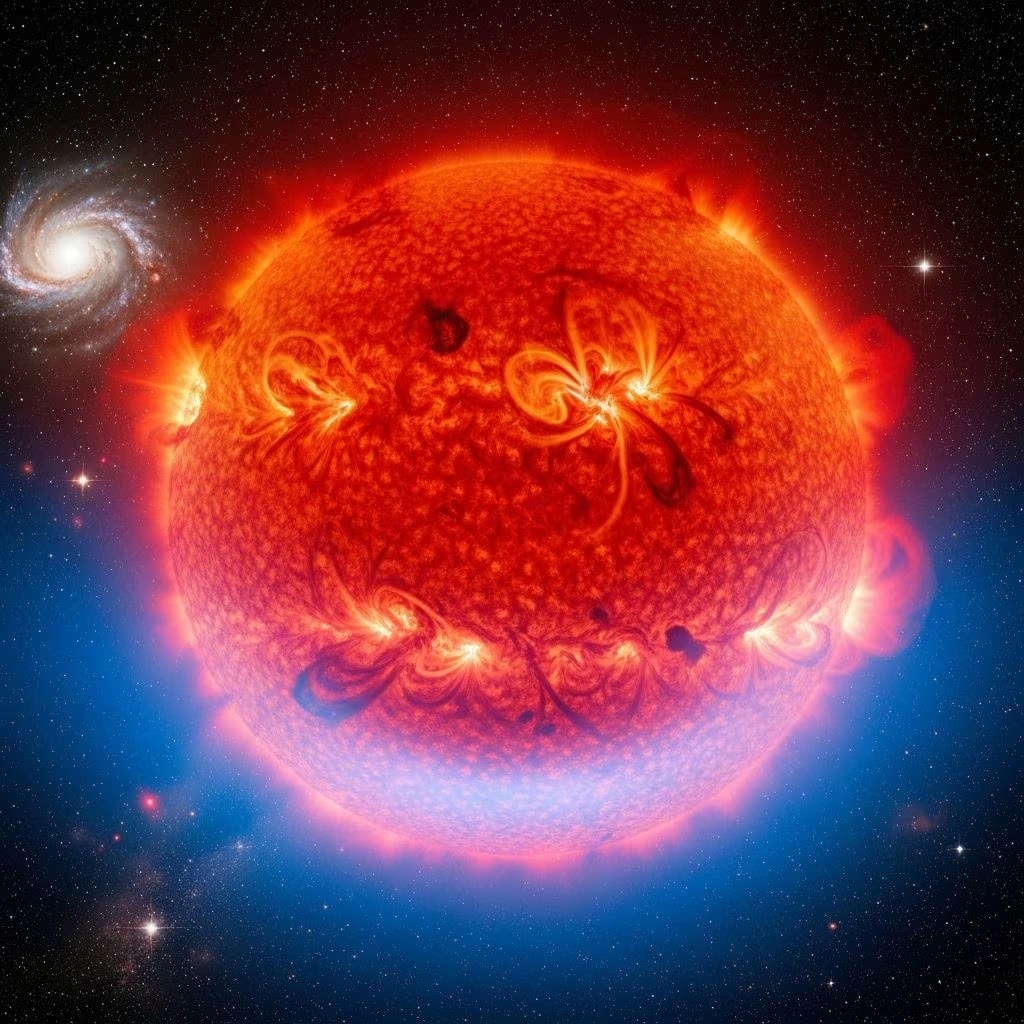
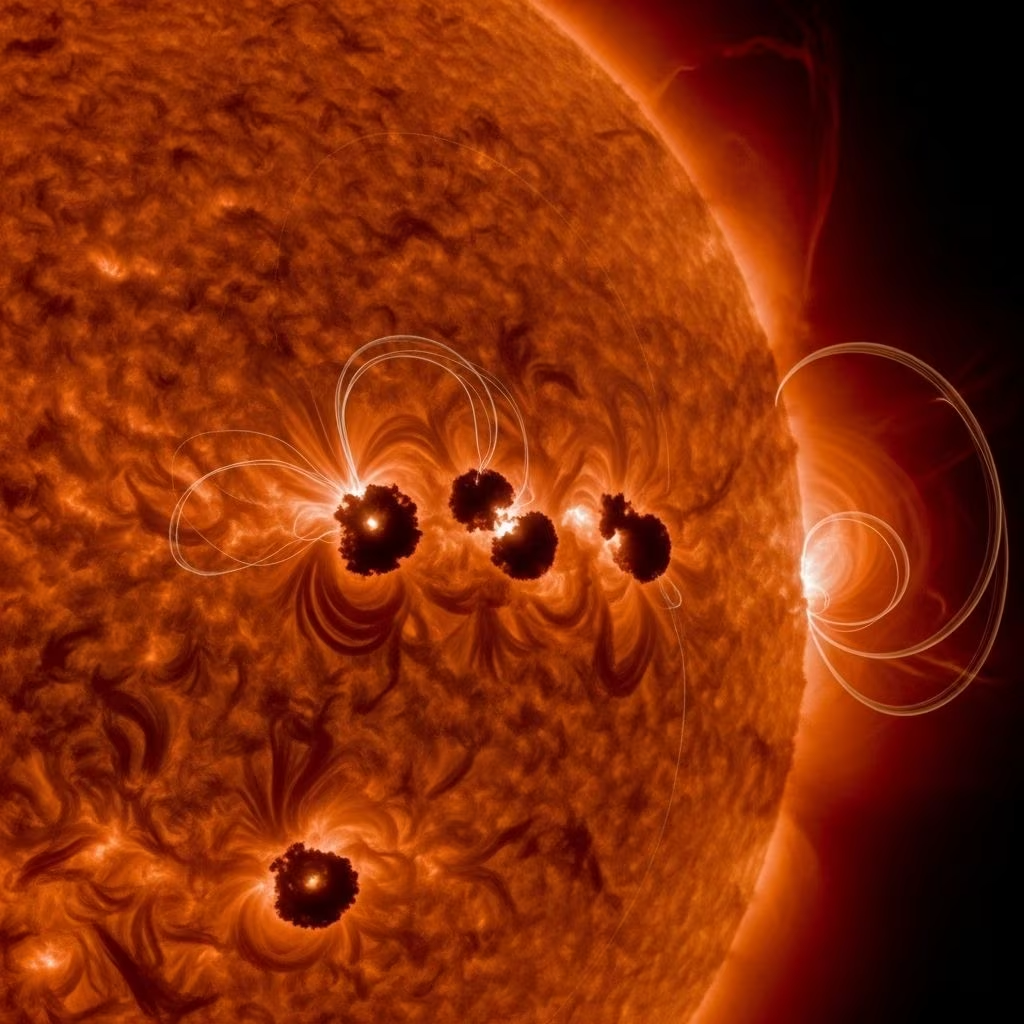
Despite its modest brightness compared to other famous stars, Polaris is a luminous giant. Its fluctuations in brightness are due to its identity as a Cepheid variable—a kind of pulsating star that’s crucial for measuring cosmic distances.
| Characteristic | Value |
|---|---|
| Type | Yellow Supergiant |
| Diameter | ~50 times Sun’s Diameter (70 million km) |
| Mass | 5.4 solar masses |
| Luminosity | ~2,500 times the Sun |
| Temperature | 6,015 K |
| Companions | Triple system (Polaris Aa, Ab, and B) |
Polaris Aa, the primary, is orbited closely by Polaris Ab, while both are orbited at a greater distance by Polaris B. These companions were first discerned in the late 18th century, when William Herschel identified the outer pair. This multi-star nature is not visible to the unaided eye.
Why Polaris Is Special
Unlike other stars, Polaris sits almost directly above the Earth’s North Pole—within less than a degree of the north celestial pole. This fixed position makes Polaris unique:
- Nightly Motion: Polaris appears almost motionless in the sky, while other stars circle around it.
- Navigation: Its near-constant position enables travelers to determine true north with remarkable reliability.
- Latitude Measurement: The angle between Polaris and the horizon closely matches the observer’s geographic latitude.
- Astrometry: Polaris provides an essential reference point for measuring stellar motion and celestial coordinates.
Historically, this reliability has made Polaris far more trustworthy than magnetic compasses, which are subject to local variations.
How to Locate Polaris
Finding Polaris is straightforward with clear skies and knowledge of the constellations. The easiest method:
- Locate Ursa Major (the Big Dipper). Find its two outermost stars in the bowl—the “pointer” stars Dubhe and Merak.
- Draw an imaginary line from Merak through Dubhe and continue it about five times the distance between those two stars.
- The next bright star on this line is Polaris, marking the end of the Little Dipper’s handle.
Because Polaris is so close to true north, its elevation above the horizon nearly equals the observer’s latitude, making it invaluable for navigation.
Historical and Navigational Importance
For centuries, Polaris has been the primary celestial tool for determining direction and position without compasses or modern technology.
- Navigators: Sailors, explorers, and travelers in the Northern Hemisphere relied on Polaris for navigation at sea and across deserts.[13]
- Latitude Calculation: Ancient mariners gauged their latitude by measuring the angle from the northern horizon to Polaris.
- Cultural Symbol: Many cultures saw Polaris as a guiding light or spiritual anchor, integrating it into mythologies and folklore.
At high northern latitudes, Polaris never sets and is visible all night, making it a constant source of guidance. For those at the North Pole, Polaris sits perpetually overhead.
Polaris and Earth’s Precession
The perfect alignment of Polaris with the celestial north pole is not permanent. The Earth’s axis slowly wobbles in a 26,000-year cycle known as axial precession. As a result:
- Polaris’s proximity to the pole: In 2018, Polaris was about 0.66° from the pole. By 2100, it will be only 0.45°, after which it will gradually move away.
- Changing Pole Stars: In thousands of years, other stars—like Vega—will replace Polaris as the North Star.
- Astrometric Corrections: The apparent position of Polaris shifts slightly over centuries, requiring navigational adjustments to keep accuracy.
This celestial cycle explains why Polaris was not always the North Star, nor will it remain so forever.
Polaris’s Companion Stars
Within its triple-star system, the main star—Polaris Aa—is accompanied by:
- Polaris Ab: A main-sequence white star orbiting tightly with the primary.
- Polaris B: A more distant companion visible through telescopes, discovered in the 18th century.
The system’s dynamics have made it the subject of extensive study for astronomers. Notably, Polaris Aa is the closest Cepheid variable star to Earth, making observations of its pulsations fundamental for calibrating the cosmic distance ladder.
Frequently Asked Questions (FAQs)
Q: Why isn’t Polaris the brightest star in the sky if it’s so important?
A: Although Polaris is a massive and luminous supergiant, it lies hundreds of light-years away. Stars much closer, like Sirius, appear brighter because of their relative proximity, not their actual luminosity.
Q: How does Polaris help measure latitude?
A: The angle between Polaris and the northern horizon closely matches the observer’s latitude in degrees north. At the North Pole, Polaris is directly overhead; at the equator, it sits on the horizon[13].
Q: Has Polaris always been the North Star?
A: No. Due to the Earth’s axial precession, other stars—such as Thuban and Vega—have served as the pole star in the distant past, and will again in future millennia.
Q: Will Polaris ever be the South Star?
A: No. Polaris is located near the Earth’s northern rotational axis, while the southern celestial pole lacks an equivalently bright star. The closest southern counterpart is Sigma Octantis, which is much dimmer.
Q: What type of star is Polaris?
A: Polaris is a yellow supergiant and a classical Cepheid variable star. Its pulsations help astronomers measure cosmic distances. It is part of a triple-star system with close companions.
Q: How far is Polaris from Earth?
A: Modern measurements from missions including Hipparcos and Gaia estimate its distance at around 446 light-years (137 parsecs).
Q: Can I always see Polaris in the northern sky?
A: You can see Polaris at any time of year from almost any location in the Northern Hemisphere. The farther south you go, the lower it sits above your horizon. At the equator, Polaris appears right at the horizon and is barely visible.
Cultural and Mythological Significance
Polaris’s unwavering position has inspired countless legends, poems, and beliefs. From ancient seafarers to explorers on land:
- Cultures have seen it as a guide, a spiritual anchor, or the “eye of heaven.”
- Indigenous peoples, including Inuit in the Arctic, depended on Polaris for seasonal migration and survival.
- In medieval Europe, Polaris was depicted as a fixed point in cosmological charts and artworks.
The universality of Polaris’s role as a guide through darkness has earned it global reverence.
More Interesting Facts About Polaris
- Polaris appears motionless, but it actually describes a tiny circle (less than 1° diameter) around the celestial pole due to its slight offset.
- The star’s pulsations vary in intensity, aiding astronomers in measuring distances to galaxies and refining our understanding of the universe’s structure.
- Its triple-star system is unusually hard to observe directly, making each new measurement significant for stellar physics.
- Polaris’s status as the pole star is temporary, with axial precession gradually shifting the north celestial pole away over centuries.
Observing and Studying Polaris Today
Modern telescopes, including advanced arrays such as CHARA, have been utilized to study Polaris’s surface, companions, and variability. Its role in calibrating the cosmic distance ladder is pivotal, especially since Cepheid variables have provided astronomers with the means to measure distances to far-away galaxies and trace the expansion of the universe.
In addition to professional study, Polaris is a favorite target for amateur astronomers, sky-watchers, and navigators. Its accessibility and enduring significance make it a central figure in astronomy outreach and education.
Table: Key Facts About Polaris
| Fact | Value |
|---|---|
| Constellation | Ursa Minor |
| System Type | Triple Star (Aa, Ab, B) |
| Distance | Approx. 446 light-years |
| Star Type | Yellow Supergiant Cepheid variable |
| Apparent Magnitude | 1.86 – 2.13 |
| Diameter | ~50 times Sun |
| Closest Approach to Celestial Pole | 0.45° (in 2100) |
| Navigation Use | Indicates true north, helps determine latitude |
How to Find Polaris Tonight
If you’re in the Northern Hemisphere and the sky is clear, follow these steps:
- Find the Big Dipper (Ursa Major).
- Locate the two stars furthest from the dipper’s handle (Dubhe and Merak).
- Draw an imaginary line from Merak through Dubhe and continue about 5x that distance.
- The next bright star is Polaris, at the tip of the Little Dipper’s handle[12].
Even when other stars seem to move with Earth’s rotation, Polaris remains in place—your cardinal point of the northern sky.
Bottom Line
Polaris is more than just a star: it is a celestial cornerstone for navigation, scientific discovery, and human culture. Its proximity to the celestial north pole makes it a staple for skywatchers and adventurers alike. While it hasn’t always been the pole star—and won’t always be—its significance in our history, mythology, and science endures. As the world and sky change, Polaris remains a guiding light, inviting us to look up and navigate the mysteries of our universe.
References
- https://en.wikipedia.org/wiki/Polaris
- https://science.nasa.gov/solar-system/what-is-the-north-star-and-how-do-you-find-it/
- https://www.britannica.com/place/Polaris-star
- https://theplanets.org/stars/polaris-star/
- https://starchild.gsfc.nasa.gov/docs/StarChild/questions/question64.html
- https://www.space.com/stargazing/has-polaris-always-been-the-north-star-how-earths-26-000-year-cycle-changes-the-pole-star
- https://astrobackyard.com/the-north-star/
- https://www.star-facts.com/polaris/
- https://www.astronomytrek.com/stars/polaris/
- https://www.youtube.com/watch?v=cDhSSxmk3PQ
- https://nineplanets.org/kids/polaris/
- https://www.stelvision.com/astro/the-north-star/
- https://astrocamp.org/blog/north-star/
- https://starwalk.space/en/news/polaris-north-star
- https://science.howstuffworks.com/north-star.htm
- https://en.wikipedia.org/wiki/North_Star
- https://www.universetoday.com/articles/polaris-earths-north-star-has-a-surprisingly-spotted-surface