


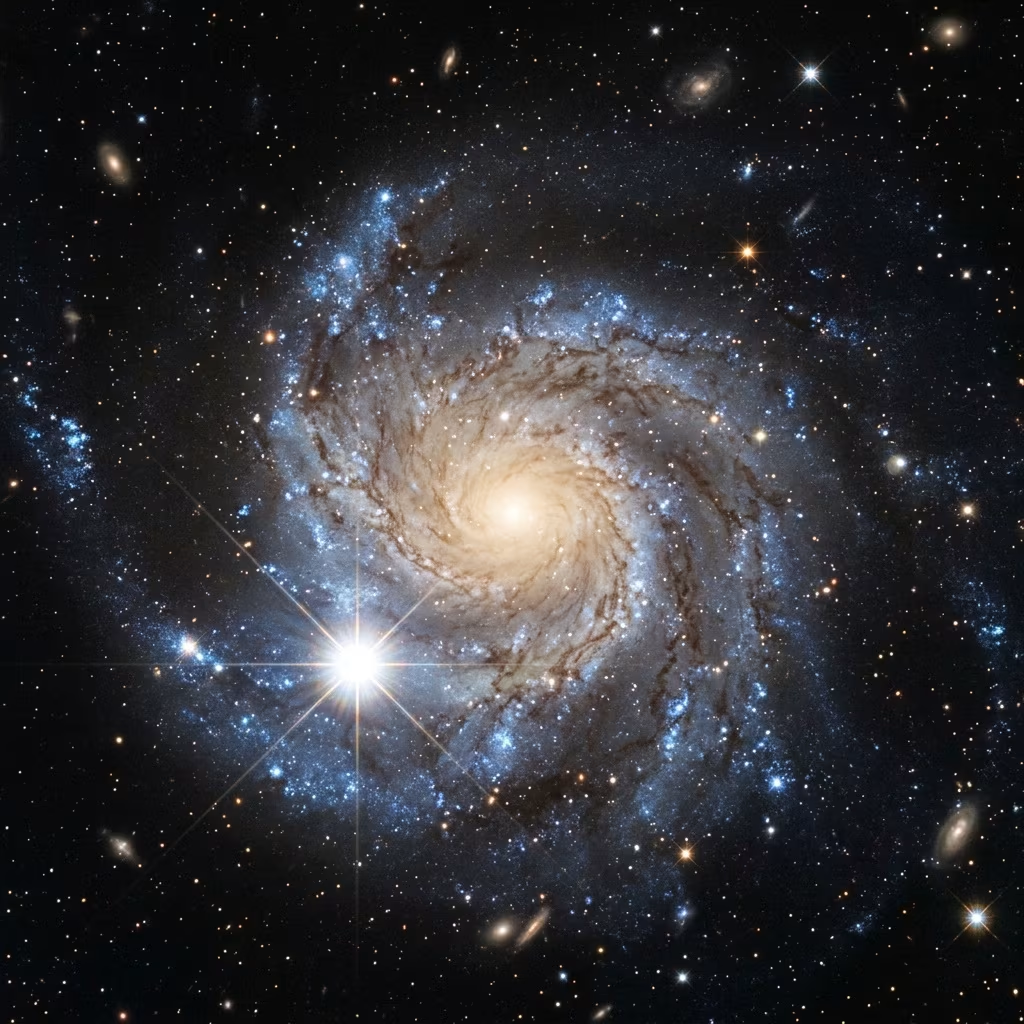
Hubble Telescope Captures Supernova SN 2018gv: A Beacon in Space
The cosmos routinely stages spectacles of staggering beauty, but few match the drama and scientific value of a supernova. In a recent astronomical milestone, NASA’s Hubble Space Telescope captured a rare before-and-after view of a star’s explosive death in the spiral galaxy NGC 2525. The event, cataloged as SN 2018gv, offers not only a cosmic light show but also a critical astronomical yardstick that helps scientists map and measure the expanding universe.
What Is Supernova SN 2018gv?
SN 2018gv is the name given to a supernova explosion documented in the spiral galaxy NGC 2525. The event was initially detected not by a giant observatory, but by the careful eye of Japanese amateur astronomer Koichi Itagaki in early 2018. Shortly after this discovery, NASA’s Hubble Space Telescope was trained on the explosion, setting the stage for an unprecedented detailed record of a star’s death throes over the course of a year.
Origins of a Stellar Explosion
Supernovae are among the most powerful explosions in the universe. SN 2018gv belongs to the class of Type Ia supernovae. These are not typical supernovae—they arise from a “white dwarf” star (an ultra-dense stellar remnant) in a binary system that accumulates material from its companion until it reaches a critical mass, igniting a runaway thermonuclear explosion. The star is instantly obliterated, releasing enormous energy and briefly outshining its entire host galaxy.
The Location: NGC 2525, 70 Million Light-Years Away
SN 2018gv occurred in NGC 2525, a striking spiral galaxy situated around 70 million light-years from Earth in the constellation of Puppis. This cosmic distance translates to the light from the explosion having begun its journey towards us while dinosaurs ruled the planet. Space telescopes like Hubble make it possible to observe, with stunning clarity, events that unfolded eons ago.
Quick Facts: NGC 2525’s Cosmic Address
- Galaxy: NGC 2525 (Spiral galaxy)
- Distance from Earth: ~70 million light-years
- Constellation: Puppis
- Mortality event: Type Ia supernova (SN 2018gv)
Type Ia Supernovae: Cosmic Standard Candles
What sets Type Ia supernovae apart is their remarkable consistency. Upon detonation, their peak brightness is reliably uniform across the cosmos. Because of this, astronomers have dubbed them “standard candles”. This unique quality is invaluable for calculating cosmic distances—by comparing a supernova’s intrinsic luminosity (how bright it truly is) with its apparent brightness from Earth, the distance to its host galaxy can be determined with exceptional precision.
Table: Key Properties of Type Ia Supernovae
| Property | Description |
|---|---|
| Progenitor Star | White dwarf in binary system |
| Explosion Trigger | Mass accretion exceeds Chandrasekhar limit (~1.4 solar masses) |
| Peak Luminosity | Nearly identical across all Type Ia supernovae |
| Main Use | Measuring galaxy distances (cosmic standard candles) |
| Scientific Importance | Understanding universe’s expansion rate |
Hubble’s Observations: Before and After the Blast
The Hubble Space Telescope offered a unique lens on SN 2018gv’s evolution, capturing images spanning a full year before and after the star’s detonation. This time-lapse perspective illuminates several critical aspects of supernova physics:
- Explosion’s Initial Brilliance: The supernova’s light outshines its home galaxy, offering a rare opportunity to study the detonation’s physics at its brightest peak.
- Decline in Brightness: Over the following year, Hubble scientists tracked the rapid fading of SN 2018gv, capturing the transient nature of these ephemeral cosmic lighthouses.
- Visual Comparison: The contrasting images poignantly reveal life, death, and the passage of time on an astronomical timescale—a supernova’s fade from dazzling beacon to invisibility.
Such detailed time-lapse photography is possible on only a handful of supernovae each decade, and the visual documentation of SN 2018gv stands as a testament to Hubble’s enduring legacy.
Unlocking the Universe’s Expansion
Standard candles like SN 2018gv do much more than measure the distance to their home galaxies. By collecting observations of many such explosions—both near and far—astronomers can analyze how fast galaxies are retreating from us due to cosmic expansion.
This measurement led to the discovery of the universe’s accelerating expansion, earning the 2011 Nobel Prize in Physics. Observations of distant Type Ia supernovae have revealed that not only is the universe expanding, but the rate of expansion (the Hubble constant) changes across different cosmic epochs. This led to the postulation of dark energy—a mysterious force thought to drive this acceleration.
Type Ia Supernovae and the Hubble Constant
- The Hubble constant is the unit of measurement for the universe’s expansion rate.
- By measuring redshift (how much a galaxy’s light has been stretched by expansion) in conjunction with standard candles, scientists can create a “cosmic distance ladder”.
- Discrepancies in the measured value of the Hubble constant using different methods are fueling new research and debate.
The Roman Space Telescope: Next Frontiers
While Hubble continues to push the boundaries, NASA’s Roman Space Telescope—currently under development—aims to revolutionize the field. The Roman Telescope is designed to:
- Survey millions of galaxies for Type Ia supernovae at greater distances and earlier epochs than Hubble.
- Measure the universe’s expansion history with unprecedented precision.
- Help uncover the nature and role of dark energy by vastly expanding the pool of standard candles available to researchers.
Roman’s wide field of view and advanced detectors will allow astronomers to peer deeper and further back in time than ever before, adding new chapters to our story of cosmic origins and destiny.
Key Facts About Supernovae
- Supernovae are the catastrophic deaths of stars, releasing massive amounts of energy and synthesizing many elements found in the universe.
- There are two main types: core-collapse (from massive stars) and thermonuclear (Type Ia, from white dwarfs).
- Type Ia supernovae are crucial for cosmological measurements due to their stable luminosity.
- They are rare in any given galaxy, but visible across immense cosmic distances.
Supernovae’s Impact on Science
- They serve as origins of heavy elements (like iron) in the universe.
- Provide insight into binary star systems and stellar evolution.
- Advance our understanding of cosmic distances and universe expansion.
Frequently Asked Questions (FAQs)
Q: What is SN 2018gv?
A: SN 2018gv is a Type Ia supernova that exploded in the spiral galaxy NGC 2525, located about 70 million light-years away. It was initially discovered by amateur astronomer Koichi Itagaki in early 2018 and was later observed in great detail by NASA’s Hubble Space Telescope.
Q: Why are Type Ia supernovae so important for astronomy?
A: Type Ia supernovae act as cosmic “standard candles,” whose consistent peak brightness makes them ideal for measuring vast intergalactic distances and refining estimates of the universe’s expansion rate.
Q: How does Hubble observe these explosions?
A: The Hubble Space Telescope can capture high-resolution, time-lapse images of supernovae before, during, and after their explosions, producing crucial data for understanding supernova physics and cosmic distances.
Q: What will the Roman Space Telescope do differently?
A: When launched, NASA’s Roman Space Telescope will carry out wide-field surveys to detect even more distant supernovae, helping to measure the universe’s expansion more precisely and investigate the mysterious force of dark energy.
Q: Can amateur astronomers discover supernovae?
A: Yes, many supernova discoveries start with dedicated amateur astronomers who monitor the night sky, as happened with SN 2018gv. Their findings often trigger detailed follow-up by space-based observatories.
Conclusion: A Stellar Light That Helps Illuminate the Cosmos
The Hubble Space Telescope’s documentation of SN 2018gv in NGC 2525 isn’t just a gallery of cosmic beauty—it’s a key rung on the “cosmic distance ladder” and a vital tool for measuring our universe’s size and fate. As new instruments like the Roman Space Telescope prepare to launch, the next chapter of discovery grows ever closer, promising even deeper revelations about space, time, and the fabric of our expanding cosmos.
References
- https://www.space.com/astronomy/nasas-hubble-telescope-watches-supernova-explosion-space-photo-of-the-day-for-aug-22-2025
- https://www.inkl.com/news/nasa-s-hubble-telescope-watches-supernova-explosion-space-photo-of-the-day-for-aug-22-2025
- https://science.nasa.gov/missions/hubble/hubble-spies-swirling-spiral/
- https://science.nasa.gov/missions/hubble/hubble-spots-a-supernova/
- https://www.youtube.com/watch?v=TKmoo6Fuwws
- https://openexo.com/feed/item/nasas-hubble-telescope-watches-supernova-explosion-space-photo-of-the-day-for-aug-22-2025?a=moon-auto-multiverse
- https://www.space.com/space-exploration/hubble-space-telescope/hubble-telescope-sees-rare-supernova-explosion-as-a-violent-pale-blue-dot-image
- https://www.sciencedaily.com/releases/2025/07/250722035656.htm
- https://www.youtube.com/watch?v=qmlbnIGFnHs
- https://starwalk.space/en/news/t-coronae-borealis-nova-star-exploding
- https://esahubble.org/wordbank/supernova/
- https://nasaspacenews.com/2025/02/a-stars-final-show-hubble-captures-a-spectacular-supernova-in-gemini/
- https://en.wikipedia.org/wiki/List_of_supernovae
- https://esahubble.org/images/heic2018a/
- https://www.sciencedaily.com/releases/2025/08/250821004234.htm
- https://www.sci.news/astronomy/hubble-swirling-spiral-galaxy-ngc-3285b-14079.html
- https://universemagazine.com/en/hubble-photographs-a-galaxy-with-a-supernova-in-the-constellation-hydra/
- https://www.openaccessgovernment.org/hubble-telescope-captures-spectacular-supernova-in-distant-galaxy/180870/
- https://www.gadgets360.com/science/news/nasa-hubble-space-telescope-magnetar-mysterious-origin-discovered-8179239


