


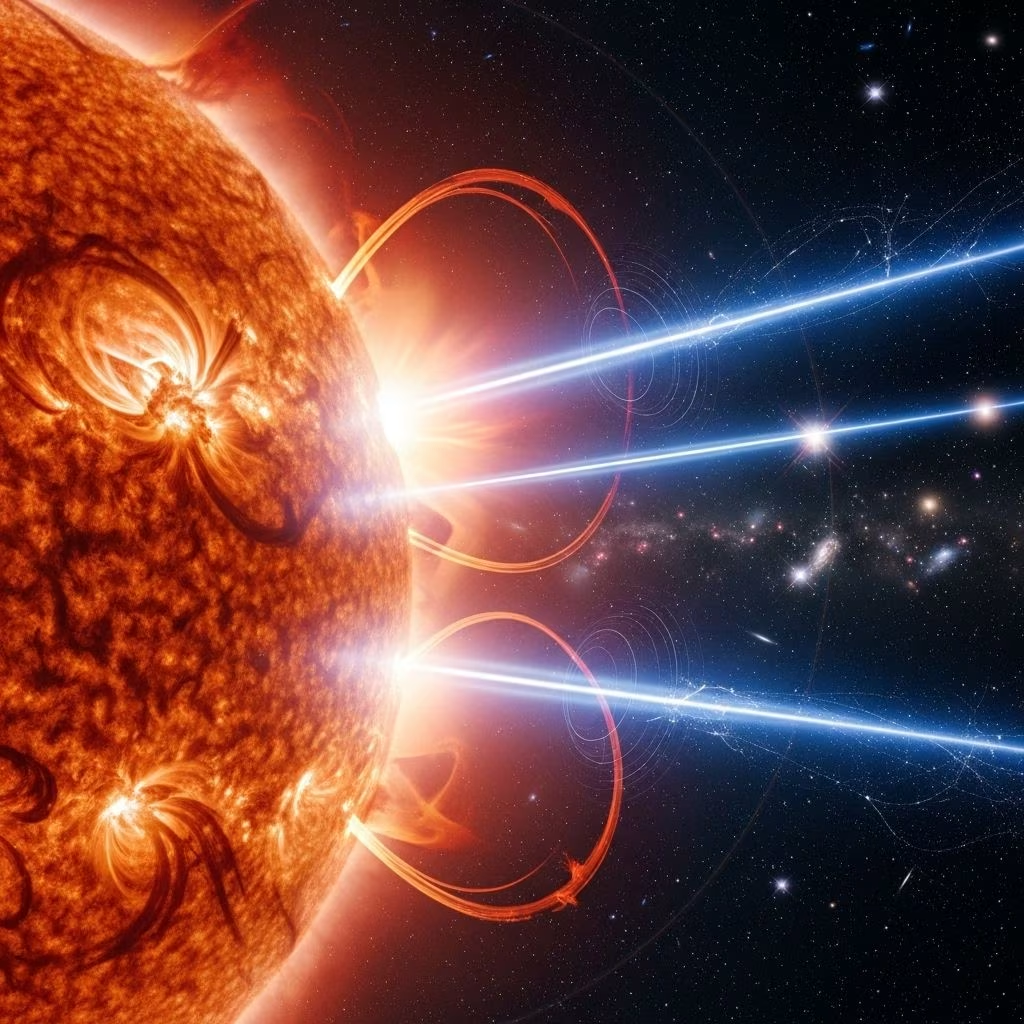
Sun Shatters Records With Highest-Energy Gamma Rays
In a ground-breaking revelation, astronomers have detected the highest-energy gamma rays ever observed emanating from our sun. This staggering emission — reaching up to nearly 10 trillion electron volts (TeV) — has defied current solar models, expanding the mysteries surrounding our familiar star and launching a new wave of scientific inquiry.
The Discovery: Sun Brighter Than Expected
The sun was long assumed to shine brightest in visible and ordinary ultraviolet light, yet a surprising excess of ultra-energetic gamma rays has changed this perception. Researchers, led by postdoctoral associate Meher Un Nisa of Michigan State University, analyzed six years’ worth of data, only to find an unexpected abundance of gamma rays far beyond what had ever been recorded from the sun. Initial disbelief gave way to excitement as the data’s validity became apparent.
“After looking at six years’ worth of data, out popped this excess of gamma rays,” said Nisa. “When we first saw it, we were like, ‘We definitely messed this up. The sun cannot be this bright at these energies.'”
- Highest energies detected: Nearly 10 trillion electron volts (TeV)
- Gamma rays: Most energetic form of electromagnetic radiation
- Source: High-Altitude Water Cherenkov (HAWC) Observatory
What Are Gamma Rays?
Gamma rays sit at the uppermost end of the electromagnetic spectrum. They are the most energetic and penetrating form of electromagnetic radiation, often produced during cosmic explosions, radioactive decay, or interactions of particles traveling near light speed. Until now, the sun was not considered a major natural generator of such extreme-energy gamma rays.
- Electromagnetic spectrum: Ranges from low-energy radio waves to high-energy gamma rays
- Typical energy from sunlight (visible): ~1 electron volt (eV)
- Gamma rays detected by HAWC: From 1 trillion to nearly 10 trillion electron volts — a million times more energetic than visible light
Peering Into the Data: How the Gamma Rays Were Found
The discovery was made possible by the High-Altitude Water Cherenkov Observatory (HAWC), a sophisticated ground-based array built in Mexico. Designed to detect some of the universe’s most energetic events, HAWC has been tracking cosmic gamma rays since 2015. Analyzing data collected over six years, the team identified an unmistakable excess of very-high-energy gamma rays from the sun, pushing the boundaries of observational solar physics.
- Observatory: HAWC (High-Altitude Water Cherenkov Observatory)
- Location: Mexico (4100 meters altitude) — optimal for cosmic-ray studies
- Key function: Senses cascades of subatomic particles generated when high-energy gamma rays strike Earth’s atmosphere
- Data timespan: 6 years
The observatory’s unique design allows it to continuously survey two-thirds of the sky, making it especially sensitive to rare, high-energy gamma-ray bursts — including those from our sun.
Why Is This Discovery Groundbreaking?
The notion that the sun could produce such extremely high-energy gamma rays was previously unforeseen by established models. Conventionally, the sun’s gamma-ray emission was expected to be relatively modest, primarily limited to moderate energies generated, for example, during solar flares or by cosmic-ray interactions.
- Previous expectations: Maximum gamma-ray energies from the sun should not exceed a few billion electron volts (GeV)
- New findings: Emissions millions of times more energetic than anticipated
- Result: Existing solar models challenged, requiring new theories to explain the source and mechanism
According to Brian Fields, an astrophysicist at the University of Illinois who was not involved in the study: “Despite being our closest and most familiar stellar neighbor, the sun still holds surprises for us.”
Potential Gamma-Ray Sources on the Sun
While the sun’s nuclear fusion core generates visible light and other radiation, the mechanisms behind such high-energy gamma ray production are far less obvious. Scientists propose the following theorized sources and processes:
- Cosmic-ray collisions: High-energy particles from outside the solar system (cosmic rays) may smash into the solar atmosphere, producing showers of secondary particles — some of which decay into gamma rays at extreme energies.
- Magnetic field interactions: The sun’s complex and intense magnetic fields could play a role in accelerating particles to nearly light speed, giving rise to ultrahigh-energy gamma rays.
- Unknown processes: The data hint at the possibility of mechanisms not previously considered within solar physics, emphasizing how incomplete our current understanding is.
Impact on Solar Physics
This discovery prompts a revision of our understanding of the sun’s magnetic environment, particle acceleration, and solar activity. It opens new avenues in the study of how energetic particles behave within — and emerge from — the sun’s intense magnetic environment.
- New research questions:
- What role does the sun’s magnetic field play in gamma-ray generation?
- How do these rays escape the sun’s surface and corona?
- Are there yet-undiscovered mechanisms producing such high energies?
- Astronomical context: Gamma-ray emissions at such energies are usually found in the most extreme environments, like supernovae, neutron stars, and active black holes.
How Does This Affect Us?
The detection naturally raises concerns about the implications for life on Earth. However, scientists emphasize that although these gamma rays are stupendously energetic, Earth’s protective magnetosphere and atmosphere block virtually all of them from reaching the ground. Human safety is not at risk.
- Earth’s protection: Atmosphere and magnetic field absorb incoming gamma rays efficiently
- Impact: No health concerns or technological threats for people on Earth
Why Study Solar Gamma Rays?
Gamma-ray astronomy — especially at these high energies — gives astrophysicists a rare and powerful diagnostic tool. Studying these emissions allows researchers to probe fundamental particle interactions, solar magnetic fields, and cosmic-ray behavior near our sun in ways never before possible.
- Understanding cosmic rays: High-energy solar gamma rays help trace cosmic-ray origins and propagation
- Solar magnetic fields: Observations reveal how magnetic fields trap, accelerate, or direct energetic particles
- Astrophysical testing: The sun offers a close laboratory for phenomena usually observed only in distant galaxies
Expert Insights: A Surprising Star
“The sun is more surprising than we knew,” reiterated Nisa. The remarkable discovery has stunned solar scientists, who thought they understood most of the mechanisms responsible for high-energy emissions from the sun. Instead, the findings reveal our sun still holds secrets — perhaps many — about its deepest workings.
Other astronomers echoed this sentiment. Brian Fields noted the scientific thrill: “This new observation is as exciting as it is puzzling, because the HAWC team have shown that the Sun shines brightly in high-energy gamma rays — brighter than anyone expected.”
Implications for Future Research
This paradigm-shifting discovery means several things for the direction of current and future solar research:
- Model updates: Theoretical models of solar physics need revision to account for high-energy gamma ray emissions
- Multi-wavelength astronomy: Combines visible, ultraviolet, X-ray, and gamma-ray data for a holistic sun profile
- Connections to space weather: Further study could reveal how energetic particles affect the solar system’s environment
Astrophysicists are eager to harness the full potential of new observatories — on Earth and in space — to track these emissions and decode the sun’s persistent mysteries.
Frequently Asked Questions (FAQs)
Q: What exactly did scientists find?
A: Researchers detected gamma rays from the sun with energies up to nearly 10 trillion electron volts — far above what existing models predicted.
Q: Are these gamma rays dangerous?
A: No, despite their tremendous energy, Earth’s atmosphere and magnetic field shield us from harmful effects; these rays do not reach the surface.
Q: How are such energetic gamma rays produced?
A: The leading hypothesis is that cosmic rays collide with particles in the solar atmosphere, generating high-energy showers that can emit gamma rays; the sun’s magnetic field may enhance these interactions.
Q: Which instruments enabled the discovery?
A: The High-Altitude Water Cherenkov (HAWC) Observatory was crucial in tracking and confirming the high-energy gamma emissions from the sun.
Q: What does this mean for solar science?
A: It compels solar physicists to rethink existing models and explore new theories for particle acceleration and magnetic activity on the sun.
Comparative Table: Gamma Ray Emissions in the Universe
| Source | Typical Gamma-Ray Energy | Notes |
|---|---|---|
| Sun (Current Discovery) | Up to 10 trillion electron volts (TeV) | Much higher than expected for a “normal” star |
| Gamma-ray bursts | From millions to billions of TeV | Most powerful known cosmic explosions |
| Neutron stars/Pulsars | Billions of electron volts (GeV) range | Produced by rapid rotation and strong magnetic fields |
| Supernova remnants | Millions of electron volts (MeV) to low TeV | Shockwaves accelerate cosmic-ray particles |
Looking Ahead: The Sun’s Puzzling Power
The unprecedented detection of trillion-electron-volt gamma rays from our sun compels a reimagining of solar physics, particle interactions, and magnetic field dynamics. While humanity remains protected from these cosmic fireworks, this discovery nudges our understanding forward and suggests innumerable secrets still to be gleaned from our nearest star.
- Future missions and ground-based observatories will further probe these high-energy rays.
- Solar scientists recognize that the path to unveiling the sun’s deepest mysteries has only just begun.
- This breakthrough is not just a leap in solar science — it’s a reminder that even familiar stars can offer the most unexpected surprises.
References
- https://www.space.com/sun-blasts-highest-energy-radiation-ever-recorded-raising-questions-solar-physics
- https://www.nasa.gov/universe/nasas-fermi-detects-the-highest-energy-light-from-a-solar-flare/
- https://www.livescience.com/space/highest-energy-sunlight-ever-recorded-is-far-beyond-what-scientists-thought-possible
- https://www.sciencealert.com/scientists-detect-highest-energy-light-ever-seen-from-the-sun
- https://phys.org/news/2023-08-scientists-highest-energy-sun.html
- https://nasaspacenews.com/2024/02/the-sun-blasts-the-highest-energy-gamma-rays-ever-recorded-raising-questions-for-solar-physics/
- https://www.ign.com/articles/scientists-spot-super-high-energy-gamma-rays-coming-from-the-sun
- https://svs.gsfc.nasa.gov/11000/
- https://www.independent.co.uk/space/sun-highest-energy-gamma-rays-b2387495.html
- https://www.sciencedaily.com/releases/2023/08/230803213824.htm
- https://www.youtube.com/watch?v=bbP7-V1_2oc
- https://umdphysics.umd.edu/about-us/news/research-news/1894-high-energy-sun.html
- https://en.wikipedia.org/wiki/Solar_cycle_25
- https://www.foxnews.com/science/sun-emits-highest-energy-light-ever-observed-scientists
- https://www.laboratoryequipment.com/599071-Highest-energy-Light-Ever-Observed-from-the-Sun/
- https://www.youtube.com/watch?v=8oGVgwDa0Z4
- https://newatlas.com/space/gamma-rays-highest-energy-light-sun/


