Olympus Mons: Towering Giant of the Red Planet
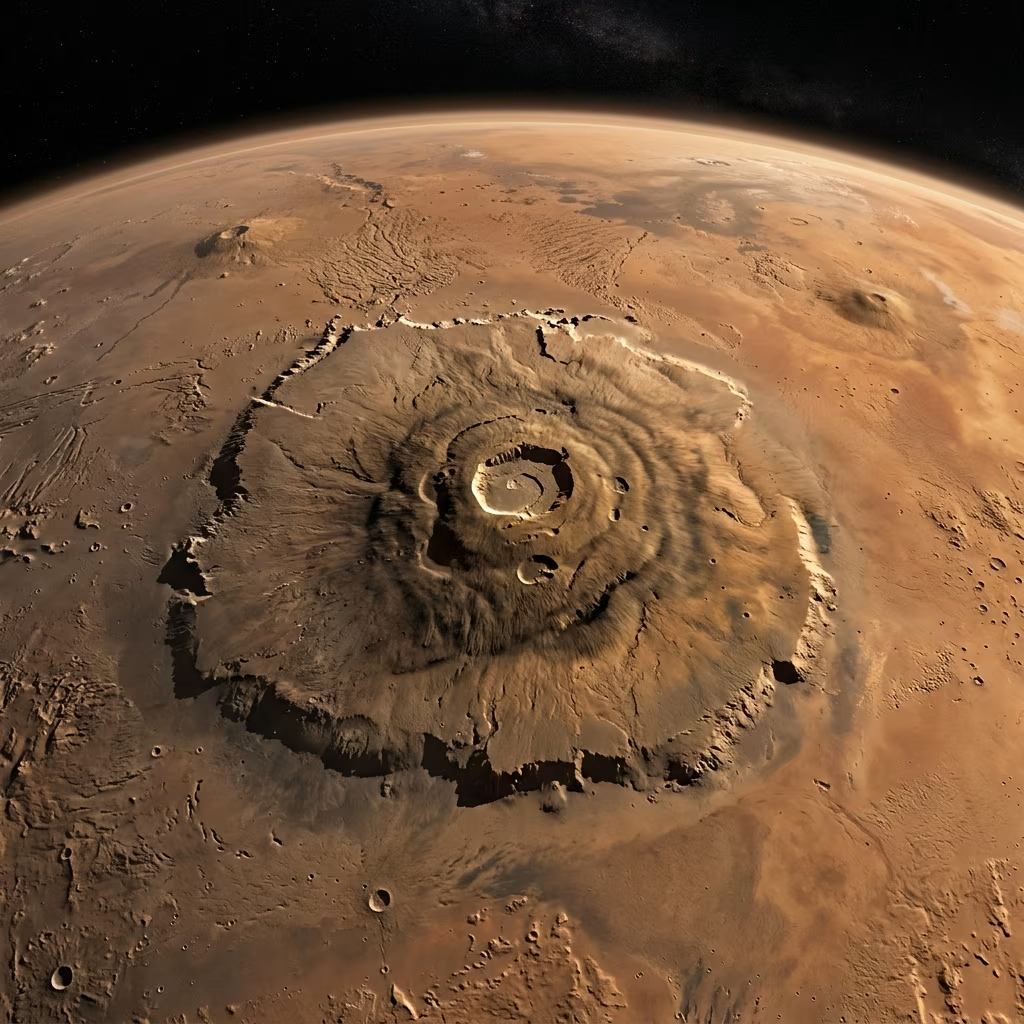
Olympus Mons stands unrivaled as the tallest volcano and mountain in our solar system. Situated within the Tharsis region near Mars’ equator, this colossal shield volcano testifies to the planet’s dramatic volcanic history and remains a focal point for planetary scientists studying Mars’ geology and landscape evolution.
Quick Facts about Olympus Mons
- Type: Shield volcano
- Location: Tharsis Montes region, western hemisphere near Mars’ equator
- Height: Roughly 16 miles (25-26 km) above surrounding plains; about 13 miles (21 km) above Mars’ areoid (‘sea level’)
- Diameter: ~374 miles (601 km) at base—about the size of Arizona, greater than the area of France
- Volume: Nearly 100 times greater than Earth’s largest volcano, Mauna Loa
- Formation Age: Estimated to have formed around 3.5 billion years ago
What Makes Olympus Mons So Massive?
Olympus Mons’ enormous size is both a product of Mars’ unique geological activity and its lack of plate tectonics. As a shield volcano, it built up over millions of years by repeated flows of highly fluid basaltic lava, typical for such landforms. Unlike Earth—where moving plates shift volcanoes off their lava sources—Mars’ stationary crust allowed Olympus Mons to repeatedly erupt in the same location. This relentless growth resulted in a volcanic structure far grander than any seen on our home planet.
- Height Comparison: Mauna Loa in Hawaii rises 6.3 miles (10 km) from base to summit but only 2.6 miles above sea level—Olympus Mons is approximately three times taller.
- Width & Bulk: Olympus Mons is about 20 times wider than it is high, giving it an immense footprint. It could cover entire states or countries on Earth, including Arizona or France.
- Volume Comparison Table:
| Volcano | Height from Base | Diameter | Approximate Volume |
|---|---|---|---|
| Olympus Mons (Mars) | 16 mi (25-26 km) | 374 mi (601 km) | ~1,000,000 cubic mi (4,000,000 km3) |
| Mauna Loa (Earth) | 6.3 mi (10 km) | ~75 mi (120 km) | ~10,000 cubic mi (42,500 km3) |
Location: The Tharsis Montes Region
Olympus Mons is nestled in the Tharsis Bulge, a massive volcanic plateau on Mars. This location is significant—it’s home to a dozen other gigantic volcanoes, including the three peaks of the Tharsis Montes: Ascraeus Mons, Pavonis Mons, and Arsia Mons. Clustering of these volcanic giants in such proximity placed tremendous stress on the planet’s crust, dramatically influencing Mars’ geological evolution.
- The combined mass of Olympus Mons and the Tharsis Montes volcanoes was so great it caused Mars’ crust and mantle to slip approximately 20 degrees about 3 billion years ago.
This shift was substantial enough to alter river paths and climate patterns across ancient Mars.
Defining Martian “Sea Level”: What is the Areoid?
Measuring elevation on a planet without oceans presents a unique challenge. Mars utilizes the concept of an areoid—an imaginary sphere with the average equatorial radius of the planet—analogous to Earth’s mean sea level. Relative to the areoid, Olympus Mons soars about 13 miles (21 km). Even by this conservative metric, it remains the solar system’s tallest volcano.
Why Does Olympus Mons Look So Different?
Despite its extreme height, Olympus Mons does not resemble the steep mountains or volcanoes we might expect. Its vast width and shield-like shape result in extremely gentle slopes—on average only about 2-5 degrees. If you stood anywhere on its massive flanks, the horizon would appear almost flat and featureless, more reminiscent of a softly rising plain than a dramatic peak.
The summit features a large caldera—an expansive depression caused by the collapse of the surface following eruptions. This caldera includes multiple overlapping collapse pits, evidence of the volcano’s punctuated eruptive history.
- Summit Caldera: 53 miles (85 km) wide, 2 miles (3 km) deep
- Flanks: Gentle slope interrupted by steep cliffs at edges, or escarpments, up to 4 miles (6 km) tall
Formation and Volcanic History of Olympus Mons
What allowed Olympus Mons to become so big—and to stay that way—is a subject of enduring scientific curiosity. The answer lies in Mars’ ancient volcanic activity and very different internal dynamics compared to Earth. On Earth, plate tectonics causes volcanic hotspots to migrate, creating series of smaller volcanoes. But on Mars, a fixed crust meant one volcano could grow for hundreds of millions of years at the same spot.
- Olympus Mons is considered a relatively “young” feature in Martian geological terms, primarily active during the Hesperian epoch (~3.7 to 3.0 billion years ago).
- Volcanic activity persisted much longer because Mars has a smaller planet mass and cooled more slowly relative to its size, extending volcanic lifespans.
- The lack of both plate tectonics and erosion (due to Mars’ thin atmosphere and absence of liquid water) preserved Olympus Mons’ extreme height and distinctive structure.
Geological Impact: Mars’ Outer Layer Shift
Perhaps most remarkable, the enormous mass of Olympus Mons and neighboring volcanoes caused Mars’ thin crust and upper mantle to reorient by about 20 degrees. This phenomenon, known as “true polar wander,” resulted when the great weight forced Mars’ outer layers to move, effectively shifting the volcanoes from the polar region toward the equator over a period exceeding a billion years. This shift played a role in modifying river flows and possibly even climate dynamics on Mars.
Comparing Olympus Mons to Earth’s Mountains and Volcanoes
To appreciate Olympus Mons’ magnitude, it helps to place it side-by-side with familiar terrestrial giants. Below is a comparison table of prominent planetary volcanoes and mountains:
| Feature | Planet/Body | Type | Height (mi/km) | Key Note |
|---|---|---|---|---|
| Olympus Mons | Mars | Shield volcano | 16 (25-26 km) | Tallest volcano/mountain in Solar System |
| Mauna Loa | Earth | Shield volcano | 6.3 (10 km) from base, 2.6 (4.2 km) above sea level | Earth’s largest volcano by volume |
| Mount Everest | Earth | Mountain | 5.5 (8.8 km) above sea level | Earth’s highest mountain above sea level |
| Rheasilvia Central Peak | Vesta (asteroid) | Impact peak | 14.2 (22.8 km) | Contender for solar system’s tallest peak |
Scientific Significance and Exploration
Olympus Mons is a treasure trove for scientists exploring Martian volcanism, surface evolution, and potential planetary habitability. The features preserved on and around this volcano enable researchers to :
- Reconstruct the history of volcanic activity on Mars
- Study differences in planetary geology between Earth and Mars
- Understand implications for Martian climate shifts and water presence
- Plan for potential future missions, including robotic and human exploration
High-resolution imaging from NASA’s Mars missions continues to provide new insights into Olympus Mons’ caldera structure, lava flows, and landslide features.
Frequently Asked Questions (FAQs) about Olympus Mons
Q: Why is Olympus Mons so much bigger than any volcano on Earth?
A: The immense size of Olympus Mons is primarily due to Mars’ lack of plate tectonics, allowing the volcano to remain stationary over a mantle hotspot for hundreds of millions of years. On Earth, moving plates disperse volcanic activity, creating basalt chains like the Hawaiian Islands instead of a single giant volcano.
Q: Could Olympus Mons erupt again?
A: While Olympus Mons is considered extinct or dormant today, evidence suggests its most recent eruptions may have been relatively recent in Martian terms. However, there is currently no sign of imminent volcanic activity.
Q: What would it look like to stand on Olympus Mons?
A: Because of its tremendous width and gentle slope, someone standing on Olympus Mons would experience a nearly flat, expansive landscape. The summit’s vast caldera would be visible nearby, and the horizon would appear surprisingly close, with little indication of the volcano’s true size from ground level.
Q: How did the weight of Olympus Mons affect Mars?
A: The collective mass of Olympus Mons and its neighbors in Tharsis was so substantial that it caused Mars’ outer shell to shift by about 20 degrees, significantly altering the planet’s drainage patterns and climate history.
Q: Is Olympus Mons the tallest feature in the solar system?
A: Olympus Mons holds the record for the tallest volcano and planetary mountain in the solar system. Only some features on Vesta (like the Rheasilvia central peak) may rival its prominence, but Olympus Mons remains unmatched in volume and area.
Conclusion: A Monumental Martian Legacy
Olympus Mons is more than a Martian mountain; it’s a record-holder that reshaped a planet. Its gigantic caldera, broad shield, and enduring geological footprint remind us that Mars, while cold and dormant today, was once a world of unimaginable volcanic forces. Whether as a future target for robotic probes or even human explorers, Olympus Mons continues to fuel curiosity about our solar system’s most awe-inspiring landscapes.
References
- https://www.space.com/20133-olympus-mons-giant-mountain-of-mars.html
- https://www.astronomy.com/science/olympus-mons-mars-mega-volcano-height-formation/
- https://eeps.rice.edu/news/2023/hotly-debated-history-largest-volcano-solar-system
- https://www.britannica.com/place/Olympus-Mons
- https://www.skyatnightmagazine.com/space-science/olympus-mons
- https://en.wikipedia.org/wiki/Olympus_Mons
- https://lowell.edu/olympus-mons-the-biggest-hotspot-in-the-solar-system/
- https://marsed.asu.edu/mep/volcanoes
- https://en.wikipedia.org/wiki/Olympus_mons
- https://www.lpi.usra.edu/publications/slidesets/redplanet2/slide_11.html
- https://www.ebsco.com/research-starters/astronomy-and-astrophysics/olympus-mons
- https://vajiramandravi.com/current-affairs/olympus-mons/
- https://study.com/learn/lesson/olympus-mons-facts-discovery-height.html
- https://www.youtube.com/watch?v=8qdYCpSW2eY
- http://hyperphysics.phy-astr.gsu.edu/hbase/Solar/marsoly.html
- https://marsed.asu.edu/mep/tectonics
- https://www.worldatlas.com/space/the-largest-volcano-in-the-solar-system.html