


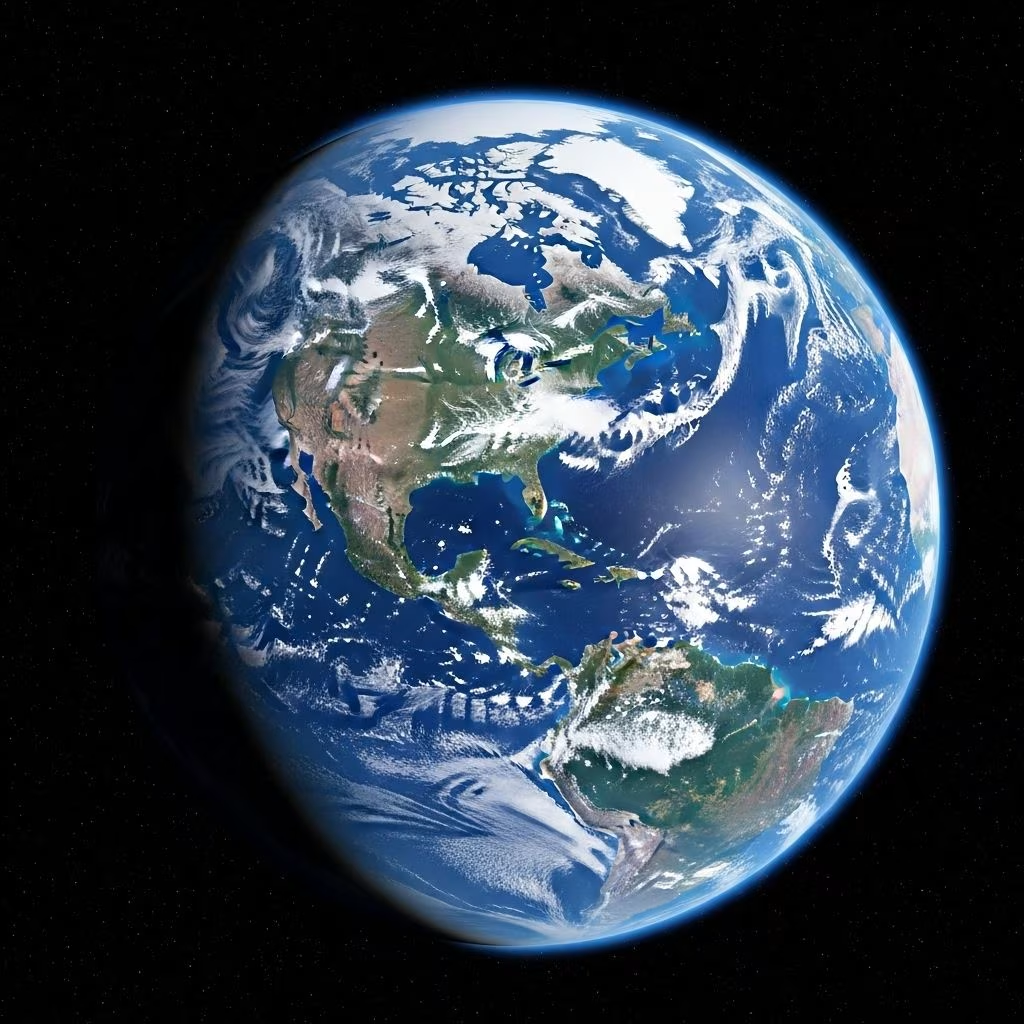
How Big Is Earth? Understanding the True Scale of Our Home Planet
From the moment humanity first gazed over distant horizons, the enormity of Earth has captivated our curiosity. To the casual eye, Earth’s surface appears boundless, its horizons seemingly unreachable. Yet, measured alongside the cosmic giants of the universe, our planet is both substantial and modest, possessing a size that is vital for its role as a cradle for life. How do scientists quantify Earth’s size, and what do those measurements mean for our understanding of the planet’s place in the cosmos?
Measuring Earth: More Than Just a Number
Determining the true size of Earth is more nuanced than simply measuring one dimension. Scientists use several key metrics to define Earth’s magnitude:
- Diameter
- Circumference
- Surface Area
- Volume
- Mass
Each of these measurements reveals a different aspect of Earth’s physical characteristics and helps put our world in perspective. Let’s explore each of these metrics, and uncover the story they tell about the planet we call home.
Earth’s Diameter: The Width of Our World
The diameter of Earth is a critical measurement that defines the planet’s width. However, Earth is not a perfect sphere — it’s an oblate spheroid, which means its diameter is slightly larger at the equator than at the poles due to the force of rotation causing a bulge.
- Equatorial Diameter: 12,756 kilometers (7,926 miles)
- Polar Diameter: 12,714 kilometers (7,900 miles)
- Difference: The equatorial diameter is about 42 kilometers (26 miles) longer than the polar diameter.
This discrepancy arises because Earth’s spin causes it to flatten slightly at the poles and bulge at the equator, creating its subtle but important oblate shape.
What About the Mean Diameter?
Scientists often refer to the mean diameter, which averages the equatorial and polar diameters. For Earth, the mean diameter is about 12,742 kilometers (7,918 miles).
Earth’s Circumference: Traveling Around the Globe
The circumference of Earth—the distance around its widest point—can be calculated using the equatorial diameter:
| Circumference Type | Value (km) | Value (miles) |
|---|---|---|
| Equatorial Circumference | 40,075 | 24,901 |
| Meridional (Polar) Circumference | 40,008 | 24,860 |
These precise values were determined with modern measurements, though cultures as far back as Ancient Greece understood the concept — Eratosthenes estimated Earth’s circumference with remarkable accuracy more than 2,200 years ago.
Surface Area: The Vastness of Earth’s Expanse
The surface area of Earth—the total area of its outer shell—is another important metric. Mathematically, the surface area depends on the radius of the planet. For an oblate spheroid, a slightly more complex formula is used, but the principle is the same.
- Total Surface Area: Approximately 510,072,000 square kilometers (197 million square miles)
- Land Area: About 148,940,000 square kilometers (~29% of total)
- Ocean Area: Around 361,132,000 square kilometers (~71% of total)
These measurements highlight just how dominant the oceans are on Earth’s surface, with land making up less than one-third of the planet’s surface.
Earth’s Volume and Density
Calculating Earth’s volume helps us understand how much space the planet actually occupies:
- Volume: 1.083×10¹² cubic kilometers (about 260 billion cubic miles)
Earth’s average density is about 5.515 grams per cubic centimeter, making it the densest planet in the solar system. This density reflects Earth’s unique internal structure, with a solid iron-nickel core, a mantle composed of silicate rocks, and a comparatively thin crust.
Earth’s Mass: Weighing Our Planet
The mass of Earth is crucial for calculating gravitational forces and for understanding the planet’s interactions within the solar system:
- Mass: 5.9736 × 1024 kilograms (13,170,000,000,000,000,000,000,000 pounds)
This tremendous mass enables Earth to exert the force of gravity that holds our atmosphere, guides the Moon in its orbit, and affects objects on our planet and even in space.
Earth’s Shape: The True Form of Our Planet
Though Earth often appears as a perfect sphere in diagrams, its true shape is an oblate spheroid. The centrifugal force from Earth’s rotation causes it to bulge at the equator and flatten at the poles. This results in:
- Slightly shorter polar radius (6,357 kilometers / 3,950 miles).
- Slightly longer equatorial radius (6,378 kilometers / 3,963 miles).
These subtle distinctions have a measurable impact on phenomena such as gravity, which is slightly weaker at the equator and stronger at the poles due to this shape.
Comparing Earth to Other Planets
Understanding how Earth compares to its neighbors gives further perspective on its size and significance within the solar system.
| Planet | Diameter (km) | Relative to Earth |
|---|---|---|
| Jupiter | 142,984 | ~11 times larger |
| Saturn | 120,536 | ~9.5 times larger |
| Neptune | 49,528 | ~3.9 times larger |
| Uranus | 51,118 | ~4 times larger |
| Venus | 12,104 | ~95% Earth’s size |
| Mars | 6,779 | ~53% Earth’s size |
| Mercury | 4,880 | ~38% Earth’s size |
Earth takes the fifth spot in the planet size rankings in our solar system. Venus is Earth’s closest twin, while Jupiter dwarfs all other planets with a diameter more than eleven times larger than Earth’s.
Earth’s Place in the Cosmos: Size on the Grandest Scale
From a cosmic perspective, Earth seems minuscule compared to the Sun, which has a diameter about 109 times larger than our planet, or the supergiant stars that populate the galaxy. Yet, Earth’s size is optimal for supporting a stable atmosphere, retaining water, and sustaining life as we know it.
Why Earth’s Size Matters
- Atmospheric Retention: Earth’s mass is sufficient to keep most atmospheric gases, crucial for moderating temperature and supporting life.
- Gravity: Its size and density ensure gravity strong enough to allow liquid water but not so strong as to trap only dense, toxic gases.
- Geological Activity: A planet of this size sustains internal heat, buffering against extreme temperature swings and enabling tectonic activity that cycles nutrients.
Frequently Asked Questions (FAQs)
Q: Is Earth a perfect sphere?
A: No. Earth is an oblate spheroid, slightly flattened at the poles and bulged at the equator due to its rotation.
Q: How do scientists measure Earth’s diameter?
A: Measurements involve mathematical calculations, satellite imagery, and geodetic surveys, comparing distances at the equator versus the poles.
Q: How much of Earth’s surface is covered by ocean?
A: About 71% of Earth’s surface is covered by oceans, with the remaining 29% being land.
Q: How does Earth’s size compare to the Moon?
A: Earth is about 3.7 times larger in diameter than the Moon and has over 80 times its volume.
Q: Why is Earth’s size important for life?
A: Its size allows retention of a protective atmosphere, stable environmental conditions, and liquid water—essential ingredients for life as we know it.
Key Facts and Summary Table
| Measurement | Value |
|---|---|
| Mean Diameter | 12,742 km (7,918 miles) |
| Equatorial Circumference | 40,075 km (24,901 miles) |
| Total Surface Area | 510,072,000 sq km (197 million sq miles) |
| Volume | 1.083×10¹² km³ |
| Mass | 5.9736 × 1024 kg |
| Mean Density | 5.515 g/cm³ |
Earth’s Measurements: A Foundation for Science and Exploration
Understanding how big Earth is helps scientists model weather patterns, study geological events, plan satellite orbits, and assess environmental changes. Knowing these figures is fundamental not just for astronomy, but for understanding how interconnected systems support life on this extraordinary planet.
As we continue exploring our universe, Earth’s unique combination of size, density, and composition stands as a crucial benchmark—reminding us that even in the vastness of space, our planet occupies a remarkable place.
References
- https://www.space.com/54-earth-history-composition-and-atmosphere.html
- https://www.space.com/19160-alien-earth-size-planets-population-infographic.html
- https://myspacemuseum.com/how-big-is-the-earth
- https://www.astronomy.com/science/earth/
- https://www.universetoday.com/articles/size-of-the-earth
- https://science.nasa.gov/universe/exoplanets/our-milky-way-galaxy-how-big-is-space/
- https://www.britannica.com/place/Earth
- https://en.wikipedia.org/wiki/Outer_space
- https://www.youtube.com/watch?v=pSHVbLPWA28
- https://bigthink.com/starts-with-a-bang/how-large-universe/
- https://en.wikipedia.org/wiki/Observable_universe
- https://futurism.com/series-images-help-put-size-earth-perspective
- https://www.youtube.com/watch?v=PTYl-d9j_qM
- https://study.com/academy/lesson/shape-of-the-earth-density-stress-gravity.html
- https://astronomyexplained.com/how-big-is-the-universe-exploring-space/
- https://www.nasa.gov/science-research/astrophysics/how-big-is-space-we-asked-a-nasa-expert-episode-61/
- https://nerdist.com/article/celestial-bodies-size-comparison-scaled-to-human-size/


