The Search for the Universe’s Largest Star
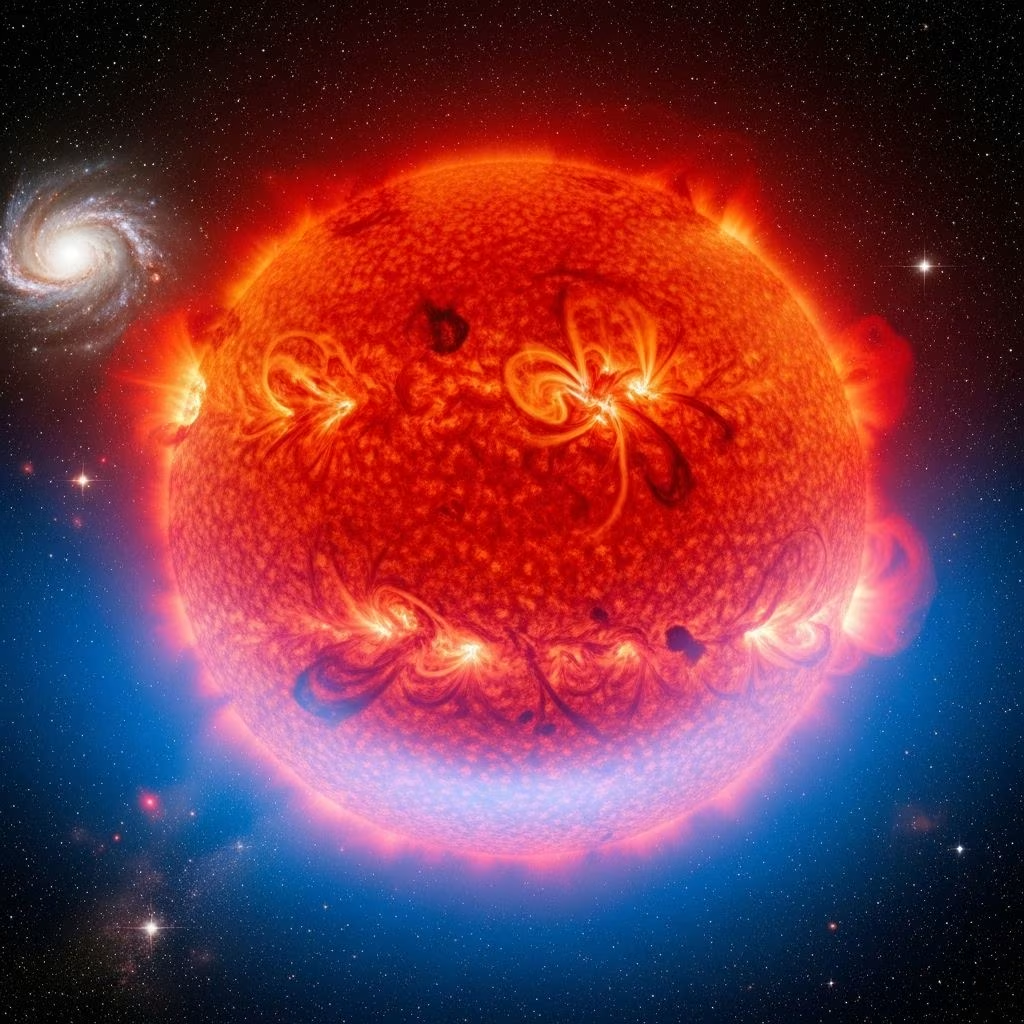
Astronomers have long sought to identify the largest stars in the universe. Among these giants, VY Canis Majoris (VY CMa) stands out as a record-shattering behemoth, stretching our understanding of stellar evolution and the true limits of cosmic scale.
What Is VY Canis Majoris?
VY Canis Majoris is an extreme red hypergiant star located in the constellation Canis Major, approximately 3,900 light-years (1.2 kiloparsecs) from our solar system. Listed as one of the largest known stars by radius, it never fails to astonish with its jaw-dropping physical properties.
- Type: Red hypergiant (M5)
- Distance from Earth: ~3,900 light-years
- Constellation: Canis Major
- Brightness: Around 270,000 times that of the Sun
Location and Discovery
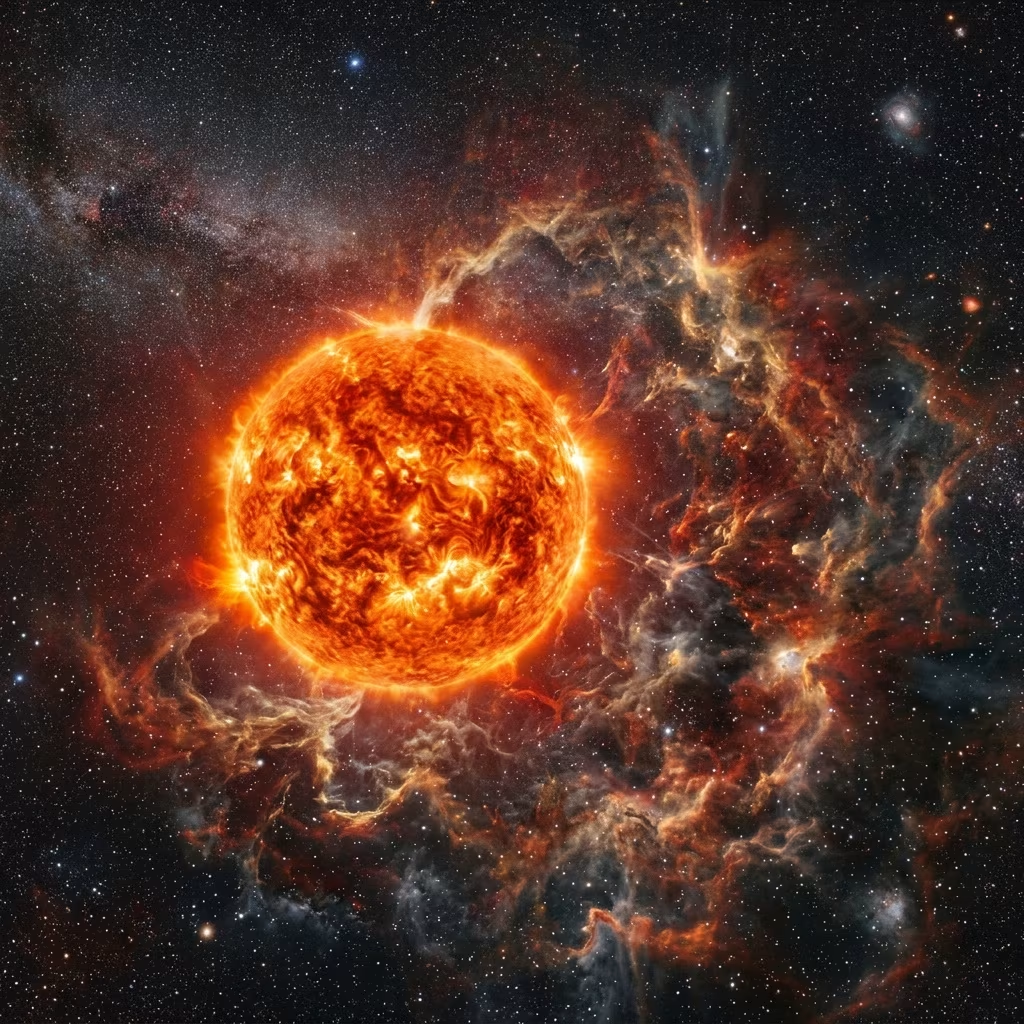
VY Canis Majoris is found in the southern sky, rich in giant and massive stars. Its location and sheer luminosity make it an object of fascination for both professional astronomers and stargazing enthusiasts. The star is embedded within the large molecular cloud known as Sh2-310, a sprawling H II region conducive to star formation.
- Coordinates: RA 07h 22m 58.33s, Dec −25° 46′ 03.17″
- Surroundings: Dense star-forming region with nebular structures
Just How Big Is VY Canis Majoris?
VY Canis Majoris’s physical size defies easy comparison. To put its radius in perspective:
- Radius: Approximately 1,420 times that of the Sun
- Diameter: About 13.2 Astronomical Units (AU)
- Volume: Over 3 billion times the Sun’s volume
- Surface distance: Light would take about 6 hours to travel around its surface—compared to just 14.5 seconds for the Sun
If placed at the center of our solar system, VY CMa’s surface would stretch far beyond the orbit of Jupiter—possibly as far as the orbit of Saturn in some size estimates.
| Property | VY Canis Majoris | The Sun |
|---|---|---|
| Type | Red hypergiant | Yellow dwarf |
| Mass | 17–40 solar masses* | 1 solar mass |
| Radius | 1,420 R☉ | 1 R☉ |
| Diameter | 13.2 AU | 0.0092 AU |
| Luminosity | 270,000 L☉ | 1 L☉ |
| Effective Temp. | <4,000 K | 5,778 K |
| Volume | ~3 billion × Sun | 1 |
*Mass estimates vary due to heavy mass loss; some sources give higher initial mass, now reduced.
Stellar Structure: What Makes VY Canis Majoris Unique?
VY Canis Majoris is classified as an oxygen-rich red hypergiant—a very rare type of star. Several factors make it extraordinary:
- Pulsating Variable Star: Shows semi-regular variability with a period around 2,000 days
- Great Infrared Excess: Among the brightest objects at IR wavelengths (5–20 µm), revealing a surrounding shell of hot dust
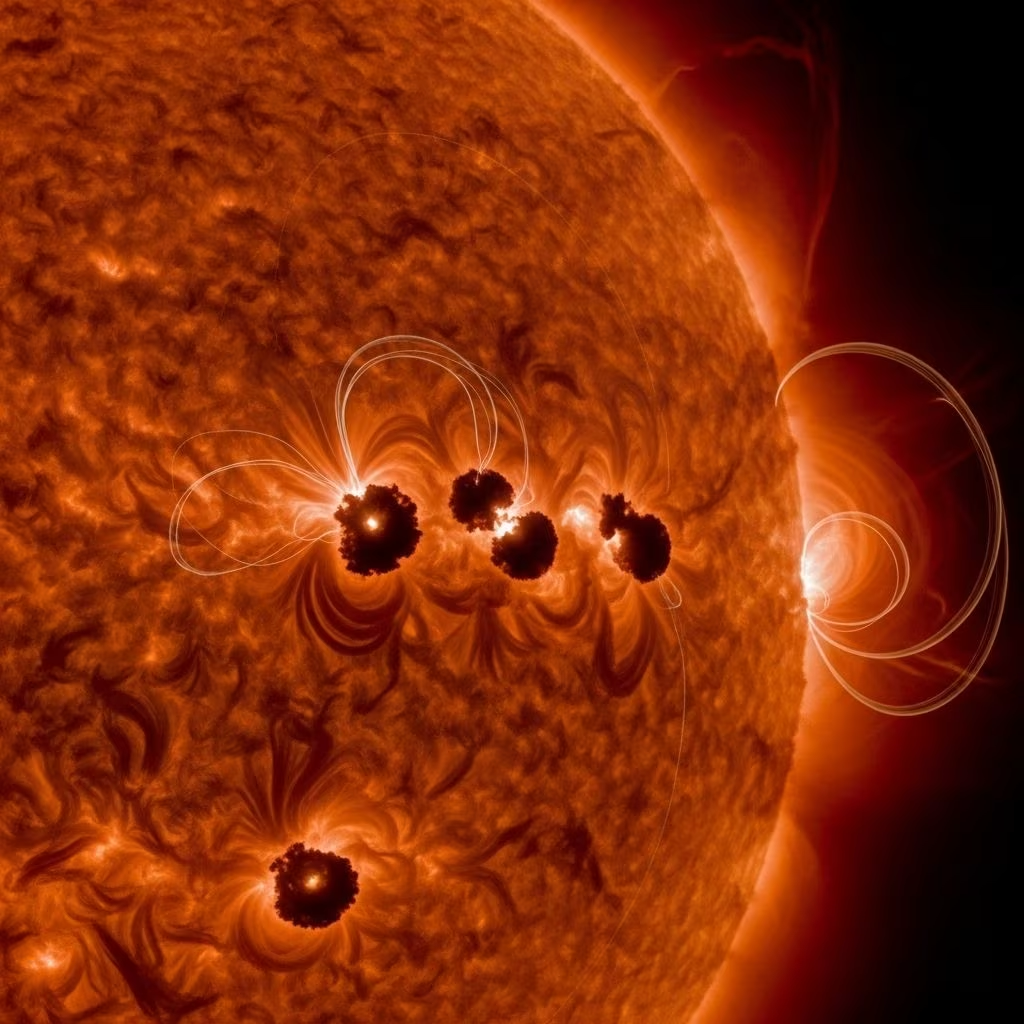
- Surrounding Nebula: Its stellar winds create a complex, asymmetric circumstellar envelope (CSE), shaped by massive ejections of gas and dust
- Molecular Masers: Emits strong maser signals in the radio, one of the first such objects found
The star is not part of a multiple-star system nor does it have direct stellar companions, making its evolution less complicated by interactions with other stars.
How Do Stars Like VY Canis Majoris Get So Big?
The path to becoming a hypergiant such as VY Canis Majoris requires unique circumstances. All stars are born from giant molecular clouds, but only the most massive can reach hypergiant status:
- Massive stars fuse hydrogen rapidly, building up helium “ash” at the core
- As helium accumulates, the fusion zone is forced into a shell around the core, increasing outward pressure
- The star’s outer layers are pushed out by intense radiation from within, causing the star’s envelope to expand dramatically
- This expansion leads to enormous radii—thousands of times the Sun’s—while mass loss events shed huge quantities of material into space
Comparing the Biggest Stars in the Universe
VY Canis Majoris isn’t alone in the pantheon of gigantic stars, though it is often cited as the largest by measured size. Here are some other red hypergiants and supergiants often compared:
- UY Scuti: Once considered the largest known star, with a comparable radius to VY CMa
- Betelgeuse: A famous red supergiant, much smaller than VY CMa at only about 887 times the Sun’s radius
- Antares: Another well-known red supergiant, with a radius about 700 times that of the Sun
While some stars are more massive or luminous, VY Canis Majoris dominates in sheer physical size—its diameter eclipsing even most contenders for the title “largest star”.
The Life Cycle and Fate of VY Canis Majoris
VY Canis Majoris is currently near the end of its stellar life. As a hypergiant, it is unstable and losing mass at an extraordinary rate:
- Mass Loss: Sheds as much as 30 times the mass of Earth every year
- Cloud of Material: Surrounded by a dense nebula of ejected gas and dust, illuminated by starlight
- End Stage: Will eventually explode as a supernova, releasing its contents back into the galaxy and seeding new generations of stars
The exact fate may depend on its core mass and current rate of mass loss, but the end will be dramatic—a cataclysmic supernova that, for a brief time, may outshine the rest of the galaxy.
Why VY Canis Majoris Matters to Science
Observing stars like VY Canis Majoris provides astronomers with critical insights:
- Stellar Evolution: Hypergiants help refine models of how massive stars live and die
- Supernova Precursors: Studying these stars reveals clues about the physical conditions leading to core-collapse supernovae
- Galactic Chemistry: The material ejected by hypergiants enriches the interstellar medium with heavy elements necessary for planets and life
Visualizing the Colossus: Scale in the Solar System
To comprehend just how enormous VY Canis Majoris is, picture the following:
- If the star replaced our Sun, the surfaces of Mercury, Venus, Earth, Mars, Jupiter—and probably Saturn—would all lie deep inside the star’s atmosphere.
- The “surface” is defined by the point where temperature drops below about 3,500–4,000 K—there is no hard edge as with solid planets.
- The star is bright in infrared because much of its visible light is absorbed then re-emitted by its thick circumstellar dust envelope.
Important Scientific Characteristics
- Spectrum: Shows features of titanium oxide (TiO) strong enough for M5 classification, but with blue variable star features as well
- Chemistry: Oxygen-rich envelope, with complex molecular and dust chemistry detected in spectra
- Variability: Light curve fluctuates with semi-regular periods of up to 2,000 days
- Nebula: Reflected light and asymmetrical clouds suggest enormous, uneven mass-loss events
Other Notable Mega Stars
While VY Canis Majoris claims the size record, it’s part of an exclusive club. Others in contention include:
- UY Scuti: At times measured as the “largest star,” but with greater measurement uncertainty
- WOH G64: Another red supergiant, located in the Large Magellanic Cloud
- Betelgeuse and Antares: Famous but not nearly as large
- RW Cephei and Mu Cephei: Massive red supergiants with significant variation in mass-loss signatures
How Do Astronomers Measure Such Giants?
Determining the true size of stars like VY Canis Majoris is challenging. Observational strategies include:
- Direct Imaging: Using very large telescopes and interferometry to resolve the star’s extended atmosphere
- Spectral Analysis: Examining the broad absorption features and interpreting the signatures of molecular bands
- Measurement of Infrared Emission: The star’s infrared excess reveals its dusty, extended envelope, informing models of outer size
- Modeling Light Curves: Observing periodicity and amplitude of variability over long periods
Measurement uncertainties are significant, especially with actively losing-mass hypergiants, but improved techniques in infrared astronomy have refined size estimates.
Frequently Asked Questions (FAQs)
Q: Is VY Canis Majoris the most massive star?
A: No, while VY Canis Majoris is among the largest by radius, it is not the most massive. Its mass is estimated at about 17 solar masses, less than some other supergiants that can reach 100–300 solar masses.
Q: How far is VY Canis Majoris from Earth?
A: The star is approximately 3,900 light-years (1.2 kiloparsecs) from Earth, located in the constellation Canis Major.
Q: What will happen to VY Canis Majoris?
A: It will end its life in a massive supernova explosion, dispersing elements into space and leaving behind either a neutron star or black hole, depending on the final core mass.
Q: How do scientists know how big it is?
A: Astronomers use infrared observations, direct imaging, interferometric measurements, and spectral models to estimate its radius and mass. These methods compensate for the dense dust envelope and variability in the star’s outer layers.
Q: What makes VY Canis Majoris unique besides its size?
A: Its complex, asymmetric circumstellar envelope, significant variability, and extreme mass-loss rates make it a rare and valuable subject for the study of late-stage stellar evolution.
Conclusion: A Cosmic Record-Holder
VY Canis Majoris captivates astronomers not just because of its staggering size, but because of the mysteries it helps unlock about the lives and deaths of our universe’s most massive stars. At over 1,400 times the radius of the Sun, surrounded by a cloud of ejected material, and racing towards a spectacular demise, VY CMa demonstrates both the scale and the fleeting grandeur of cosmic physics in action.
References
- https://en.wikipedia.org/wiki/VY_Canis_Majoris
- https://www.skyatnightmagazine.com/space-science/vy-canis-majoris
- https://herscheltelescope.org.uk/results/spectrum-massive-star-vy-canis-majoris/
- https://theplanets.org/stars/vy-canis-majoris/
- https://scaleofuniverse.com/en/universe/vy-canis-majoris
- https://en.wikipedia.org/wiki/Canis_Major
- https://www.discovery.com/space/giant-star
- https://www.space.com/astronomy/stars/how-do-the-biggest-stars-in-the-universe-grow-so-large
- https://www.star-facts.com/vy-canis-majoris/
- https://the-universe-of-the-universe.fandom.com/wiki/VY_Canis_Majoris
- https://universe-size-comparison.fandom.com/wiki/VY_Canis_Majoris
- https://www.youtube.com/watch?v=jSYR0clIQG8
- https://www.youtube.com/watch?v=UF6ME0b0Pp4
- https://forums.space.com/threads/what-is-vy-canis-majoris.32215/
- https://www.constellation-guide.com/vy-canis-majoris/
- https://esahubble.org/images/opo0703c/
- https://scaleofuniverse.com/pt/universe/vy-canis-majoris