How Big Is the Universe?
The question of how big the universe is has fascinated humankind for millennia. As our tools and understanding have evolved, so too has our conception of size — from the Earth-centered cosmos of ancient thinkers to an ever-expanding universe marked by immense structures and mysteries that challenge the limits of imagination. Today, astronomers estimate the observable universe is about 93 billion light-years in diameter, but the true scale of the cosmos may be vastly larger and perhaps even infinite.
Contents
- The Observable Universe
- Methods of Measuring Cosmic Distances
- Our Place in the Cosmos
- The Universe Beyond What We Can See
- Cosmic Structures: From Galaxies to Superclusters
- Origins and Expansion: The Big Bang
- What Lies Beyond the Observable
- Frequently Asked Questions
The Observable Universe
The term “observable universe” refers to the region of space from which light has had time to reach us since the beginning of cosmic expansion. That boundary is determined not by the physical edge of existence but by the age of the universe and the speed of light.
- Age: Approximately 13.8 billion years.
- Diameter: About 93 billion light-years (due to ongoing expansion).
- No Edge: The observable universe is not a “bubble” floating in emptiness — it’s simply our horizon of visibility.
Because the universe is expanding, the light reaching us today from the edge of the observable universe began its journey when those regions were much closer; the continual stretching of space means objects now reside far further away than their light-travel-distance alone suggests.
Methods of Measuring Cosmic Distances
Astronomers use ingenious methods to determine distances across the universe. These techniques have become increasingly sophisticated, allowing us to map vast stretches of cosmic real estate. Here are some of the key methods:
- Parallax: By observing how an object appears to move against the background from two different vantage points (such as opposite sides of Earth’s orbit), its distance can be calculated. Works best for nearby stars, up to a few thousand light-years.
- Standard Candles: Objects with known luminosity, like certain supernovae and variable stars, are used to estimate distances by comparing their observed brightness to their intrinsic brightness.
- Redshift: For very distant objects, astronomers examine how much the light from galaxies is stretched (redshifted) due to expansion. This shift relates directly to distance and velocity, enabling maps of the deepest cosmic reaches.
- Cosmic Microwave Background (CMB): The afterglow of the Big Bang provides a snapshot of the universe when it was just 380,000 years old; its uniformity and fluctuations help anchor large-scale measurements.
Table: Techniques for Measuring Cosmic Distances
| Method | Effective Range | Main Usage |
|---|---|---|
| Parallax | Up to ~10,000 light-years | Nearby stars |
| Standard Candles (Cepheid/Type Ia SN) | Millions to billions of light-years | Galaxies, supernovae |
| Redshift | Billions of light-years | Distant galaxies, large-scale structure |
| Cosmic Microwave Background | Entire observable universe | Cosmological scales, universe’s age |
Our Place in the Cosmos
Earth is only a tiny speck within the grand architecture of space. Our solar system sits within the Milky Way galaxy, which contains around 100–400 billion stars. The Milky Way is just one of hundreds of billions of galaxies in the observable universe.
- Milky Way diameter: ~100,000 light-years
- Local Group: Our galaxy cluster includes the Milky Way, Andromeda, and more than 50 other galaxies.
- Virgo Supercluster: The Local Group belongs to this enormous collection of clusters, stretching over 110 million light-years.
- Laniakea Supercluster: A structure spanning 520 million light-years, encompassing the Virgo Supercluster and many others.
We reside in a universe teeming with filaments, clusters, superclusters, and vast voids, with no clear center or edge.
The Universe Beyond What We Can See
The observable universe is defined by how far light has traveled since the Big Bang. Yet, the cosmos is likely much, much larger — possibly even infinite. We cannot observe or receive information from regions beyond the observable boundary, leading to profound unanswered questions.
- No Known Edge: Extensive surveys reveal the universe is homogeneous and isotropic on the largest scales.
- Unobservable Universe: Regions too far away for their light to ever reach us, even as time goes on.
- Fate of Expansion: Driven by dark energy, expansion appears to be accelerating, pushing unobservable regions ever farther out of reach.
The total size of the universe — whether finite or infinite — remains one of the biggest open questions in cosmology.
Cosmic Structures: From Galaxies to Superclusters
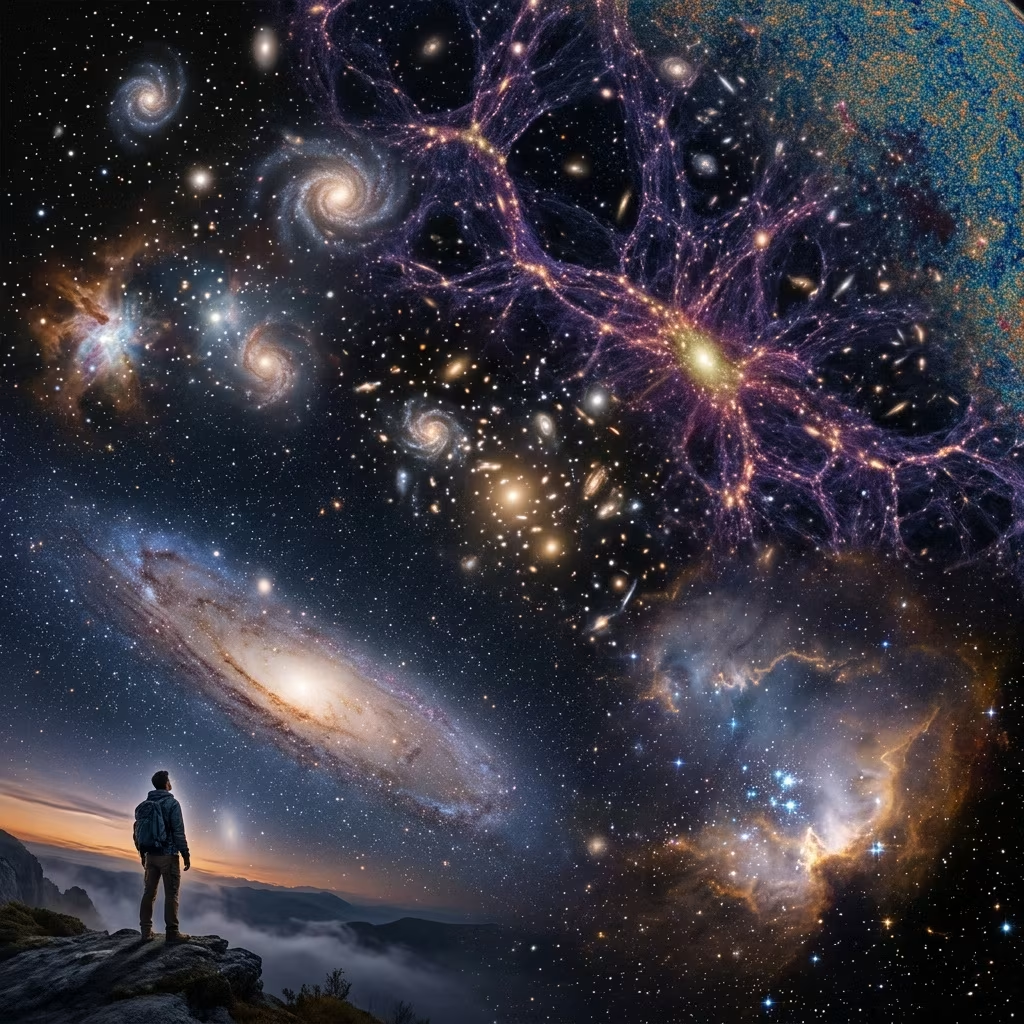
On the largest scales, matter is distributed in a vast web. This cosmic web features filaments of galaxies and clusters separated by huge voids. The biggest structures include:
- Galaxy Clusters: Hundreds or thousands of galaxies bound by gravity.
- Superclusters: Collections of galaxy clusters, like the Virgo and Laniakea superclusters.
- Cosmic Filaments: Massive thread-like structures composed of galaxies, clusters, and intergalactic gas.
- Voids: Regions with very few galaxies, sometimes hundreds of millions of light-years across.
This distribution makes the large-scale universe look like a foam or sponge, with dense threads interconnecting vast empty spaces.
Origins and Expansion: The Big Bang
Current cosmological consensus holds that the universe began about 13.8 billion years ago in the Big Bang. This event was not an explosion in space, but the rapid expansion of space itself. All of space, time, matter, and energy originated from a hot, dense state, then expanded and cooled to form the universe as we see it today.
- Expansion: The universe continues to expand, carrying galaxies apart.
- Accelerated Expansion: Observations show expansion is speeding up, attributed to a mysterious substance called dark energy.
- No Center, No Edge: Expansion takes place everywhere; every observer sees distant galaxies receding.
What Lies Beyond the Observable?
While the observable universe is defined by the age of light that can reach us, many cosmologists believe the universe continues far beyond this horizon. Some theories even propose infinite space — though we may never be able to confirm or explore these regions.
- Multiverse Hypothesis: Some theories suggest our universe is one of many “bubbles” in a larger multiverse.
- Shape and Geometry: Measurements indicate the overall geometry of the universe is remarkably flat, consistent with infinite or incredibly vast size.
- Observable Limits: Physical laws mean that information outside our observable limits will never reach us, restricting direct study.
Ultimately, the mystery of what lies beyond — both in terms of physical size and conceptual boundaries — is a frontier of ongoing research and philosophical debate.
Frequently Asked Questions (FAQs)
Q: What is meant by the ‘observable universe’?
A: The observable universe is the region of space from which light has reached Earth since the Big Bang, currently calculated as about 93 billion light-years in diameter.
Q: Is there an edge to the universe?
A: There is no known edge. The universe is either infinite or so large that our observable horizon is far smaller than its actual expanse. What we call the ‘edge’ is the limit of what we can observe, not a literal boundary.
Q: How do astronomers measure vast distances?
A: Astronomers use methods such as parallax (for nearby stars), standard candles (like supernovae), and redshift (for very distant galaxies) to track and calculate distances across space.
Q: Did the universe always exist?
A: Scientific consensus is that the universe began approximately 13.8 billion years ago in the Big Bang. There was no ‘before’ in the traditional sense because time itself began with the universe.
Q: What is beyond the observable universe?
A: The region beyond the observable universe is inaccessible to us; we can theorize about its properties, but cannot observe or receive information from those locations.
Key Takeaways
- The observable universe is about 93 billion light-years wide, but the actual size may be infinite.
- We measure cosmic distances with methods like parallax, standard candles, and redshift.
- No center or edge exists; expansion occurs everywhere.
- Our universe is filled with enormous structures and mysteries, both visible and forever hidden beyond our observational reach.
References
- https://en.wikipedia.org/wiki/Size_of_the_universe
- https://en.wikipedia.org/wiki/Universe
- https://www.skyatnightmagazine.com/space-science/how-big-universe
- https://science.nasa.gov/universe/exoplanets/our-milky-way-galaxy-how-big-is-space/
- https://www.space.com/astronomy/astronomers-turn-up-missing-matter-in-the-largest-structures-in-the-cosmos-the-models-were-right
- https://www.youtube.com/watch?v=pSHVbLPWA28
- https://www.nasa.gov/science-research/astrophysics/how-big-is-space-we-asked-a-nasa-expert-episode-61/
- https://www.zmescience.com/feature-post/space-astronomy/cosmology/how-big-is-the-universe/
- https://www.youtube.com/watch?v=cKRfIx4XthA
- https://www.astronomy.com/science/how-immense-is-the-universe/
- https://bigthink.com/starts-with-a-bang/comprehend-size-universe/
- https://www.astronomy.com/science/size-of-the-universe/
- https://astrobackyard.com/how-big-is-the-universe/
- https://astronomyexplained.com/how-big-is-the-universe-exploring-space/
- https://bigthink.com/starts-with-a-bang/how-large-universe/
- https://serious-science.org/the_size_of_the_universe-8186