Asteroid 2024 YR4: A Significant Potential Earth Impact Risk
Asteroid 2024 YR4 is a recently discovered near-Earth object (NEO) generating significant attention from the planetary science community. With current estimates suggesting a 1-in-83 chance of impacting Earth on December 22, 2032, it temporarily ranks among the highest-risk asteroids ever detected, prompting astronomers and space agencies worldwide to prioritize its observation and risk analysis.
Discovery and Size of Asteroid 2024 YR4
2024 YR4 was first identified in late December 2024 by the ATLAS (Asteroid Terrestrial-impact Last Alert System) — an international four-telescope survey focused on finding and tracking NEOs. According to initial data, 2024 YR4 measures between 40 and 100 meters wide, with more recent estimates suggesting a mean diameter of approximately 196 feet (60 meters). This makes it comparable in length to half a football field.
- Current distance from Earth: 27 million miles.
- Closest predicted approach in 2032: 66,000 miles (106,200 kilometers) from Earth.
- Orbital uncertainties mean a direct hit cannot be ruled out yet.
- Size uncertainty: Estimates range from 130 to 330 feet.
Risk Assessment: Odds and Rankings
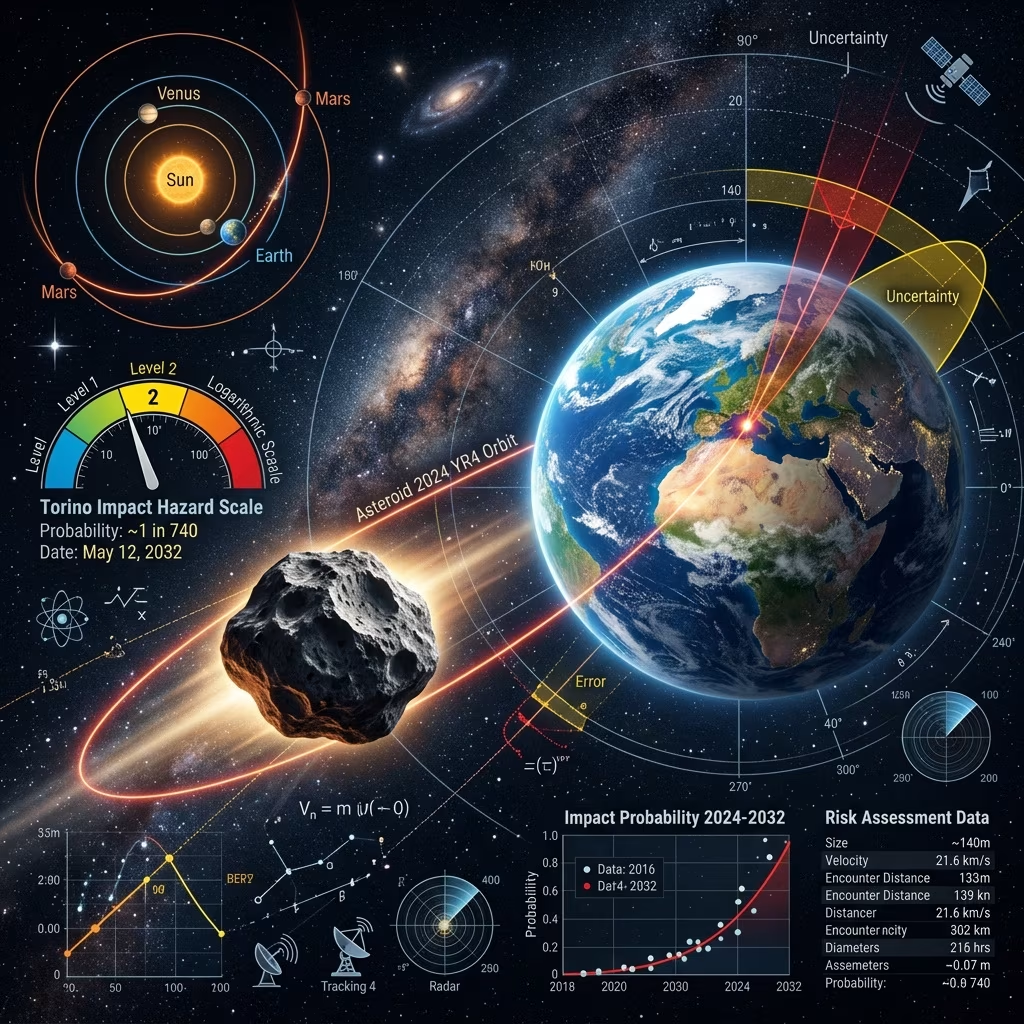
The odds of asteroid 2024 YR4 impacting Earth in 2032 have fluctuated since its discovery, with probabilities ranging from 1.3% (about 1-in-83) to a reported peak of up to 2% in early assessments. This places the asteroid at the top of the European Space Agency’s NEO Risk List and NASA’s Sentry Risk Table, a rare position for any NEO.
| Ranking System | Current Status | Implications |
|---|---|---|
| Torino Scale | Level 3 | Close encounter; requires attention; >1% chance of impact |
| ESA NEO Risk List | Top ranked | Highest known current risk from a sizeable object |
| NASA Sentry Table | Priority object | Ongoing updates as observations improve |
- Torino Scale: A rating of 3 signals an event rare for substantial asteroids, requiring close observation and media attention.
Potential Impact: Effects on Earth
If 2024 YR4 were to strike Earth, the consequences would be regionally catastrophic, though not globally extinction-causing. The primary risks depend on whether the asteroid explodes in the sky (an “airburst”) or survives to create a ground impact crater.
- Explosion energy: Estimated up to 8 million tons of TNT.
- Blast comparison: Equivalent to 500 Hiroshima bombs.
- Severe blast radius: Up to 45 kilometers (28 miles) from impact site.
- Airburst or impact crater: Dependent on speed, composition, and entry angle.
Similar events include the 2013 Chelyabinsk meteor in Russia, which exploded above the ground releasing energy equivalent to 500,000 tons of TNT and caused widespread damage, though no fatalities.
Uncertainties and the Need for Further Observation
Despite current predictions, the orbit of 2024 YR4 contains significant uncertainty due to its recent discovery and incomplete data set. The chance of impact is expected to decline as more precise orbital calculations become available and follow-up observations accumulate.
- Orbit refinement: Ongoing astronomer efforts aim to clarify trajectory.
- Data sources: ATLAS survey, NASA’s Center for Near-Earth Object Studies (CNEOS), and amateur astronomers.
- Public simulations: Shared by enthusiasts and professionals alike to educate and model scenarios.
Amateur astronomer Tony Dunn published orbital simulations demonstrating possible close approaches and the impact of measurement uncertainties on event probability.
Comparing Asteroid 2024 YR4 to Apophis
| Asteroid Name | Date of Notable Risk | Initial Impact Probability | Torino Scale | Current Threat Level |
|---|---|---|---|---|
| 2024 YR4 | Dec 22, 2032 | 1.3–2% (1-in-83 to 1-in-50) | 3 | Highest known active threat |
| 99942 Apophis | 2029, 2036 | ~2.7% (initial) | 4 (then 0) | Risk essentially eliminated after further study |
Apophis, discovered in 2004, initially posed a slightly higher threat before updated data ruled out any possibility of impact for the foreseeable future. This historical precedent underlines the importance of gathering additional observations for 2024 YR4 before drawing final conclusions.
Planetary Defense: Responses and Preparedness
Attention to NEOs like 2024 YR4 has driven advances in planetary defense planning and international cooperation. While the current threat does not warrant panic, both NASA and ESA continue to invest in technologies and protocols for detecting, tracking, and — if ever necessary — deflecting or disrupting hazardous objects.
- Global monitoring via specialized surveys (e.g., ATLAS, Pan-STARRS).
- Risk assessment models: Used to prioritize observation time and public engagement.
- Development of kinetic impactors, gravity tractors, and other mitigation strategies in worst-case scenarios.
- Public education and early warning systems coordinated via the International Asteroid Warning Network.
The Importance of Ongoing Observation Efforts
As with previous risk-category asteroids, 2024 YR4’s fate hinges on continued data collection and international collaboration. Every new measurement reduces uncertainty regarding orbit path, size, and composition — crucial elements for accurate risk modeling.
- Existing systems are designed to issue alerts when new NEO threats are found.
- Crowdsourced data and amateur contributions play an increasing role in event analysis.
- Media attention and simulation sharing help raise awareness and preparedness among global communities.
Ultimately, experts anticipate the odds of an Earth collision will decrease with improved measurement, but each new object—and each new close pass—reminds humanity of our cosmic vulnerability.
Key Takeaways and What Comes Next
- 2024 YR4 currently poses the highest impact risk among all known sizeable asteroids, but this risk is expected to be refined downwards over time.
- Potential impact in 2032 would be locally devastating, though not globally catastrophic.
- Observation and tracking will continue for years, with decisive updates expected as astronomers chart the NEO’s orbit.
- Planetary defense strategies are improving, but public engagement and awareness remain essential.
Frequently Asked Questions (FAQs)
Q: What is asteroid 2024 YR4, and why is it notable?
A: 2024 YR4 is a near-Earth asteroid approximately 40–100 meters wide. Its projected close approach to Earth in December 2032, with a small but significant chance of impact, has placed it at the top of planetary risk charts.
Q: How likely is 2024 YR4 to hit Earth?
A: Current estimates suggest a 1-in-83 chance (about 1.3%) of impact, ranking it as one of the most concerning asteroids detected. This probability is expected to decrease as more data becomes available.
Q: What would happen if 2024 YR4 struck Earth?
A: The impact could release about 8 million tons of TNT energy, equivalent to 500 Hiroshima bombs, causing severe damage up to 45 kilometers from the site. Depending on entry angle, it could explode in the atmosphere (airburst) or create a crater.
Q: What is the Torino Scale rating of 2024 YR4, and what does it mean?
A: Asteroid 2024 YR4 is rated a 3 on the Torino Scale, which calls for close monitoring and indicates a greater than 1% impact probability requiring media and scientific attention.
Q: Is there anything that can be done if the asteroid’s risk doesn’t decrease?
A: For cases where impact remains possible, international planetary defense strategies include disruption, deflection, and evacuation measures. Most likely, improved tracking will eliminate significant concern before this is necessary.
Conclusion: Vigilance and Scientific Response
The case of 2024 YR4 is a timely illustration of the importance of global vigilance against cosmic hazards. Although the impact odds are slim and likely to drop with further study, its initial ranking underscores the necessity for robust observation networks, transparent risk communication, and ongoing refinement of planetary defense techniques. As the world watches and astronomers continue their work, our understanding of both asteroid risks and our capacity to respond will improve.
References
- https://www.space.com/180-foot-asteroid-1-in-83-chance-hitting-Earth-2032
- https://science.nasa.gov/solar-system/asteroids/2024-yr4/
- https://science.nasa.gov/blogs/planetary-defense/2025/02/24/latest-calculations-conclude-asteroid-2024-yr4-now-poses-no-significant-threat-to-earth-in-2032-and-beyond/
- https://neo.ssa.esa.int/risk-list
- https://en.wikipedia.org/wiki/99942_Apophis
- https://www.youtube.com/watch?v=31zgxGXm7VQ
- https://en.wikipedia.org/wiki/Asteroid_impact_avoidance
- https://www.science.org/content/article/asteroid-may-collide-earth-7-years-though-impact-risk-low
- https://www.youtube.com/watch?v=swOcV6XWAUk
- https://www.livescience.com/space/asteroids/thats-zero-folks-asteroid-2024-yr4-is-no-longer-a-hazard
- https://www.cbsnews.com/news/asteroid-2024-yr4-chance-hit-earth-what-to-know/
- https://www.aip.org/news-and-analysis/aas/newly-discovered-asteroid-has-slight-chance-of-earth-impact-in-2032
- https://www.techspot.com/news/106548-asteroid-half-size-football-field-has-1-83.html
- https://www.skyatnightmagazine.com/space-science/chances-asteroid-hitting-earth