The Moon has fascinated humanity for millennia, shaping cultures, calendars, and science itself. This detailed guide illuminates the Moon’s mysterious origins, unique material makeup, dramatic surface features, its mesmerizing phases, and the intricacies of its journey around Earth.
How Did the Moon Form?
Scientists have proposed several theories about the Moon’s formation, but in recent decades, a consensus has emerged around the giant-impact hypothesis.
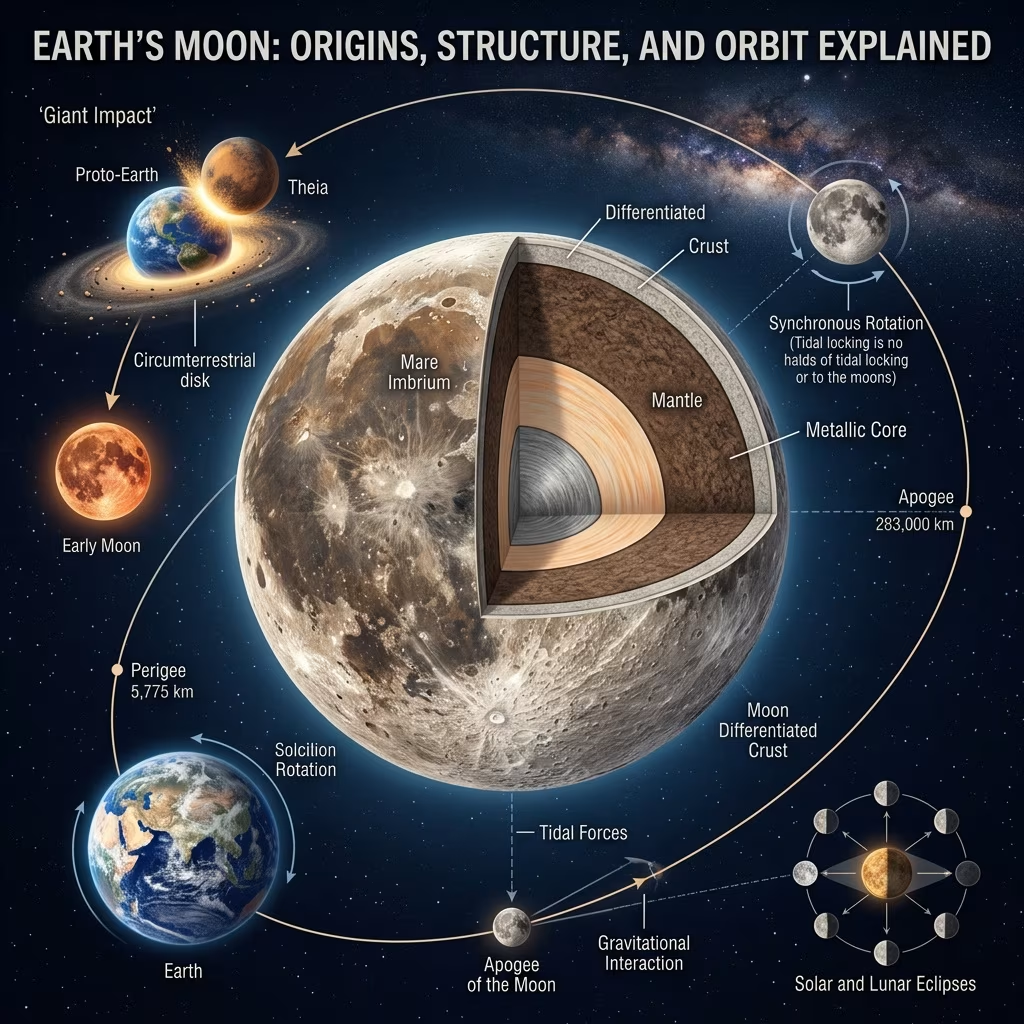
- Giant-Impact Hypothesis: Earth was struck by a Mars-sized object, often called Theia, roughly 4.5 billion years ago. The colossal collision ejected vast amounts of material from both bodies into Earth’s orbit, which then coalesced under gravity to form the Moon.
- Alternative Theories: Other ideas, like the Moon forming elsewhere and being captured by Earth, or both Earth and Moon co-forming together from the same cloud of material, have largely been discounted due to inconsistencies with current evidence.[10]
Recent computer simulations and geochemical evidence reinforce the idea that the Moon’s composition closely matches Earth’s upper layers, supporting the giant-impact origin.
Variants and Challenges to the Giant-Impact Model
- Compositional Similarity: Lunar rocks brought back from the Apollo missions show an oxygen isotope ratio nearly identical to Earth’s. This similarity is hard to explain if most lunar material came from the impactor, but can be reconciled if there was substantial mixing of materials or if Theia was itself similar to Earth in makeup.[11]
- Multiple Impacts Hypothesis: Some researchers propose that the Moon formed from the debris of several massive collisions, merging smaller moonlets over time.[11]
- Synestia Model: A recently suggested model posits that the impact generated a short-lived, vaporized, donut-shaped mass (a synestia), inside which the Moon coalesced.
While details are still debated, the giant-impact scenario remains the leading explanation.
Moon Facts at a Glance
| Attribute | Value |
|---|---|
| Average Diameter | 3,474 km (2,159 miles) |
| Mean Distance from Earth | 384,400 km (238,855 miles) |
| Orbital Period (Sidereal) | 27.3 days |
| Orbital Eccentricity | 0.0549 |
| Surface Gravity | 1.62 m/s² (about 1/6 of Earth’s) |
| Surface Temperature Range | About -173°C to 127°C (-280°F to 260°F) |
| Atmosphere | None (Exosphere only) |
The Moon’s Internal Structure
The Moon is a differentiated body, meaning its elements have separated into distinct layers:
- Crust: A thin outer layer, primarily anorthosite in the highlands, about 30-40 km thick on average.
- Mantle: The thickest layer, composed mostly of silicate minerals, extending to about 1,000 km deep.
- Core: The innermost part, partially molten and relatively small, consisting of iron, nickel, and sulfur. The core is estimated to span about 1-2% of the Moon’s mass.[10]
This internal chemistry, less iron-rich than Earth’s, suggests the processes of lunar formation and differentiation were distinct from our planet’s.
Moon’s Surface Features
The Moon’s surface showcases a dramatic and varied geological landscape:
- Maria (“Seas”): Dark, basaltic plains. They formed from ancient volcanic eruptions and cover about 16% of the Moon’s surface, mostly on the near side.
- Highlands: Lighter, heavily cratered regions made primarily of anorthosite. These are older than the maria and dominate the far side.
- Craters: Created by billions of years of asteroid and meteorite impacts. Notable craters include Tycho, Copernicus, and Clavius.
- Rilles and Ridges: Features formed by ancient volcanic or tectonic activity.
- Regolith: A blanket of loose dust, rocks, and particles covering the surface, produced by constant meteorite bombardment.[10]
Why Does the Moon Have Phases?
The Moon does not emit its own light; instead, we see sunlight reflected off its surface. Lunar phases are the result of observing the lit portion of the Moon from Earth as it orbits our planet. The dynamic arrangement of the Sun, Earth, and Moon produces the predictable cycle of phases over about a 29.5-day synodic month:
- New Moon: The Moon is between Earth and the Sun; its near side is in darkness.
- Waxing Crescent: A sliver of the Moon’s right side begins to illuminate.
- First Quarter: The right half is illuminated.
- Waxing Gibbous: More than half but not yet full.
- Full Moon: The entire face visible from Earth is illuminated.
- Waning Gibbous: Illumination begins shrinking from the right.
- Last Quarter: The left half is visible.
- Waning Crescent: Only a sliver on the left remains illuminated.
This phase progression repeats each month. The actual length between similar phases (synodic month) is longer than the Moon’s orbital period with respect to the stars (sidereal month) because of Earth’s simultaneous motion around the Sun.[10]
How the Moon Orbits Earth
The Moon orbits Earth in an elliptical, slightly tilted path and is gravitationally locked, always showing us the same face.
- Orbit Period: About 27.3 days (sidereal), but the observed phase cycle (synodic month) is about 29.5 days.
- Distance: Its distance from Earth varies from ~356,500 km (perigee) to ~406,700 km (apogee).
- Tidal Locking: The Moon rotates on its axis once every orbit, resulting in the same side (the near side) always facing Earth.
- Orbital Inclination: The Moon’s orbit is inclined about 5 degrees relative to Earth’s orbital plane, accounting for the rarity of lunar and solar eclipses.[10]
Earth-Moon System: Unique Among Planets
- Large Relative Size: The Moon is large compared to Earth—over a quarter the diameter and about 1/81 the mass of our planet. This is an unusually large ratio among planet–satellite systems in the solar system.
- Mutual Tides: The gravitational tug-of-war between Earth and Moon raises tides on both bodies, gradually slowing Earth’s rotation and causing the Moon to drift about 3.8 cm farther from Earth each year.
Exploring the Far Side and Lunar Mystery
The Moon’s far side (often called the “dark side,” though it receives sunlight) remained unseen by humans until the Soviet Luna 3 probe photographed it in 1959. Notably, the far side has a much thicker crust and far fewer maria compared to the near side. The reasons for these dramatic differences are still being studied and may relate to heat distribution after formation, variations in impact rates, or composition of the primordial disk.
Composition: What Is the Moon Made Of?
- Oxygen, Silicon, Magnesium, Iron: These are the dominant elements, bound mostly in silicate minerals such as pyroxene and olivine. The Moon’s composition is quite similar to Earth’s mantle.
- Trace Elements: Titanium, aluminum, and calcium are present; the near side’s maria are especially rich in titanium compared to the highlands.
- Volatiles: The lunar surface is extremely poor in water and other volatiles—though recent missions have found ice in shadowed craters at the poles.
This similarity to Earth supports the hypothesis that the lunar material originated from Earth’s outer layers ejected during a massive impact.
The Moon’s Role in Earth’s History
- Tides: The Moon’s gravity is the main driver of Earth’s ocean tides, influencing marine life and coastal habitats.
- Stabilizing Tilt: By exerting gravitational pull, the Moon stabilizes Earth’s axial tilt, which moderates seasons and climate over long timescales.
- Astronomical Reference: Ancient and modern calendars are based on the Moon’s phases and orbital cycles.
- Scientific Frontier: Lunar geology is a window into the early history of the solar system, with many surface features remaining unchanged for billions of years due to lack of an atmosphere, water, and tectonics.
Past and Future Exploration
From the first telescopic observations to robotic landings and human exploration, the Moon has been a focus for scientific and technological progress.
- Apollo Missions: From 1969 to 1972, six successful Apollo landings brought back 382 kg of lunar rocks, revolutionizing our knowledge of lunar formation and evolution.
- Unmanned Missions: Luna, Surveyor, Chang’e, and other missions have mapped, sampled, and examined the lunar environment.
- Current and Future Plans: Renewed interest in lunar landings, resource utilization, and lunar bases are driving a new era of lunar exploration, targeting both scientific goals and as a stepping stone to Mars and beyond.
Frequently Asked Questions (FAQs)
Q: How old is the Moon?
A: The Moon is estimated to be about 4.5 billion years old, forming soon after Earth in the aftermath of a colossal impact event.
Q: Why do we always see the same side of the Moon?
A: The Moon is tidally locked—it rotates once on its axis for each orbit around Earth, resulting in the same hemisphere always facing our planet.
Q: Is there water on the Moon?
A: While the surface is extremely dry, NASA and other missions have detected water ice in permanently shadowed craters at the lunar poles, sparking interest in future resource use.
Q: What causes lunar eclipses?
A: Lunar eclipses occur when Earth passes directly between the Sun and the Moon, casting a shadow on the lunar surface. The reddish tint during a total eclipse arises when Earth’s atmosphere scatters blue light, letting through only red wavelengths.
Q: Will the Moon ever leave Earth’s orbit?
A: The Moon is gradually moving away from Earth at about 3.8 cm per year. Over billions of years, this will alter tides and lunar phases, but the Moon will remain gravitationally bound to Earth for the foreseeable future.[10]
Summary Table: Key Comparisons
| Feature | Earth | Moon |
|---|---|---|
| Average Diameter | 12,742 km | 3,474 km |
| Surface Gravity | 9.81 m/s² | 1.62 m/s² |
| Main Atmospheric Components | Nitrogen, Oxygen | None (Exosphere) |
| Dominant Surface Features | Oceans, Continents | Maria, Highlands, Craters |
| Days for One Rotation | 1 (24 hours) | 27.3 (synchronous with orbit) |
References
- This article is based on the latest lunar science as of 2025, referencing major NASA and academic sources alongside geological evidence from Apollo, Luna, and other missions.
References
- https://science.nasa.gov/moon/formation/
- https://science.nasa.gov/moon/
- https://news.uchicago.edu/explainer/formation-earth-and-moon-explained
- https://en.wikipedia.org/wiki/Origin_of_the_Moon
- https://en.wikipedia.org/wiki/Giant-impact_hypothesis
- https://www.lpi.usra.edu/education/explore/marvelMoon/background/moon-formation/
- https://www.ucdavis.edu/news/how-moon-formed-inside-vaporized-earth-synestia
- https://www.nhm.ac.uk/discover/how-did-the-moon-form.html
- https://pmc.ncbi.nlm.nih.gov/articles/PMC6476314/
- https://www.britannica.com/place/Moon/Origin-and-evolution
- https://www.space.com/35258-earth-moon-formed-in-moonlet-mashup.html
- https://www.youtube.com/watch?v=Ll_2i_PmP6M
- https://www.sciencenews.org/article/earth-moon-formation-impact
- https://www.lpi.usra.edu/education/moonPosters/Poster1/Poster-1-back-compliant.pdf
- https://www.livescience.com/57435-earth-moon-formed-in-moonlet-mashup.html
- https://arxiv.org/pdf/1608.08959.pdf
- https://www.pas.rochester.edu/~blackman/ast104/moon_formation.html
- https://phys.org/news/2025-01-moon-chunk-ejected-earth-formation.html