NASA’s Lunar Trailblazer: An Ambitious Mission Ends in Silence
In February 2025, NASA launched the Lunar Trailblazer, a compact and cost-effective orbiter, as part of its ongoing efforts to unravel mysteries of lunar water. Hopes were high for the $94-million mission, which sought to help future moon explorers by mapping and characterizing water reserves on the Moon’s surface. However, what began as a promising endeavor ultimately ended in heartbreak after a series of technical setbacks and failed recovery attempts.
Mission Overview: What Was Lunar Trailblazer?
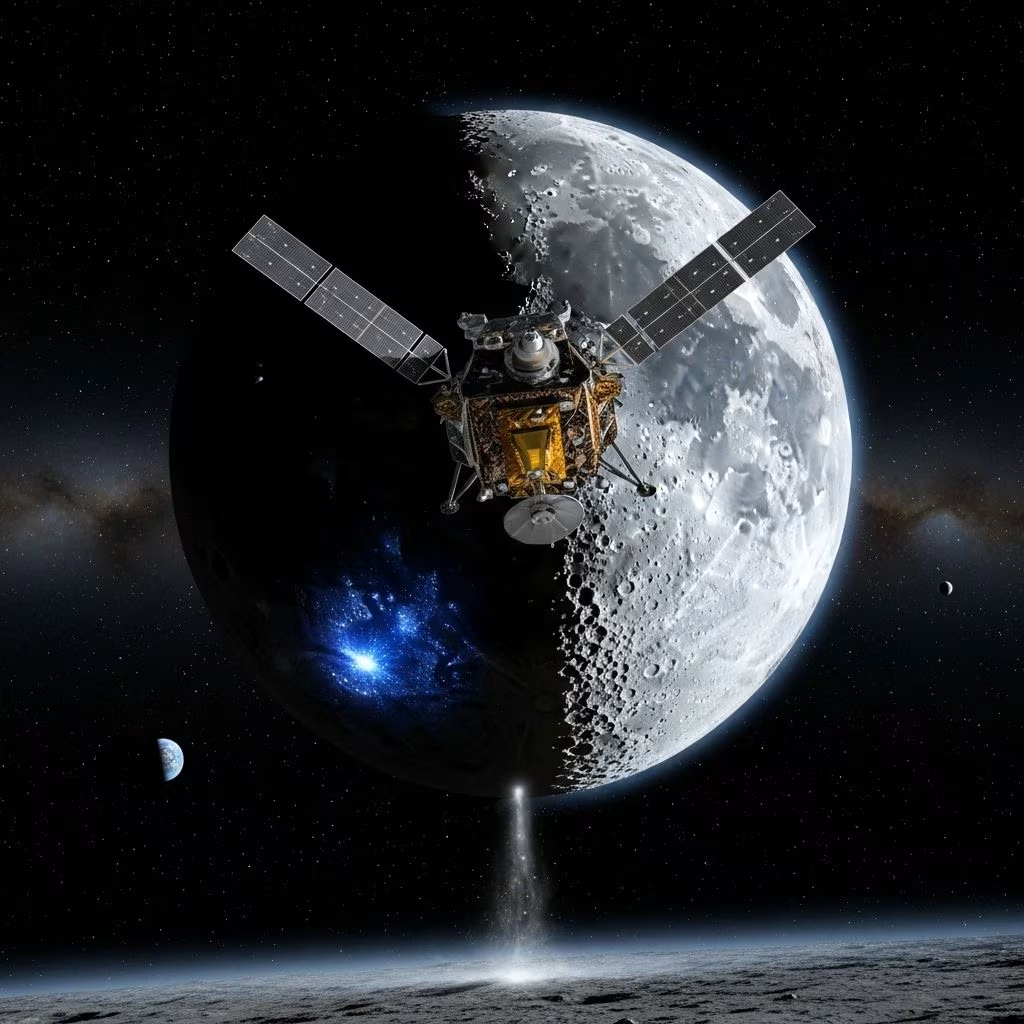
The Lunar Trailblazer was a 200-kilogram orbiter designed under NASA’s Small Innovative Missions for Planetary Exploration (SIMPLEx) program. Its primary science objective was to thoroughly map, characterize, and quantify water deposits—both in ice and molecular form—at the Moon’s surface. Scientists hoped this data would provide vital support for future human and robotic lunar missions, especially those aiming for long-term habitation.
- Launched: February 26, 2025 (aboard a SpaceX Falcon 9 on the IM-2 rideshare mission)
- Developer: NASA, in collaboration with Caltech’s IPAC and Lockheed Martin Space
- Goal: Map lunar water for use by future missions
- Orbit: Intended to enter a robust lunar orbit for extended mapping
The Launch: High Hopes and Early Successes
Trailblazer separated from its carrier rocket about 38–48 minutes after launch and rapidly established initial contact thanks to an Earth-based team at Caltech’s IPAC in Pasadena. The early hours following launch looked optimistic; engineers received initial telemetry, suggesting all systems were nominal.
Rideshare Environment
Lunar Trailblazer was a secondary payload, hitching a ride as part of IM-2—a commercial lunar payload mission by Intuitive Machines. This cost-effective launch strategy placed several spacecraft en route to the Moon simultaneously, including the Polar Resources Ice Mining Experiment (PRIME), which landed and operated for a brief but successful 10-hour period due to solar recharge limitations.
Crisis Strikes: Sudden Loss of Communication
- Initial Contact: Successful, post-launch via Caltech’s IPAC
- Problem: By early morning the next day, communication ceased
- Root Cause: Intermittent power system failures caused the orbiter to spin uncontrollably, preventing its solar panels from facing the Sun and disabling battery recharge
As the spacecraft tumbled through space, NASA engineers and mission specialists soon realized that Lunar Trailblazer might not recover. Keeping the solar panels oriented toward the Sun was critical for the vehicle’s survival; with batteries drained, communication was lost within 24 hours of separation.
Months of Troubleshooting and Recovery Attempts
NASA’s teams at Jet Propulsion Laboratory (JPL), Caltech, and Lockheed Martin Space did not give up easily. For months, throughout spring and summer, efforts persisted, involving:
- Continuous monitoring by NASA’s Deep Space Network and international space observatories
- Attempts to predict and leverage optimal sunlight conditions that might allow a battery recharge
- Alternative recovery plans for remote troubleshooting in case contact was restored
Nicky Fox, Associate Administrator at NASA’s Science Mission Directorate, summed up the spirit with, “At NASA, we undertake high-risk, high-reward missions like Lunar Trailblazer to find revolutionary ways of doing new science.” However, the consistent silence was a persistent reminder of the mission’s fate.
The Final Outcome: Declaring the Mission Dead
Despite determined recovery efforts, Trailblazer drifted far beyond the Moon’s gravitational influence, tumbling ever more slowly and eventually moving too far for ground teams to send commands or receive telemetry. On July 31, 2025, NASA officially terminated the mission, recognizing it could no longer yield scientific results.
- Date Declared Dead: July 31, 2025
- Status: Unresponsive and lost to deep space
The Trailblazer’s demise was a poignant moment amidst NASA’s push for sustainable lunar exploration and small, cost-sensitive science missions.
Scientific Impacts and Lessons Learned
The loss of Lunar Trailblazer created a gap in projected lunar water mapping, which was a cornerstone of NASA’s Artemis program and future resources management. Still, Trailblazer’s mission provided crucial lessons for the design, deployment, and support of small-scale, high-risk scientific instruments.
Key Scientific Objectives (Unrealized)
- High-resolution mapping of water ice and minerals on the lunar surface
- Support for locating water resources for future lunar bases
- Improved science of lunar hydrology and the Moon’s water cycle
Table: Trailblazer’s Mission Timeline and Events
| Date | Event | Status/Outcome |
|---|---|---|
| Feb 26, 2025 | Launch aboard SpaceX Falcon 9 as IM-2 rideshare | Success |
| Feb 26-27, 2025 | Initial separation and communication | Successful telemetry and contact |
| Feb 27, 2025 | Loss of communications | Intermittent power failures reported |
| Spring-Summer 2025 | Attempts to recover and troubleshoot | No contact; orbiter drifts into deep space |
| July 31, 2025 | NASA officially ends mission | Mission declared dead |
Roots of the Failure: Technical Analysis
Post-mortem investigations described the pivotal issue as a power system failure. Intermittent battery and solar panel operation meant spacecraft attitude (orientation) was lost, so it could neither generate nor store power.
- Tumbling spacecraft prevented solar panels from collecting sunlight
- Dead batteries meant critical onboard systems could not operate
- No suitable remote reset due to lack of communication
Broader Implications for Lunar Missions
NASA’s experience with Lunar Trailblazer led to several key recommendations and insights for future missions:
- Importance of robust, redundant power and attitude controls for small spacecraft
- Need for enhanced mission planning for rideshare deployments and early-orbit contingencies
- Recognition of high-risk, high-reward nature of innovative science missions
- Value of cross-team, international monitoring in troubleshooting spacecraft distress
Quote from NASA Leadership
“While it was not the outcome we had hoped for, mission experiences like Lunar Trailblazer help us to learn and reduce the risk for future, low-cost small satellites to do innovative science as we prepare for a sustained human presence on the moon.” — Nicky Fox, NASA Science Mission Directorate
Trailblazer in Context: NASA’s Lunar Ambitions
The Trailblazer mission was one of several ongoing NASA and commercial efforts directed at the Moon. The United States is keen on returning humans to lunar orbit and eventually establishing long-term lunar bases. Water is a critical ingredient—not only for human consumption but for creating fuel and sustaining life.
- Support for Artemis Program: Lunar Trailblazer’s intended data would have supported Artemis and future crewed surface missions
- Parallel Missions: Other rideshare missions, such as the PRIME experiment, offer valuable data, though limited by hardware failures
SIMPLEx and Small Satellite Programs
The SIMPLEx program, under which Lunar Trailblazer was developed, aims to produce affordable, fast-turnaround planetary exploration missions. These efforts are vital for rapid advancement in space science, though they also carry elevated risk due to their experimental nature and cost-saving design choices.
- Advantages: Enables frequent launches, diverse science, and cost-effective access to lunar and planetary environments
- Challenges: Lower cost can mean higher vulnerability to technical failure, faster mission cadence, and less redundancy
Frequently Asked Questions (FAQs)
Q: What was the main goal of the Lunar Trailblazer mission?
A: The primary goal was to map and characterize water on the lunar surface, including locating water ice deposits to help support future exploration and habitation.
Q: Why did the Lunar Trailblazer mission fail?
A: The orbiter suffered intermittent power system failures, causing it to spin uncontrollably and lose its ability to collect sunlight for battery recharge. This led to the loss of communication and inability to control critical spacecraft systems.
Q: Did the mission yield any usable data or discoveries?
A: No significant scientific data were returned, as communication was lost before the orbiter could begin mapping operations.
Q: What will NASA do differently in future small satellite missions?
A: NASA plans to improve redundancy in spacecraft systems, strengthen early mission-phase protocols, invest in backup communications strategies, and apply lessons from Trailblazer to design and operation.
Q: Are other lunar water missions planned?
A: Yes, NASA and international partners have several upcoming missions aiming to survey and harness lunar resources, including water mapping and mining experiments tailored for future human lunar bases.
Conclusion: Legacy and Future Directions
NASA’s Lunar Trailblazer, while unsuccessful, stands as a vital lesson in the evolution of space exploration. Its ambitious science goals reinforced the necessity of lunar water mapping, and its technical breakdown underlined the challenges of small satellite missions in hostile environments. The mission has already begun to inform future hardware, operations, and science plans, helping NASA and its partners minimize risks and maximize innovative outcomes in the next generation of lunar exploration.
In the pursuit of knowledge, not every mission will succeed. Trailblazer’s story reminds us that science thrives on both discovery and experience, and every setback is a step closer to unlocking the secrets of the Moon.
References
- https://www.nasa.gov/missions/small-satellite-missions/lunar-trailblazer/nasas-lunar-trailblazer-moon-mission-ends/
- https://www.space.com/space-exploration/missions/nasa-declares-troubled-lunar-trailblazer-moon-orbiter-dead
- https://www.jpl.nasa.gov/news/nasas-lunar-trailblazer-moon-mission-ends/
- https://www.theregister.com/2025/08/05/lunar_trailblazer_dead/
- https://timesofindia.indiatimes.com/etimes/trending/nasas-94-million-lunar-trailblazer-mission-ends-in-silence-after-launch-failure/articleshow/123140542.cms
- https://opentools.ai/news/nasas-lunar-trailblazer-mission-loses-contact-ends-prematurely
- https://www.youtube.com/watch?v=CjjvhNS8R0Q
- https://www.upi.com/Science_News/2025/08/04/NASA-Lunar-Trailblazer-mission-ends-no-moon-mapping/8681754344840/
- https://www.webpronews.com/nasas-lunar-trailblazer-mission-lost-to-power-system-failure/
- https://www.youtube.com/watch?v=fFY3Uos8RSE
- https://www.webpronews.com/nasas-lunar-trailblazer-mission-fails-after-power-loss/
- https://en.wikipedia.org/wiki/Lunar_Trailblazer
- https://hothardware.com/news/nasa-somber-update-lunar-trailblazer-moon-orbiter
- https://www.cnet.com/science/nasas-lunar-trailblazer-is-officially-lost-in-space-but-maybe-not-forever/
- https://www.theregister.com/2025/07/01/nasa_lunar_trailblazer_lost/
- https://hackaday.com/2025/07/15/the-fight-to-save-lunar-trailblazer/
- https://www.engadget.com/science/space/nasas-lunar-trailblazer-mission-ends-in-disappointment-201318932.html
- https://trailblazer.caltech.edu/news.html
- https://www.sciencedaily.com/releases/2025/08/250811094005.htm