Solar Flares Return: Three Powerful Eruptions End the Sun’s Calm
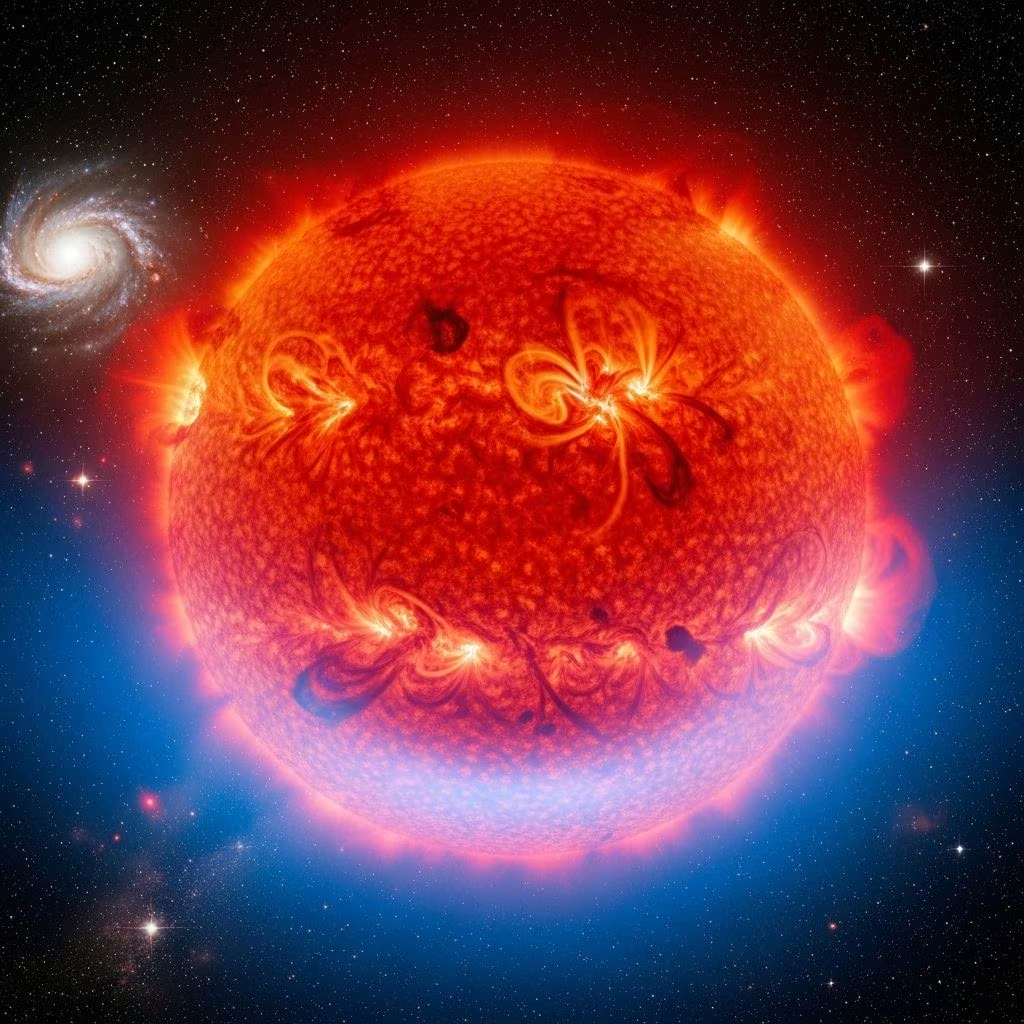
After a lengthy period of solar tranquility, the Sun unleashed a remarkable sequence of three major solar flares in just under 24 hours in September 2025. This extraordinary burst of solar activity broke several weeks of minimal flare events, quickly shifting the focus of the scientific community and skywatchers alike back to the dynamic phenomena that shape our space weather environment. These flares serve as potent reminders of the Sun’s unpredictable power and its impact on Earth’s technological infrastructure and daily life.
Overview: Recent Solar Activity
September 2025 began quietly for solar observers. Space weather forecasters noted several consecutive weeks with only minor flares and little geomagnetic disturbance. This period of calm followed an active phase earlier in the year, prompting many to speculate that the Sun had settled into a temporary lull.
However, seasoned observers know that the Sun is far from predictable. As the month progressed, scientists at observatories worldwide began to notice increased sunspot complexity and heightened magnetic flux in several active regions. On September 23, this brewing tension culminated in the eruption of three potent solar flares, delivering a dramatic end to the solar respite.
Chronicle of the Three Solar Flares
The sequence of eruptions unfolded rapidly:
- Flare #1 – Early morning, September 23: An active sunspot region unleashed a moderate-to-strong class solar flare. Instruments detected a surge in X-ray and ultraviolet emissions, with the initial blast sparking immediate shortwave radio blackouts across sunlit parts of the planet.
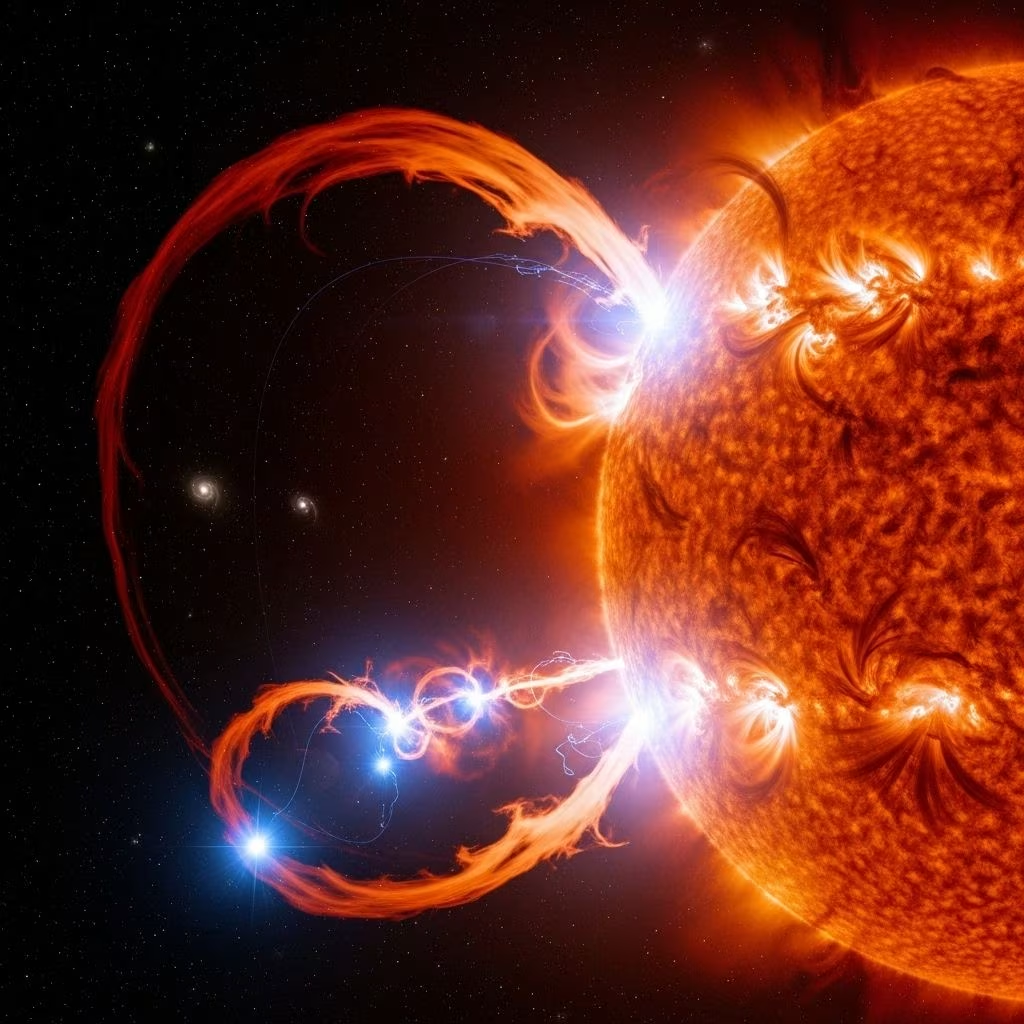
- Flare #2 – Midday, September 23: Less than six hours after the first, a second, more powerful flare erupted from the same region. This event was accompanied by a coronal mass ejection (CME), sending billions of tons of charged plasma racing toward Earth and raising geomagnetic storm alerts worldwide.
- Flare #3 – Early morning, September 24: The final eruption in this cluster occurred before dawn. The third flare reached a high level on the X-ray classification scale, with follow-up analysis confirming its potential to cause further radiowave disruptions and auroras at higher latitudes.
Each of these flares was classified according to the GOES X-ray classification system, which groups solar flares as A, B, C, M, or X, with X-class representing the most intense events. The second and third flares in this series reached the M- and low-X class thresholds, i.e., strong enough to disrupt communications and set off alarms for satellite operators and power utility managers.
Timeline Table: Solar Flare Cluster of September 2025
| Date & Time (UTC) | Region | GOES Flare Class | Immediate Effects |
|---|---|---|---|
| Sept 23, Morning | Active Sunspot (AR 13218) | M2.7 | High-frequency radio blackout |
| Sept 23, Midday | Active Sunspot (AR 13218) | X1.0 | CME toward Earth, geomagnetic storm alerts |
| Sept 24, Early AM | Active Sunspot (AR 13218) | M5.5 | Shortwave radio fadeouts, aurora warnings |
Understanding Solar Flares: Causes and Classifications
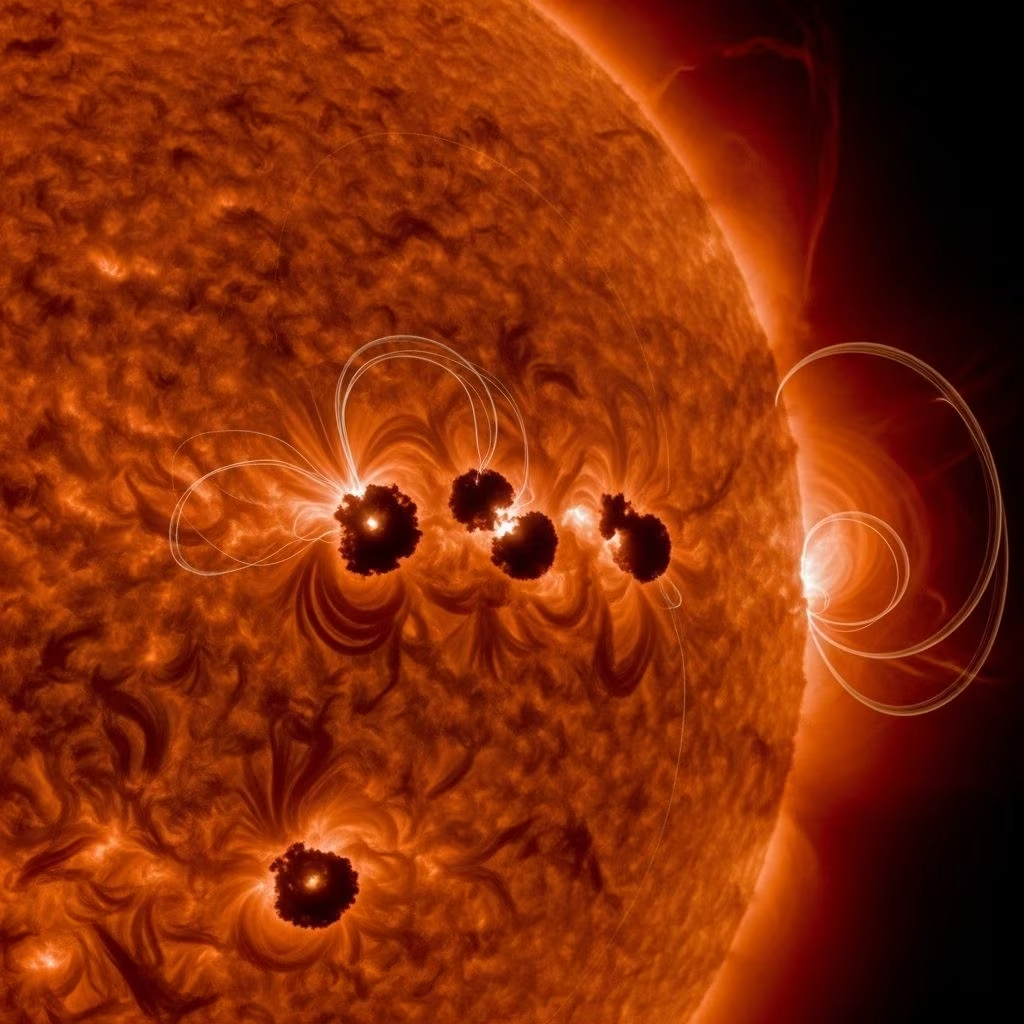
Solar flares are powerful flashes of electromagnetic radiation that erupt from the Sun’s surface and atmosphere. They originate in active regions, especially near sunspots, where intense magnetic energy is stored and can be explosively released.
The process can be broken down as follows:
- Energy Build-Up: Magnetic fields in sunspots twist and tangle.
- Instability Triggers: When the magnetic structure becomes unstable, often due to differential rotation or interaction between nearby regions, a sudden energy release occurs.
- Explosion: This process releases energy across the electromagnetic spectrum, particularly in X-ray, ultraviolet, visible, and radio wavelengths.
- Accompanying Phenomena: Flares are often associated with coronal mass ejections (CMEs), which fire enormous clouds of solar plasma into space at millions of kilometers per hour.
Solar flares are classified based on their X-ray brightness:
- C-class: Minor, with little noticeable impact on Earth.
- M-class: Moderate, can cause brief radio blackouts in polar regions and minor radiation storms.
- X-class: Major, potentially leading to widespread radio blackouts, intense radiation storms, and powerful geomagnetic storms.
Impacts of Solar Flares on Earth
Powerful solar flares unleash bursts of energy and high-speed particles that can interact with Earth’s magnetosphere, producing a variety of observable and technical effects:
- Auroras: Charged particles from solar eruptions collide with Earth’s atmosphere, lighting up the night sky with auroras that can sometimes be seen at much lower latitudes than usual.
- Radio Blackouts: Intense X-ray and UV radiation from flares can ionize the upper atmosphere, disrupting shortwave radio communications across the sunlit side of the planet.
- Satellite Disruptions: Flares and CMEs can interfere with satellite electronics, communication links, and even navigation systems like GPS.
- Power Grids: Major geomagnetic storms can induce currents in power lines, leading to voltage spikes, transformer damage, or even large-scale blackouts.
For example, space weather monitoring services issued G3 (strong) geomagnetic storm watches in response to these September 2025 flares, alerting satellite operators, aviation officials, and utility managers to prepare for potential impacts.
How Scientists Monitor & Predict Solar Activity
Observing the behavior of our star is a collaborative global effort. Methods and technologies used include:
- Solar Observatories: Space-based telescopes, such as the Solar Dynamics Observatory (SDO), scan the Sun around the clock for activity in multiple wavelengths.
- Ground-Based Telescopes: Networks of solar telescopes monitor sunspots and flare activity from Earth’s surface.
- Satellite Monitoring: The NOAA GOES satellites provide real-time X-ray and solar particle flux data used to detect and classify solar flares as they occur.
- Data Sharing: Agencies like NOAA’s Space Weather Prediction Center and international partners issue instant alerts and forecasts to aviation, satellite, and energy sectors.
- Forecasting Models: Advanced computer models simulate the solar surface and atmosphere, projecting potential impacts on Earth’s magnetosphere and space weather conditions.
These methods make it possible to issue warnings for geomagnetic storms, giving operators time to safeguard sensitive systems.
A History of Major Solar Flare Events
The September 2025 flares join a lineage of notable space weather events:
- The Carrington Event (1859): The largest recorded solar storm, it set telegraph stations ablaze and produced auroras visible near the Equator.
- March 1989 Storm: Triggered a blackout affecting millions in Quebec, Canada, and created dazzling auroras across much of North America and Europe.
- Halloween Storms (2003): A series of X-class flares and CMEs caused satellite failures, aviation reroutes, and power interruptions worldwide.
- September 2017 Solar Flares: Back-to-back X-class flares and a powerful CME disrupted communications and GPS, providing recent context for the kind of space weather the Sun can unleash with little warning.
Frequently Asked Questions (FAQs)
Q: What causes solar flares?
A: Solar flares are triggered when magnetic fields around sunspots suddenly rearrange and release energy, launching intense radiation and sometimes plasma eruptions into space.
Q: How dangerous are solar flares to humans on Earth?
A: While the radiation from solar flares doesn’t reach the ground, strong flares can disrupt technology (e.g., communications, power grids). Astronauts outside Earth’s magnetosphere are more exposed to the risks.
Q: What are geomagnetic storms?
A: Geomagnetic storms are disturbances in Earth’s magnetosphere caused by solar wind shocks and CMEs following major flares. They can amplify auroras and affect power, navigation, and communications infrastructure.
Q: What is the difference between a flare and a coronal mass ejection (CME)?
A: Flares are bursts of electromagnetic radiation, while CMEs are huge blobs of plasma and magnetic fields ejected from the Sun’s corona. Flares travel at light speed; CMEs take hours to days to reach Earth.
Q: How can I observe solar flares safely?
A: Never look directly at the Sun without certified solar viewing filters. Many observatories and space weather websites provide real-time images and videos of flare activity for public viewing.
Key Takeaways
- The Sun erupted with three significant flares in a single day after a long period of calm, highlighting the unpredictable nature of stellar activity.
- Solar flares can impact radio communications, navigation systems, and power grids, but also lead to enhanced aurora displays.
- Continuous monitoring and early-warning systems are vital for minimizing disruptions caused by solar storms.
- Staying informed about space weather is essential for operators of critical infrastructure, satellite communications, and even the general public during periods of heightened activity.
As the cycle of solar activity continues, both scientists and the public will keep a watchful eye on our star. The 2025 September flares are reminders that, despite periods of calm, the Sun retains the capacity for dramatic and influential outbursts in an instant.
References
- https://meteoagent.com/solar-flares-storms
- https://www.swpc.noaa.gov/news/g2-moderate-g3-strong-geomagnetic-storm-watch-0102-sep-2025
- https://apod.nasa.gov/apod/ap250915.html
- https://www.youtube.com/watch?v=xzoxXGTDLyM
- https://www.spaceweatherlive.com/en/solar-activity/solar-flares.html
- https://www.spaceweatherlive.com/en/archive/2025/09/23/xray.html
- https://www.swpc.noaa.gov/news/g3-strong-geomagnetic-storm-levels-reached
- https://www.youtube.com/watch?v=XxbAzht2Eq0
- https://www.space.com/stargazing/auroras/cannibal-solar-storm-sparks-dazzling-northern-lights-across-europe-and-north-america-photos
- https://geomag.bgs.ac.uk/data_service/space_weather/alerts/alert_2025-09-01.html
- https://www.space.com/stargazing/auroras/aurora-alert-incoming-cannibal-solar-storm-could-spark-labor-day-northern-lights-show-sept-2025
- https://www.iflscience.com/noaa-issues-g3-geomagnetic-storm-warning-as-500000-kilometer-hole-sends-solar-wind-at-earth-80812
- https://www.spaceweather.live/en/archive/2025/09/11/xray.html
- https://www.sidc.be
- https://www.livescience.com/space/the-sun/the-sun-is-slowly-waking-up-nasa-warns-that-there-may-be-more-extreme-space-weather-for-decades-to-come
- https://www.nasa.gov/science-research/heliophysics/nasa-analysis-shows-suns-activity-ramping-up/
- https://www.livescience.com/space/the-sun/cannibal-solar-storm-could-paint-auroras-above-18-us-states-this-labor-day
- https://meteoagent.com/geomagnetic-storms