


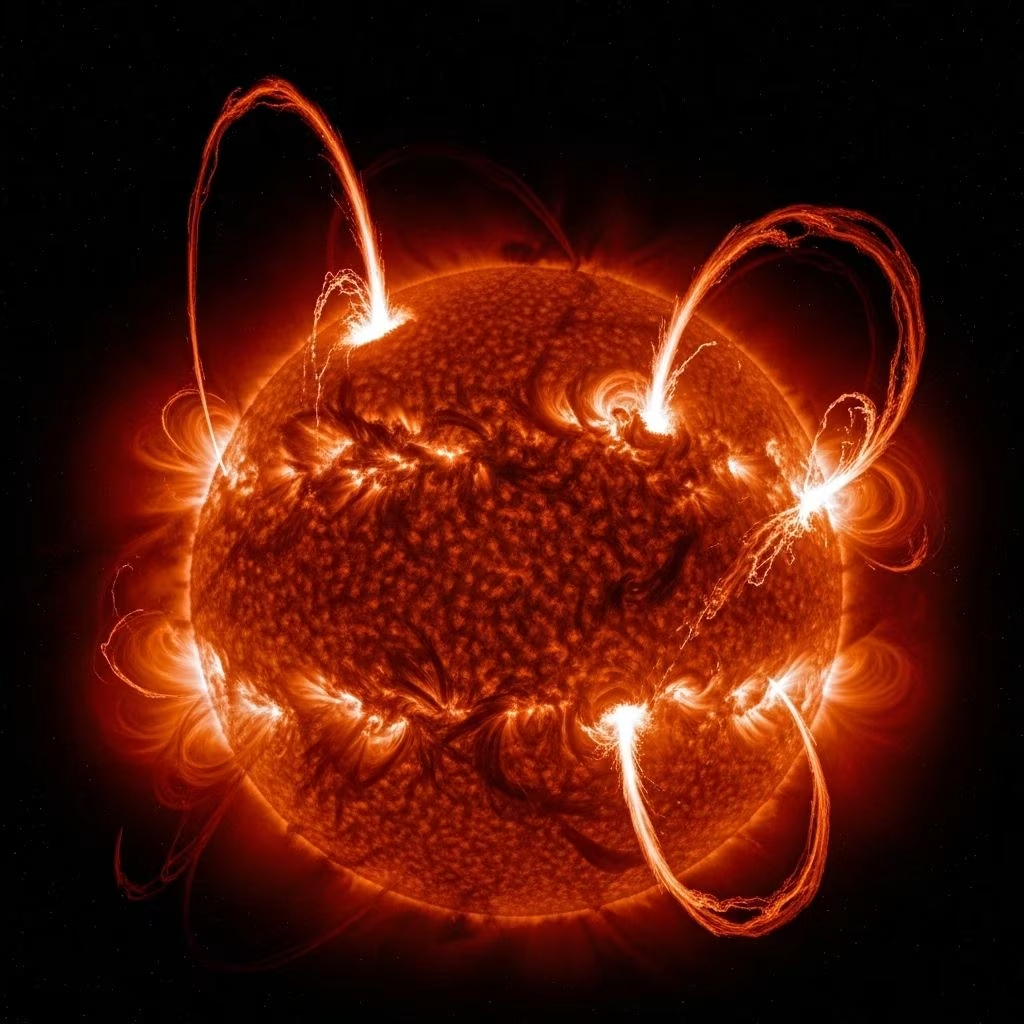
Sun Unleashes Back-to-Back Plasma Blasts in Spectacular Prominence Eruptions
On August 20th, the Sun put on one of its most captivating shows of the current solar cycle, unleashing two immense prominence eruptions in quick succession on opposite limbs—events so vivid and dramatic, they have quickly risen to legendary status among solar watchers and astronomers.
Highlights of the Twin Solar Eruptions
- First eruption: Occurred on the Sun’s southeastern limb, detected by NASA’s Solar Dynamics Observatory (SDO) and NOAA’s GOES-SUVI instrument. This colossal event exhibited ‘spectacular structure’ and dramatic plasma knots.
- Second eruption: Just hours later, the Sun’s northeastern limb experienced an equally sweeping prominence lift-off, again captured by space-based solar observatories.
- Both eruptions created huge masses of solar material (coronal mass ejections, CMEs) that were tracked speeding away into space.
- Neither CME was directed toward Earth, ruling out related aurora activity for our planet.
Solar Prominences and Their Fiery Eruptions
Solar prominences are enormous, looping structures of plasma bound tightly to the Sun by powerful magnetic fields. They can stretch hundreds of thousands of miles above the solar surface, and when they lose stability, are ejected into interplanetary space as CMEs.
- Prominence structure: Plasma is trapped in the Sun’s magnetic field, forming bright loops visible in ultraviolet and extreme ultraviolet wavelengths.
- Eruption triggers: Magnetic instabilities—such as the sudden reconfiguration of field lines—can cause a prominence to break free, releasing spectacular amounts of energy and matter.
- Impact: When CMEs are directed at Earth, they can spark powerful geomagnetic storms and vibrant auroras. In this case, the eruptions were not Earth-directed.
Scientific Observations and Reactions
The events of August 20 attracted immediate excitement from both professional solar physicists and passionate skywatchers.
- Jure Atanackov (Aurora chaser): Called the southeastern eruption ‘one of the top events of Solar Cycle 25,’ noting its spectacular plasma knots and turbulent structure.
- Vincent Ledvina (Aurora chaser): Praised the prominence as ‘one of the best I’ve ever seen.’
- Ryan French (Solar physicist): Commented on the immense size and potential auroral impact if the eruption had been Earth-directed.
- Sara Housseal (Space weather forecaster): Shared stunning imagery of the CME firing southeast, bemoaning ‘none for you’ regarding Earth-bound auroras.
How Were the Eruptions Observed?
To witness and study these enormous eruptions, astronomers leveraged a fleet of advanced solar observatories operating in space.
| Observatory | Instrument | Role in Observations |
|---|---|---|
| NASA Solar Dynamics Observatory (SDO) | Extreme ultraviolet telescopes | Captured high-resolution, real-time videos of both eruptions. |
| NOAA GOES-SUVI | Solar Ultraviolet Imager | Tracked the evolving shape of prominences in ultraviolet wavelengths. |
| SOHO spacecraft | LASCO coronagraph | Confirmed and tracked the CMEs racing away from the Sun. |
This multi-angle observation enabled scientists to study every detail, from the initial magnetic twists to the enormous arcs of plasma ejected into space.
The Nature and Consequence of Coronal Mass Ejections (CME)
A coronal mass ejection is a vast cloud of magnetized, charged solar material hurled outward during prominence eruptions. CMEs are one of the Sun’s most dynamic and influential phenomena, capable of impacting planets throughout the solar system.
- If a CME is aimed at Earth, it can disrupt satellites, power grids, communications, and create dazzling auroras.
- Tracking the trajectory of CMEs is a core task for space weather forecasters. In these events, the CMEs traveled well away from our planet, sparing Earth from possible disturbances.
- The dynamic nature of Solar Cycle 25 has led to frequent, and sometimes historic, CME events, drawing renewed attention to solar monitoring.
Solar Cycle 25: A Period of Increased Solar Activity
Solar cycles last about 11 years, with periods of minimal and maximal sunspot and flare activity. The current cycle, Solar Cycle 25, began in December 2019 and is now approaching a phase of heightened solar eruptions, flares, and CMEs.
- These dual eruptions represent ‘one of the most dramatic days’ in recent solar history.
- Space weather watchers anticipate more frequent and intense events as the cycle reaches its peak.
- Solar activity varies in both predictability and magnitude, providing scientists with ongoing challenges and opportunities for study.
What Causes a Solar Prominence Eruption?
Solar prominences are shaped and suspended by the Sun’s vast, tangled magnetic fields. Occasionally, these magnetic fields reconnect or destabilize, triggering the sudden release of plasma that forms a CME.
- Magnetic fields: The Sun’s atmosphere is governed by incredibly intense and complex magnetism.
- Prominence genesis: Plasma in the Sun’s corona follows magnetic field lines, forming gigantic arches visible as prominences.
- Instability and eruption: Changes in magnetic configuration—such as twisting, merging, or collapse—cause plasma to break away in dramatic fashion.
Magnitude of Recent Eruptions
The scale of the August 20 eruptions was extraordinary. Tens of billions of tons of plasma were propelled into space in seconds, forming arches that spanned hundreds of thousands of miles.
- Prominence arcs may extend more than 200,000 km (over 124,000 miles)—the equivalent of stacking nearly 16 Earths.
- CMEs form immense, fast-moving bubbles of energized plasma and charged particles.
- Some recent eruptions, including those caught by ESA’s Solar Orbiter, have been among the largest ever recorded, reaching even millions of miles.
Impact on Earth and Space Weather
Though these particular CMEs were not directed at Earth, their relationship to space weather is crucial.
- Earth-directed CMEs: Can trigger geomagnetic storms, disrupt satellites, power grids, and radio communications.
- Aurora effects: CMEs that reach Earth’s magnetic field can produce vibrant auroras in polar regions.
- Monitoring benefits: Observing these events improves our understanding and preparedness for future, potentially disruptive solar storms.
Solar Eruptions: A Dynamic Show in the Realm of Modern Science
The past decade has seen remarkable advances in how scientists observe, predict, and analyze solar eruptions. Missions like NASA’s SDO, SOHO, and ESA’s Solar Orbiter provide close-up views unrivalled by earlier generations. As technology improves, so too does our ability to decipher the Sun’s cryptic behavior.
Understanding Prominences and Solar Activity
- Imaging advancements: Ultraviolet, extreme UV, and coronagraph instruments reveal the subtle shapes and dynamics of solar plasma.
- Predictive science: Data gathered from repeated eruptions helps create models for forecasting when and where the next CME may occur.
- Global cooperation: International partnerships ensure near-continuous solar observation from multiple vantage points.
Frequently Asked Questions (FAQs)
What is a solar prominence?
A solar prominence is a massive loop or arc of hot, ionized plasma that extends outward from the Sun, tethered by its magnetic fields. When destabilized, prominences can burst free, releasing plasma into space as CMEs.
How do coronal mass ejections (CMEs) affect Earth?
Earth-directed CMEs can trigger geomagnetic storms, potentially affecting satellites, power systems, communications, and causing brilliant auroras in the polar skies.
What made the August 20 eruptions special?
Both prominence eruptions showcased extraordinary size, vivid structure, and near-simultaneous timing—making them the most dramatic events of Solar Cycle 25 so far.
How are solar eruptions monitored?
Solar eruptions are tracked by space-based observatories equipped with ultraviolet, extreme ultraviolet, and coronagraph instruments capable of imaging the hot plasma and mapping its trajectory into interplanetary space.
Can we predict when these eruptions will happen?
Solar cycles and magnetic activity patterns improve forecasting, but individual eruptions remain challenging to predict with precision. Ongoing observation and modeling enhance our readiness.
Why Do Solar Eruptions Fascinate Observers?
Few natural phenomena match the Sun’s capacity for cosmic drama. The detailed images and videos released from recent eruptions reveal the complex beauty and violent power of our nearest star. The combination of scientific intrigue and visual spectacle inspires both experts and enthusiasts to watch, record, and learn.
Key Takeaways
- The Sun’s August 20 twin eruptions showcased the scale and unpredictability of stellar magnetism.
- Prominences and CMEs play major roles in shaping our space environment and affecting Earth’s technology.
- International observatories and scientific collaboration are yielding unprecedented views and insights into solar behavior.
- Understanding solar eruptions helps us prepare for and mitigate the impact of intense space weather.
As Solar Cycle 25 continues, space weather watchers eagerly anticipate new eruptions and discoveries—knowing each event is a window into the vast, dynamic forces at the heart of our solar system.
References
- https://www.space.com/astronomy/sun/watch-sun-unleash-back-to-back-plasma-blasts-in-spectacular-prominence-eruptions-video
- https://nasaspacenews.com/2025/08/when-the-sun-throws-a-cosmic-party-a-solar-tornado-meets-a-gigantic-plasma-eruption/
- https://science.nasa.gov/blogs/solar-cycle-25/
- https://www.space.com/11219-sun-eruption-plasma-tentacle-prominence.html
- https://www.syfy.com/syfy-wire/largest-solar-prominence-eruption-ever-seen-by-esa
- https://www.youtube.com/watch?v=OruTEuE7Ahk
- https://www.youtube.com/watch?v=l1Ndv9ARz0s
- https://science.nasa.gov/blogs/solar-cycle-25/2025/05/13/sun-releases-strong-solar-flare-21/
- https://www.livescience.com/space/the-sun/jaw-dropping-photo-captures-solar-tornado-and-gigantic-plasma-eruption-raging-on-the-sun-at-the-same-time
- https://www.okx.com/learn/plasma-tether-blast-solar-stablecoin
- https://www.livescience.com/space/the-sun/behold-the-beast-gigantic-animal-like-plasma-plume-13-times-wider-than-earth-hovers-over-the-sun
- https://www.inkl.com/news/watch-2-fiery-blasts-erupt-from-the-sun-is-earth-in-the-danger-zone-video
- https://phys.org/news/2022-02-colossal-flare-erupted-side-sun.html
- https://dailygalaxy.com/2025/08/solar-tornado-plasma-eruption-captured/


