Earth’s Magnetic Field Explained
Earth’s magnetic field, known as the geomagnetic field, is an invisible force generated deep within our planet, extending tens of thousands of kilometers into space. It not only helps guide compasses and migratory animals but also forms a vital shield that protects Earth from solar and cosmic radiation—a phenomenon that is as crucial for planetary life today as it has been for billions of years.
What Is Earth’s Magnetic Field?
The magnetic field of Earth surrounds our planet, stretching far into space where it influences—and is influenced by—cosmic events and solar activity. Without it, Earth’s atmosphere and water might have been stripped away by solar wind, much like Mars, transforming the planet into a barren wasteland.
- It is generated by electric currents flowing in the liquid outer core, primarily composed of iron and nickel.
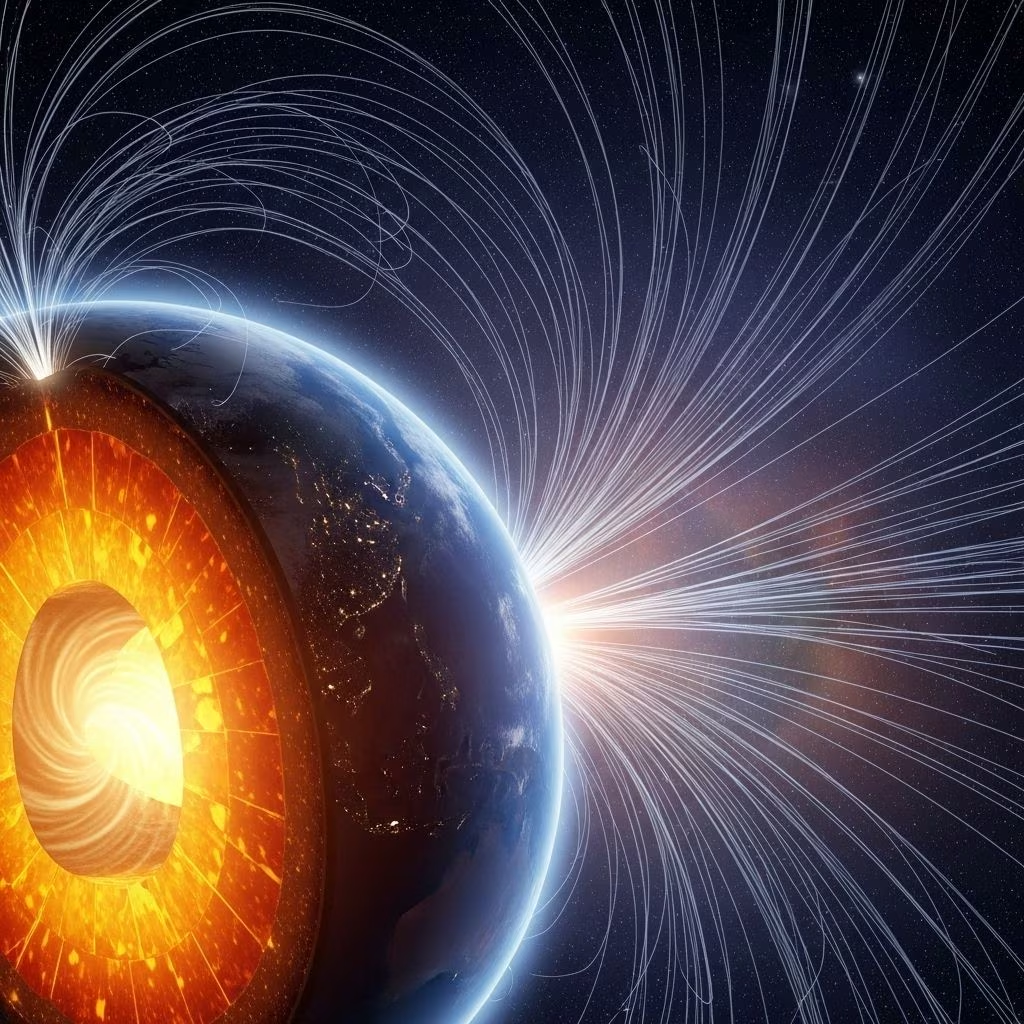
- The field extends from Earth’s interior out into space, interacting with the solar wind—a continuous stream of charged particles emitted by the Sun.
- At the surface, the field is relatively weak, ranging from 25 to 65 microteslas (μT), but in space it forms the magnetosphere, a protective envelope stretching tens of thousands of kilometers outward.
Earth’s magnetic field is constantly in flux, shifting both in strength and orientation as dynamic processes churn the planet’s core.
How Is the Magnetic Field Generated?
The geodynamo is at the heart of Earth’s magnetic field—a powerful natural generator operating deep below our feet. This mechanism relies on the motion of molten iron and other metals within the outer core.
- Earth’s core consists of a solid inner core surrounded by a liquid outer core.
- The movement of the liquid iron and nickel, combined with Earth’s rotation, generates electric currents.
- These currents produce the geomagnetic field in a self-sustaining process known as the geodynamo.
- The convection currents that drive the geodynamo are powered by heat escaping from the inner core, radioactivity, and the cooling Earth’s interior.
Put simply, our planet acts like a giant dynamo, where the constant churning of the outer core builds and sustains the magnetic field.
Components of the Core
| Component | Description | Depth (approx.) |
|---|---|---|
| Inner Core | Solid, iron-rich center | 0–1,220 km radius |
| Outer Core | Liquid, mostly iron and nickel; site of geodynamo | 1,220–3,400 km radius |
| Mantle | Overlying rocky layer | 3,400 km–Earth’s surface |
The Structure of Earth’s Magnetic Field
While scientists often model Earth’s magnetic field as a simple bar magnet, or dipole, at the planet’s center, its actual structure is far more complex.
- Dipole field: The classic “bar magnet” structure with a north and south pole aligned near Earth’s rotational axis.
- Multipole components: The true geomagnetic field includes higher-order terms (like quadrupole, octupole components), producing local disturbances and complex behaviors.
- Magnetic poles: The locations where magnetic field lines are vertical. The north geomagnetic pole is currently located in northern Canada, but it migrates over time.
Magnetic field lines emerge from near the geographic south, arc around the planet, and dive back in near the geographic north—reversing the usual convention of physical magnets because north pole of a magnet is attracted to the south pole of Earth’s field.
Earth’s Magnetosphere: The Protective Bubble
The magnetosphere is formed as the solar wind interacts with Earth’s magnetic field, shaping it into a teardrop-like cavity that shields the planet from charged particles.[13]
- The dayside magnetosphere is compressed by the solar wind, whereas the nightside is elongated into a long “magnetotail”.
- This protective envelope deflects most of the harmful solar radiation away from Earth’s atmosphere and surface.
- Occasionally, some particles spiral along magnetic field lines toward the poles, creating the auroras (Northern and Southern Lights).
Why Is Earth’s Magnetic Field Important?
- Protection from cosmic radiation: The field safeguards life by diverting high-energy charged particles and solar wind.
- Maintaining the atmosphere: Without magnetic shielding, the solar wind would gradually erode our atmosphere, as it most likely did for Mars.
- Guiding navigation and migration: Animals from birds to sea turtles rely on geomagnetic sensing for migration. Humans have used the magnetic compass for navigation for a thousand years.
- Enabling technologies: Modern systems such as satellites, electrical grids, and communications infrastructure account for space weather driven by geomagnetic activity.
Magnetic Pole Movements and Reversals
Earth’s magnetic poles are not fixed—they wander over time, sometimes rapidly. Even more dramatically, the entire magnetic field occasionally reverses, with magnetic north and south swapping places.
- Pole movement: The north magnetic pole has drifted from northern Canada toward Siberia at an average rate of tens of kilometers per year.
- Geomagnetic reversals: Geological records in ancient rocks reveal that Earth’s magnetic field has flipped hundreds of times over the last 200 million years. These reversals are irregular and can take thousands of years to complete.
- No catastrophic effects: There is no evidence that these reversals cause mass extinctions or major environmental disasters, although some effects on animal navigation and human technology are possible during transitions.
How Geomagnetic Reversals Happen
- Triggered by disturbances in the fluid motions in the outer core, disrupting and then rebuilding the magnetic field in the opposite orientation.
- While pole strength weakens during reversals, the field does not vanish completely; it becomes more complex with multiple poles appearing temporarily.
Studying—and Using—Earth’s Magnetic Field
Understanding the field provides unique glimpses into the planet’s deep interior and history, as well as practical benefits today.
- Paleomagnetism: Magnetic minerals in rocks record Earth’s field orientation at the time of their formation, storing clues to plate tectonics and earth’s evolution.
- Navigation: The compass, invented centuries ago in China, remains a fundamental part of navigation and orientation for travelers, mariners, and pilots.
- Aurora research: Observations of auroras help scientists study solar activity and space weather interactions with our magnetosphere.
- Modern technology: Magnetic field data are crucial for satellite operation, aviation, and in geoscience research.
Recent Changes and Future Trends
Earth’s magnetic field is not static. In the last two centuries, scientists have measured a steady weakening of the global field strength, particularly over the South Atlantic—a region known as the South Atlantic Anomaly.
- Current weakening trend: The average field strength has decreased about 9% over the past 170 years.
- South Atlantic Anomaly: This area of especially weak field exposes satellites and spacecraft to increased radiation risk.
- Implications: While the weakening is notable, there is no clear indication it signals an imminent reversal, nor is it considered a direct threat to life on Earth.
Geomagnetic field observations and computer simulations help scientists monitor these changes and understand what might happen in the future.
Frequently Asked Questions (FAQs)
Q: What causes Earth’s magnetic field?
A: The field is generated by the motion of molten iron and nickel in the planet’s liquid outer core, creating electric currents that form a self-sustaining geodynamo.
Q: What is the magnetosphere and why is it important?
A: The magnetosphere is the outer region of Earth’s magnetic field shaped by interaction with the solar wind. It deflects most harmful solar particles, protecting our atmosphere and life from radiation.[13]
Q: How does the magnetic field affect compass navigation?
A: Magnetic compasses align with field lines of Earth’s magnetic field, guiding navigation by indicating magnetic north—which shifts over time, requiring periodic updates to navigational charts.
Q: Can Earth’s magnetic field vanish during magnetic reversals?
A: During reversals, the field becomes complex and weak, but does not disappear entirely; local magnetic poles may appear, then settle into a new configuration. Life continues to be protected, though satellites may experience increased vulnerability.
Q: Why do auroras form near the poles?
A: Solar particles spiral along Earth’s magnetic field lines, entering the atmosphere near the magnetic poles, and exciting atmospheric gases, producing the auroras (Northern and Southern Lights).
Key Takeaways
- Earth’s magnetic field is vital for protecting the atmosphere, guiding navigation, and enabling complex technologies.
- The geodynamo in the molten outer core is responsible for generating the geomagnetic field.
- Field reversals and pole movements are natural processes revealed by paleomagnetic data—no evidence they threaten life.
- The magnetosphere forms an essential shield against space weather hazards, safeguarding all living things on the planet.
Further Reading
- Explore NASA mission data and animations about Earth’s magnetosphere.
- Read more about how paleomagnetic records reveal the secrets of Earth’s history.
- Follow the latest research as geophysicists continue to unlock the mysteries of Earth’s deep interior.
References
- https://en.wikipedia.org/wiki/Earth’s_magnetic_field
- https://geomag.bgs.ac.uk/education/earthmag.html
- https://science.nasa.gov/science-research/earth-science/earths-magnetosphere-protecting-our-planet-from-harmful-space-energy/
- https://www.usgs.gov/faqs/how-does-earths-core-generate-a-magnetic-field
- https://www.earth.com/earthpedia-articles/earths-magnetic-field-origin-structure-and-impact-on-humanity/
- https://byjus.com/physics/magnetic-field-earth-magnetism/
- https://www.pas.rochester.edu/~blackman/ast104/emagnetic.html
- https://researchoutreach.org/articles/earths-magnetic-field-changes-through-time/
- https://manoa.hawaii.edu/exploringourfluidearth/physical/ocean-floor/layers-earth/weird-science-earth-s-magnetic-field
- https://www.ncei.noaa.gov/products/geomagnetism-frequently-asked-questions
- https://www.nextias.com/blog/earth-magnetic-field/
- https://sciencedemonstrations.fas.harvard.edu/presentations/earths-magnetic-field
- https://www.swpc.noaa.gov/phenomena/earths-magnetosphere
- https://www.ebsco.com/research-starters/earth-and-atmospheric-sciences/earths-magnetic-field
- https://en.wikipedia.org/wiki/Geomagnetic
- https://www.geomag.nrcan.gc.ca/mag_fld/comp-en.php
- https://opentextbc.ca/physicalgeology2ed/chapter/9-3-earths-magnetic-field/
- https://study.com/academy/lesson/earths-magnetic-field-definition-characteristics.html
- https://www.fizziq.org/pt/elements-1/earth-magnetic-field
- https://www.geeksforgeeks.org/physics/earths-magnetic-field-definition-causes-components/