How Big is the Sun?
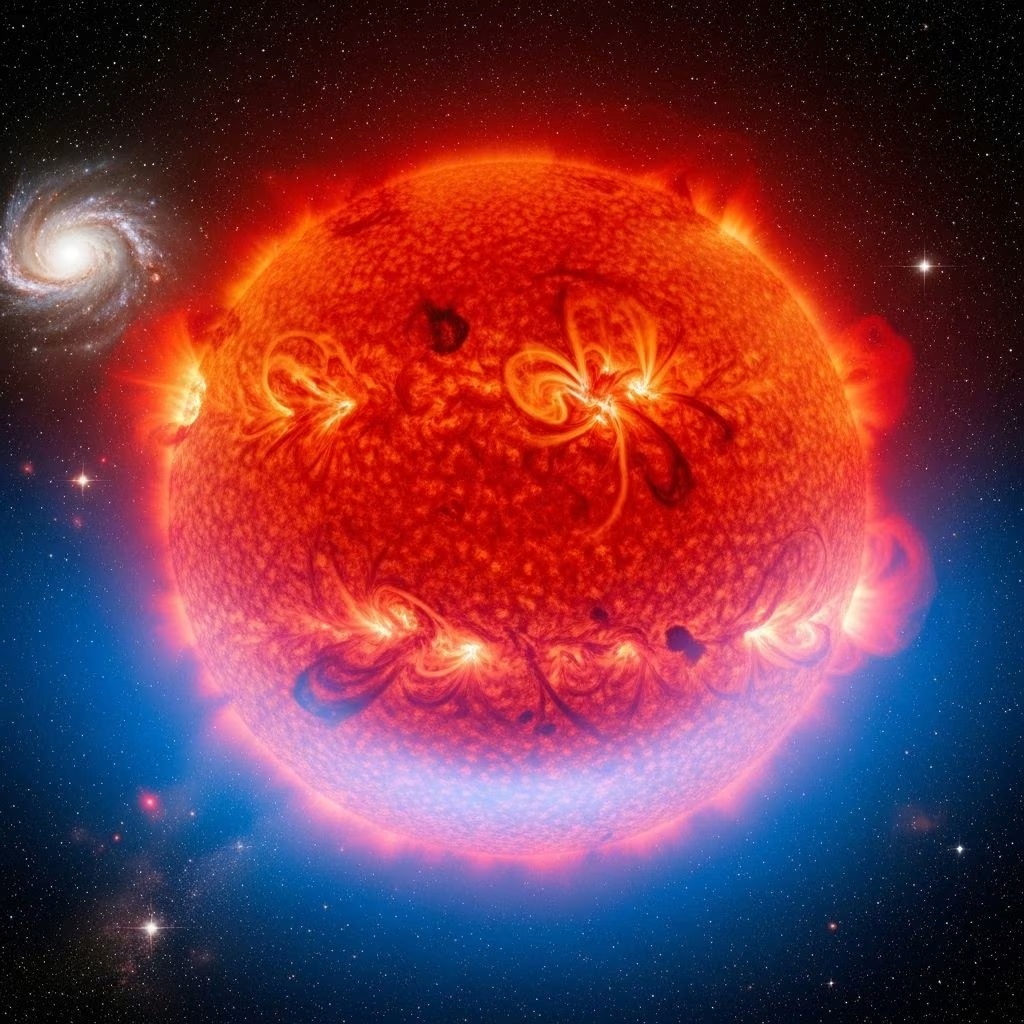
When gazing up at the sky, the sun appears as a bright, unyielding orb. However, its true scale is almost beyond comprehension. While it serves as the anchor of our solar system and dominates our daytime sky, its actual size is far more impressive than its familiar image suggests. The sun’s measurements and characteristics not only reveal the dramatic scale of our nearest star but also provide insight into the workings of the universe itself.
Understanding the Sun’s Size: Key Facts
- Diameter: The sun measures roughly 864,400 to 865,000 miles (about 1.39 million kilometers) across, roughly 109 times the diameter of Earth. Recent scientific estimates using advanced techniques suggest the sun’s diameter may be slightly less—closer to 864,675 miles (1,391,560 km).
- Mass: It holds about 333,000 times the mass of Earth and accounts for approximately 99.86% of the total mass in the solar system.
- Volume: About 1.3 million Earths could fit inside the sun.
- Surface Area: The sun’s surface is about 11,990 times that of Earth.
- Solar Type: Our sun is classified as a G-type main-sequence star (G dwarf), making it an average-sized star by cosmic standards.
The Sun Compared to Earth and Other Planets
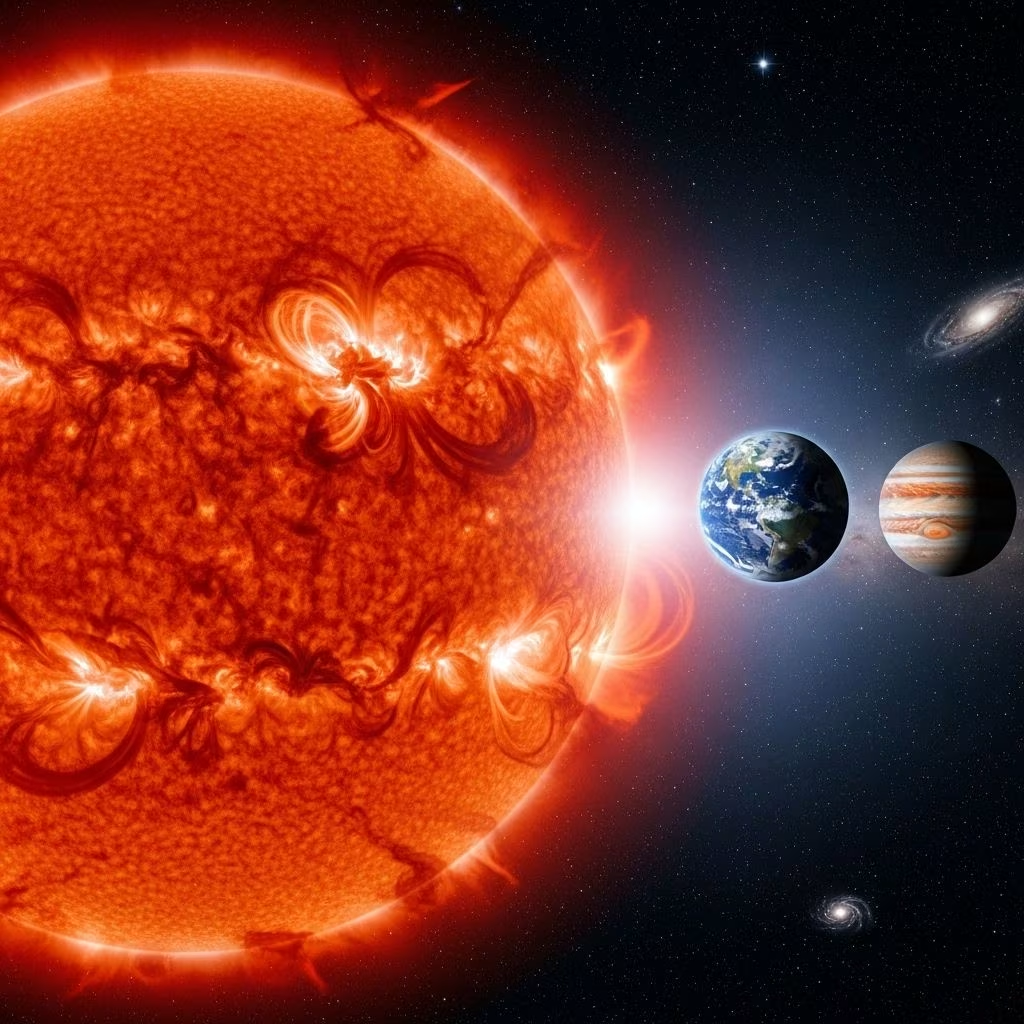
The relationship between the sun’s size and the planets orbiting it is dramatic. For humans familiar with the scale of Earth and its neighboring planets, the sun is not just the biggest body in the solar system—it is the system’s defining presence. Understanding how it scales next to Earth and other solar system members helps illustrate why the sun’s gravitational influence is overwhelming.
Visual Comparison: Sun, Earth, and Jupiter
| Object | Diameter (miles) | Relative to Earth | Volume Ratio to Sun |
|---|---|---|---|
| Sun | 864,938 | ~109 × | 1 |
| Earth | 7,917 | 1 | 1:1,300,000 |
| Jupiter | 86,881 | ~11 × | 1:1,000 |
- 109 Earths would stretch across the sun’s diameter.
- 1.3 million Earths would fill the sun’s volume.
- Even giant Jupiter, the largest planet in the solar system, is minuscule by comparison: several hundred Jupiters could fit inside the sun.
How Massive is the Sun?
Size is only one measure of the sun; its mass is another impressive feature. The sun contains 333,000 times the mass of Earth and 99.86% of all mass in the solar system. This immense mass gives the sun its dominant gravitational pull, keeping all the planets, asteroids, and comets in their orbits. The sun’s sheer mass and the gravitational energy it creates are pivotal for the stability of the solar system.
How Does the Sun Compare to Other Stars?
To people on Earth, the sun seems like an enormous, all-consuming body. Yet, in the wider universe, our sun is a relatively ordinary star—far from the true giants found elsewhere in the Milky Way and beyond.
- Average Size: The sun is classified as a main-sequence G2V star. In terms of size, it is larger than some red dwarfs but much smaller than supergiant and hypergiant stars.
- Red Giant Comparison: Betelgeuse, a red supergiant, has a diameter roughly 700 times that of the sun. The ratio of the sun to Betelgeuse is even greater than the ratio of Earth to the sun.
- Hypergiant Comparison: The largest known star, UY Scuti, is a hypergiant with a diameter up to 1,700 times greater than the sun. In terms of volume, about five billion suns could fit within UY Scuti.
Table: Sun vs. Notable Stars
| Star | Type | Diameter (Miles) | Relative Size to Sun |
|---|---|---|---|
| UY Scuti | Red Hypergiant | 1.48 billion* | ~1,700× sun’s diameter |
| Betelgeuse | Red Supergiant | ~604 million* | ~700× sun’s diameter |
| Sun | G2V Main Sequence | ~865,000 | 1 |
*Estimated values; exact diameters can vary with star evolution and pulsation.
Measuring the Sun’s Size
Determining the exact size of the sun is not trivial. While it’s possible to estimate its size based on its distance from Earth and its apparent angular width, more advanced methods have refined this measurement.
- Direct Observation: Astronomers use telescopes and measurement instruments to calculate the sun’s diameter from its angular size in the sky. However, this method can be limited by atmospheric distortion.
- Eclipse Measurement: During total solar eclipses, astronomers measure the edge of the sun (its photosphere) to obtain highly accurate readings of its diameter.
- Helioseismology: Modern techniques analyze oscillations—vibrational waves (f-modes and p-modes)—that travel through the sun’s surface and interior to refine estimates of its true size. Recent research suggests the sun’s radius is slightly smaller than previously believed, with new figures placing it around 432,337.6 miles (695,780 km).
Why Precise Measurements Matter
A small change in the measured radius of the sun, even just a fraction of a percent, can impact our understanding of its internal dynamics, nuclear reactions, and atmospheric properties. As technology improves, so do our estimates of the sun’s true dimensions—refining our broader models of star formation and evolution.
Surface and Structure of the Sun
The sun’s immense size is built from several distinct layers and zones, each with unique properties:
- Core: The center, where temperatures reach 15 million degrees Celsius and nuclear fusion occurs.
- Radiative Zone: Energy migrates slowly outward, sometimes taking hundreds of thousands of years to pass through.
- Convective Zone: Outer third of the interior; hot plasma rises, cools, and sinks repeatedly.
- Photosphere: The ‘surface’ we see, about 300 miles thick, emitting visible light.
- Chromosphere and Corona: Outer atmospheric layers, visible during solar eclipses, extending millions of miles into space.
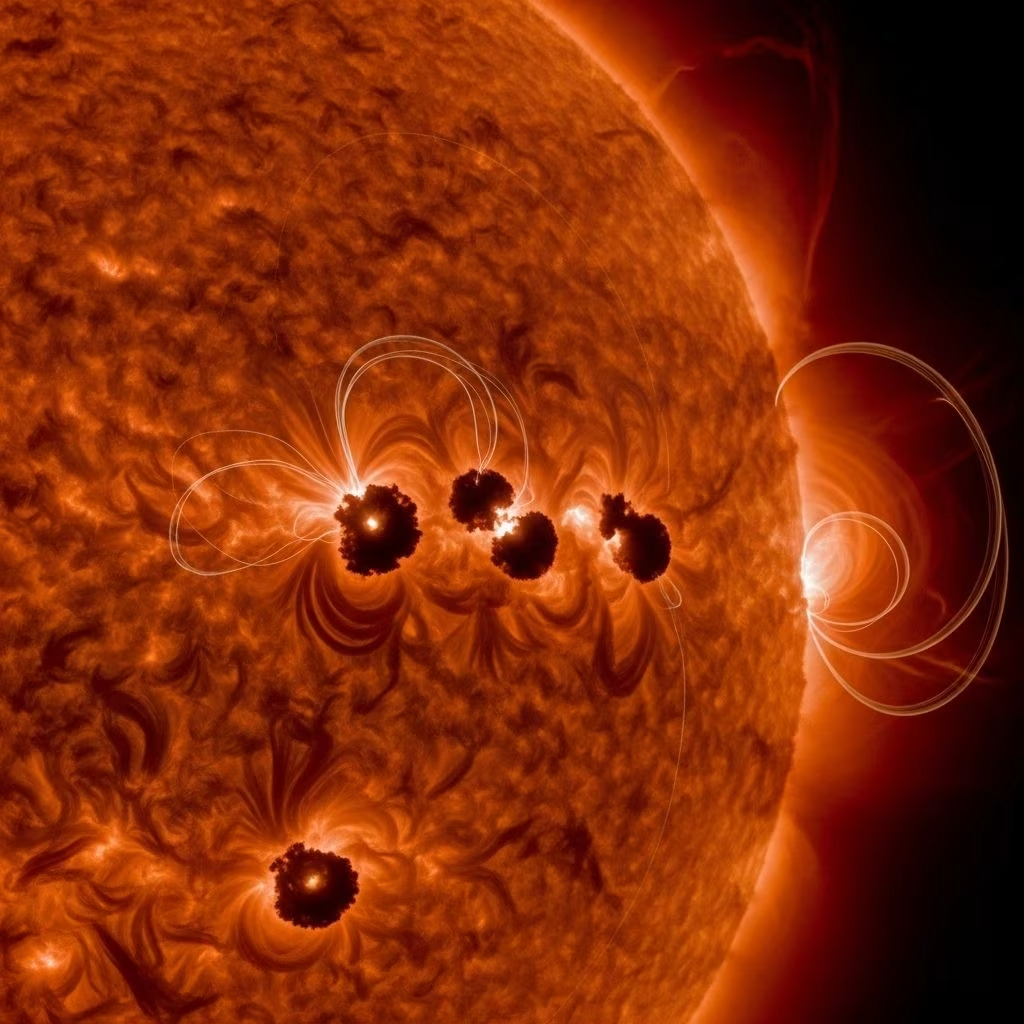
The vast size of the sun means that even its outer layers, such as the corona, can extend far beyond what we normally associate with a star’s ‘edge.’ Sometimes, outbursts such as solar flares or coronal mass ejections release matter across enormous distances, influencing the solar system, including Earth’s magnetic environment.
The Sun’s Gravitational Dominance
The sun is not just physically vast; its mass enables it to rule the entire solar system through gravity. Without the sun’s immense pull, the planets—including Earth—would not remain in their orbits. Its gravitational power shapes the region over billions of miles, from Mercury to distant objects in the Kuiper Belt and beyond.
Why the Sun’s Size Matters for Life on Earth
Were the sun dramatically smaller or larger, life on Earth could be impossible. The sun’s size and resulting output set the zone within which Earth can maintain liquid water—known as the habitable zone or “Goldilocks zone.” Its stable light and warmth provide the necessary energy for our climate, weather, and the chemistry that supports all forms of life.
Frequently Asked Questions (FAQs)
Q: How many Earths can fit inside the sun?
A: About 1.3 million Earths could fit inside the sun. This comparison is based on volume, and helps illustrate the sheer enormity of the sun relative to our home planet.
Q: Is the sun the largest star in the universe?
A: No, while the sun is the biggest object in our solar system, there are many stars much larger than the sun, such as Betelgeuse and UY Scuti. Some of these can be over 1,000 times bigger in diameter than our sun.
Q: Has our understanding of the sun’s size changed over time?
A: Yes, measurements from new instruments and analysis techniques have slightly reduced our best estimates for the sun’s true diameter by fractions of a percent. While small, these revisions are important for scientific accuracy.
Q: Why isn’t the sun considered a giant or supergiant star?
A: The sun is classified as a G-type main-sequence star, sometimes called a “yellow dwarf.” It’s considered middle-sized compared to both the smallest red dwarfs and the largest red or blue giant stars.
Q: How does the sun’s size impact space exploration and Earth’s climate?
A: The sun’s energy drives Earth’s climate and space weather. Understanding its size and activity helps scientists protect satellites, predict solar storms, and recognize how stars shape their planetary systems.
Summary: The Sun’s Size in the Context of the Universe
The sun’s scale is nearly impossible to picture on human terms—enormous even among the bodies of the solar system, yet dwarfed by the true giants of our universe. Its vast radius, mass, and volume make it the gravitational master of our planetary neighborhood. Still, to astronomers, it is a humbling reminder that our life-giving star is but one of countless stars in the galaxy—unique to us, but not extraordinary compared to all that the universe holds.
References
- https://science.nasa.gov/sun/facts/
- https://en.wikipedia.org/wiki/Sun
- https://nssdc.gsfc.nasa.gov/planetary/factsheet/sunfact.html
- https://coolcosmos.ipac.caltech.edu/ask/5-How-large-is-the-Sun-compared-to-Earth-
- https://www.astronomy.com/science/the-sun-facts-size-and-fate-of-earths-blazing-star/
- https://www.worldatlas.com/space/how-big-is-the-sun.html
- https://www.livescience.com/space/the-sun/the-sun-may-be-smaller-than-we-thought
- https://www.khanacademy.org/partner-content/nasa/measuringuniverse/measure-the-solarsystem/a/size-of-the-sun
- https://hypertextbook.com/facts/2004/AmyChan.shtml
- https://www.youtube.com/watch?v=Hxn9OBH4hWY
- https://www.popularmechanics.com/space/solar-system/a45769974/how-big-is-the-sun/
- https://www.space.com/58-the-sun-formation-facts-and-characteristics.html
- http://hyperphysics.phy-astr.gsu.edu/hbase/Solar/sun.html
- https://skyandtelescope.org/astronomy-resources/how-big-is-the-sun/
- https://enviroliteracy.org/what-size-is-our-sun/
- https://www.scienceabc.com/nature/universe/how-big-is-the-sun.html
- https://www.youtube.com/watch?v=tZ2o2IwS54Q
- https://www.sun.org/sun