China’s Pioneering Chang’e 4 Mission: A New Era for Lunar Exploration
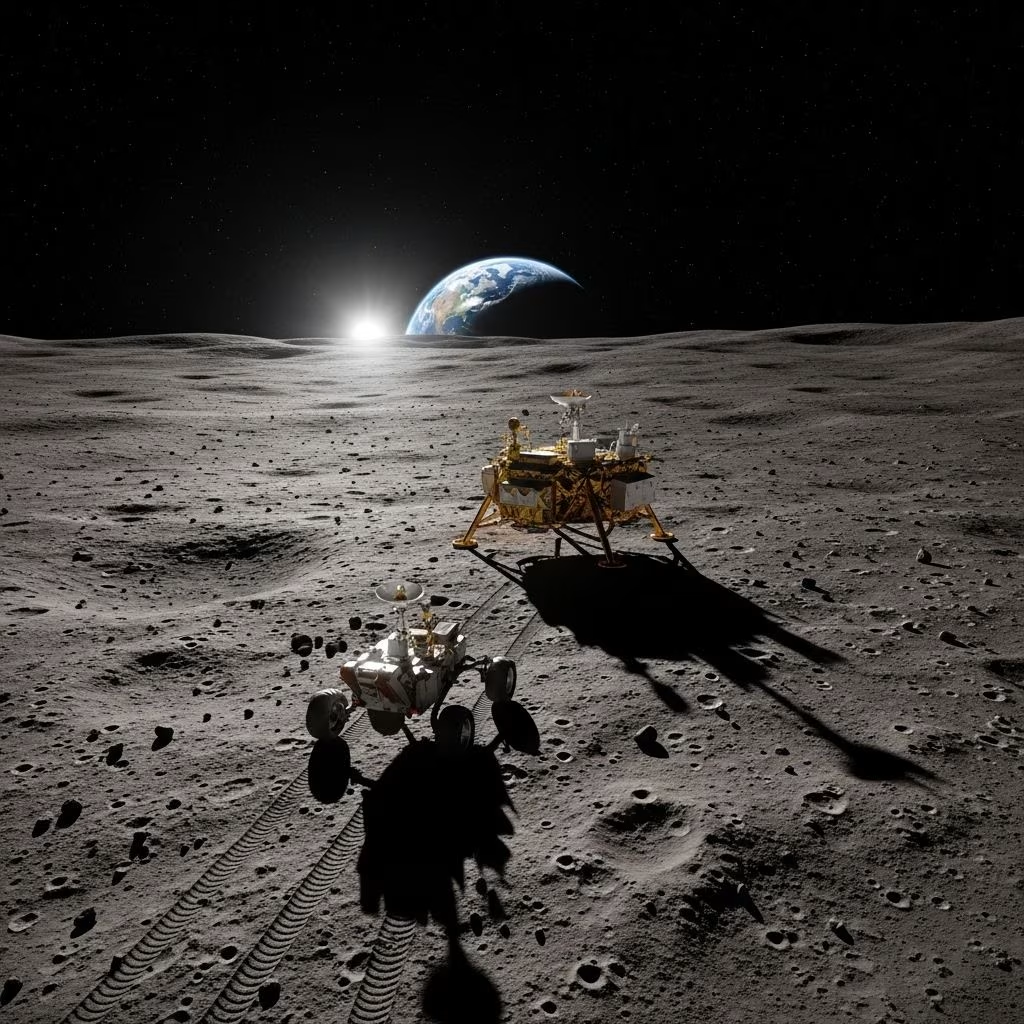
China’s Chang’e 4 mission represents a historic milestone in lunar science, delivering the first successful landing and exploration on the far side of the Moon. Since its arrival in January 2019, the Chang’e 4 lander and its companion, the Yutu-2 rover, have operated in the Von Kármán Crater within the vast South Pole-Aitken Basin, performing groundbreaking research and endurance feats beyond any previous lunar rovers.
Why the Moon’s Far Side Matters
The far side of the Moon—often called its “dark side”—is the hemisphere never seen from Earth due to the Moon’s tidally locked rotation. This region is characterized by:
- Thicker crust and differences in surface features compared to the near side.
- Relatively fewer maria (dark, basaltic regions) and more highlands.
- A unique geologic history shaped by large impacts, particularly the South Pole-Aitken Basin, one of the largest impact craters in the solar system.
Prior to Chang’e 4, this mysterious terrain had been observed only from orbit; direct lander operations were never attempted owing to communications challenges and hazardous topography.
Overcoming the Communication Challenge
One of the primary obstacles for exploring the lunar far side was the inability to directly communicate with Earth. The Chang’e 4 mission overcame this challenge by deploying the Queqiao relay satellite:
- Queqiao is positioned at the Earth-Moon Lagrange Point 2 (EML2), a location behind the Moon as seen from Earth, ensuring continuous communication between mission control and the lunar surface.
- This innovative approach allowed coordinated operation, data transfer, and remote administration of the Chang’e 4 lander and Yutu-2 rover.
Without the Queqiao satellite, real-time communication and control of surface vehicles on the far side would be impossible due to direct line-of-sight blockage by the Moon’s solid body.
The Chang’e 4 Lander: Technology and Operations
The Chang’e 4 lander serves as a stationary research platform equipped with an array of scientific instruments, including:
- Panoramic and terrain cameras for high-resolution imaging.
- Lunar Lander Neutrons and Dosimetry (LND) for cosmic ray and radiation studies.
- Lunar Lander Low-Frequency Spectrometer (LLFS) to investigate the lunar surface’s electrical properties and subsurface structure.
The lander’s robust design allows it to endure the Moon’s extreme temperature cycles, surviving both harsh daylight and subzero lunar night conditions.
The Yutu-2 Rover: The Jade Rabbit Breaks Records
Yutu-2—meaning “Jade Rabbit-2”—is the rover segment of Chang’e 4. Among its most significant achievements:
- First rover to traverse and survey the moon’s far side.
- As of March 2025, Yutu-2 has traveled over 1,630 meters, making it the longest-operating and longest-distance moon rover in history, surpassing its original 3-month planned mission by multiple years.
- Features solar panels for power in daylight and a radioisotope heater to survive lunar nights, which can last about 14 Earth days and bring temperatures down to -180°C (-292°F).
Scientific instruments on board include:
- Panoramic and hazard-avoidance cameras for imaging and navigation.
- Radar to probe beneath the lunar surface, enabling study of hidden soil layers and rocks.
- Visible and near-infrared imaging spectrometer for mineral identification and mapping.
- Lunar Penetrating Radar (LPR) to provide unprecedented views of lunar geology up to tens of meters below the surface.
Yutu-2’s mobility and advanced suite of sensors provide complementary data to the stationary lander, allowing for a multidimensional study of the Moon’s ancient far side.
Mission Timeline: Key Events and Achievements
| Date | Event | Significance |
|---|---|---|
| May 2018 | Queqiao relay satellite launched | Established communications infrastructure for far side landing |
| Dec 7, 2018 | Chang’e 4 launch | First mission targeting far side surface operations |
| Jan 3, 2019 | Soft landing in Von Kármán Crater | First-ever soft landing on the Moon’s far side |
| Jan 3, 2019 – Mar 2025 | Yutu-2 rover operations | Traveled over 1,630 meters and remains operational |
| Ongoing | Data collection and discovery | Multiple lunar days and nights survived; extensive surface and subsurface analyses |
Scientific Discoveries and Impact
The work of Chang’e 4 and Yutu-2 has led to a number of milestone discoveries that are advancing planetary science:
- Mineral diversity: The Yutu-2 rover has identified diverse rock types, including possible mantle materials such as olivine or low-calcium pyroxene, potentially revealing insights about the Moon’s deep interior.
- Subsurface structures: Lunar Penetrating Radar (LPR) data has revealed multiple layers beneath the surface, indicating a complex geologic history shaped by ancient lava flows and impacts.
- Radiation environment: The LND instrument measured the radiation environment on the lunar surface, data critical for planning future human missions.
- Lunar weathering and soil maturity: Imaging and spectrometry efforts detail how the far side’s regolith has been altered by cosmic weathering, micrometeorite impacts, and solar wind exposure.
- Potential lunar resources: Data from the lander and rover is helping to assess the presence of useful minerals for future exploration or utilization efforts.
Surviving the Lunar Day-Night Cycle
One of the remarkable technical feats achieved by the Chang’e 4 team is the successful operation through multiple lunar days and nights—each lasting about two Earth weeks.
- During the searing daytime, temperatures can exceed 120°C (248°F), while nighttime brings deep freezes below -180°C (-292°F).
- Yutu-2 relies on a radioisotope heater unit to keep its systems warm during the night, while solar power is harnessed during the day.
- Lunar ‘napping’: Both lander and rover enter a lightly dormant mode during the harshest of these periods to preserve resources and health.
International Collaboration and Future Prospects
The Chang’e 4 mission has benefited from international scientific partnerships. Notable collaborators include:
- Swedish Institute of Space Physics: Contributed to the Advanced Small Analyzer for Neutrals (ASAN) instrument.
- German Aerospace Center (DLR): Worked on neutron and dosimetry payloads critical for radiation studies.
These collaborative efforts have enhanced the scientific output of the mission and laid the foundation for deeper international partnerships in future lunar exploration.
China’s continuing Lunar Exploration Program (CLEP) plans future missions—including Chang’e 6 for sample return and Chang’e 7 for pole region studies—building upon the legacy of Chang’e 4 and Yutu-2.
Photo Highlights: A New Look at the Mysteries of the Far Side
Images transmitted by the Chang’e 4 lander and Yutu-2 rover highlight the unique terrain and regolith of Von Kármán Crater:
- Jagged rocks and craters interspersed with fine, pale lunar soil.
- Panoramic mosaics showing distant crater rims and neighboring geological features.
- Close-up investigations of surface fragments, assisting in detailed mineral mapping.
These images have not only scientific value but also inspire a new generation of lunar exploration.
Comparison: Chang’e 4 and Yutu-2 Versus Previous Lunar Missions
| Mission | Landing Site | Operational Longevity | Unique Achievements |
|---|---|---|---|
| Chang’e 4 / Yutu-2 | Von Kármán Crater (far side) | 6+ years (and counting) | First far side landing, longest-lived rover, advanced radar |
| Chang’e 3 / Yutu-1 | Mare Imbrium (near side) | About 3 years (rover lost mobility after ~2 months) | First Chinese soft landing, near-side study |
| Apollo Lunar Rovers (NASA) | Near side (Apollo 15, 16, 17) | Days to months (hardware left onsite) | Human-tended exploration |
| Lunokhod 1 & 2 (Soviet) | Near side | 10+ months (Lunokhod 2), 11 months (Lunokhod 1) | First robotic rovers |
Frequently Asked Questions (FAQs)
Q: Why is the far side of the Moon so hard to explore?
A: The Moon’s far side is perpetually hidden from direct view of Earth, preventing direct radio communication. Surface operations require a relay satellite, such as China’s Queqiao, for mission control and data download.
Q: What makes the Yutu-2 rover unique compared to previous lunar vehicles?
A: Yutu-2 is the first rover to operate on the far side, the longest-lived rover on the Moon, and the first to conduct deep ground-penetrating radar studies in this region.
Q: What scientific questions is Chang’e 4 helping to answer?
A: Chang’e 4 seeks to unravel the geologic history of the far side, understand the structure of the deep lunar crust and mantle, evaluate the radiation environment, and assess resources that may one day support human explorers.
Q: How does Chang’e 4 survive the lunar night?
A: Both the lander and Yutu-2 use radioisotope heater units to generate heat, supplemented by low-power hibernation modes and solar power generation during the lunar day.
Q: What future missions are inspired by Chang’e 4’s success?
A: China’s planned Chang’e 6 aims to return samples from the far side, while Chang’e 7 targets the south pole. The international community is also pursuing joint lunar landings and resource mapping, spurred by the technological advances demonstrated by Chang’e 4.
Legacy and the Future of Lunar Exploration
The Chang’e 4 mission and Yutu-2 rover have redefined humanity’s relationship with our nearest celestial neighbor. The successes of this mission:
- Demonstrate advanced abilities in robotic exploration and mission endurance on hostile world surfaces.
- Uncover new clues to the Moon’s origins and its evolution—knowledge crucial for future crewed exploration and off-world resource utilization.
- Open avenues for more ambitious missions (such as sample return or base construction) on the Moon’s far side and poles, making the dream of a sustainable lunar presence ever more attainable.
As China, alongside other space agencies and international partners, continues to build on this pioneering effort, the coming decades promise unprecedented discoveries on the far side and beyond.
References
- https://en.wikipedia.org/wiki/Chang’e_4
- https://www.planetary.org/space-missions/change-4
- https://en.wikipedia.org/wiki/Chang’e_6
- https://www.science.org/content/article/chinese-spacraft-successfully-lands-moons-far-side-and-sends-pictures-back-home
- https://www.space.com/42665-china-launches-moon-far-side-lander-rover.html
- https://www.space.com/china-moon-far-side-lander-rover-chang-e-4-milestone.html
- https://www.friendsofnasa.org/2025/03/chinas-yutu-2-moon-rover-new-far-side.html
- https://www.livescience.com/64263-china-launches-moon-far-side-lander-rover.html
- https://www.livescience.com/space/space-exploration/china-has-launched-a-secret-robot-to-the-far-side-of-the-moon-new-change-6-photos-reveal
- https://www.science.org/content/article/china-sets-out-far-side-moon
- https://phys.org/news/2018-12-china-rover-side-moon.html
- https://www.syfy.com/syfy-wire/lro-sees-chinese-lander-on-the-moons-far-side
- https://www.drishtiias.com/daily-news-analysis/chinas-rover-to-far-side-of-the-moon
- https://www.popularmechanics.com/space/moon-mars/a25460765/china-change-4-rover-dark-side-moon/
- https://www.sciencealert.com/nasa-s-lunar-satellite-spied-china-s-lander-on-the-moon-s-far-side
- https://www.friendsofnasa.org/2025/07/moons-far-side-earth-view-china-change.html
- https://futurism.com/china-change-4-far-side-of-the-moon-probe-rover
- https://spaceflightnow.com/2018/12/07/china-launches-historic-mission-to-land-on-far-side-of-the-moon/