What Is a Quasar?
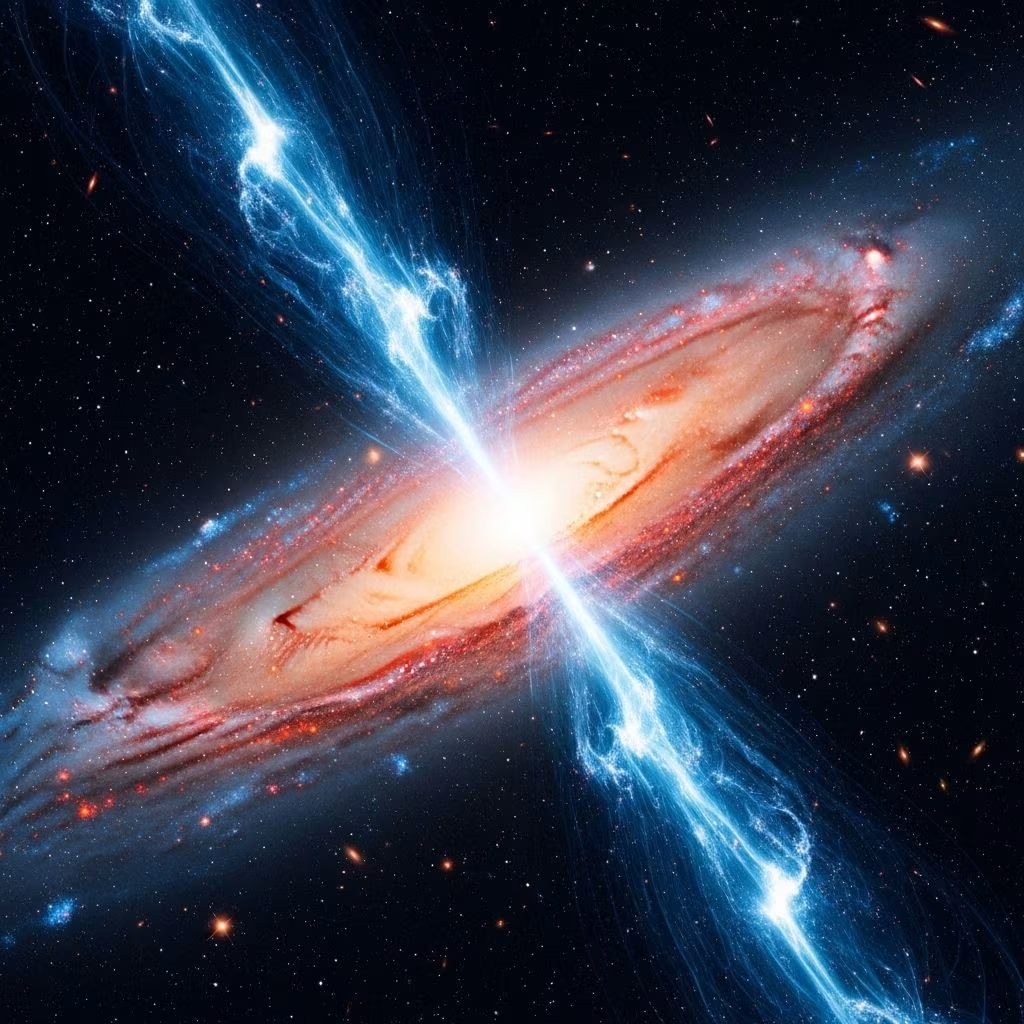
Quasars—short for quasi-stellar radio sources—are intensely luminous objects found at the centers of distant galaxies. Emitting energy levels that can outshine entire galaxies, quasars are powered by supermassive black holes devouring massive quantities of gas and dust. As this matter spirals inward, it forms a hot, gaseous accretion disk around the black hole, radiating enormous amounts of electromagnetic energy across the cosmos.
- Quasars can be thousands of times more luminous than galaxies like the Milky Way[10].
- They are classified as a highly energetic type of active galactic nucleus (AGN)[10].
- Quasars appear as star-like points in the sky due to their great distances, despite their galactic origins[10].
Discovery and Early Mysteries
Quasars first captured astronomers’ attention in the 1950s and 1960s, when radio telescopes detected unusual sources of strong radio emission that seemed to coincide with optical objects resembling faint stars. It wasn’t until 1963, with the pioneering work of Maarten Schmidt, that scientists realized these remote, star-like objects were not stars at all but enormously powerful extragalactic entities. The term “quasar” itself is a contraction of “quasi-stellar radio source,” referencing this original confusion[10].
- Initially appeared as point-like sources—hence “quasi-stellar”—in visible light images[10].
- Spectra revealed unusual lines with very high redshifts, indicating enormous distances and immense luminosities[10].
- Quasars were soon recognized as the most distant and most energetic objects known at the time.
How Quasars Work: The Galactic Engines
At the heart of every quasar lies a supermassive black hole—millions to billions of times more massive than our Sun. Quasars shine so brightly because gas and dust fall toward the black hole in a swirling accretion disk. As matter spirals closer, friction and gravitational forces heat it to extreme temperatures, releasing energy across the electromagnetic spectrum from radio to X-rays[10].
- The accretion disk is the source of most of the visible and ultraviolet light observed from quasars.
- High-energy jets may shoot out from the pole regions, emitting in radio and X-ray wavelengths.
- The orientation of the quasar’s disk and jets affects how we observe it on Earth.
- The black hole’s gravity shapes everything, while the rate of matter falling in determines the quasar’s luminosity.
Quasar Power Compared to Galaxies
| Object | Typical Luminosity (watts) | Notes |
|---|---|---|
| Milky Way Galaxy | ~4 x 1037 | 100 billion stars’ combined output |
| Typical Quasar | ~1040 to 1041 | Up to 1,000 times brighter than Milky Way |
| Supermassive Black Hole (inactive) | Near zero | Virtually undetectable without accretion |
Where Are Quasars Found?
Quasars typically reside in the distant universe, often billions of light-years away. By observing their high redshift—a stretching of their light to longer wavelengths due to cosmic expansion—astronomers deduce that quasars existed in vast numbers when the universe was only a fraction of its current age. In almost every case, quasars are found at the centers of large galaxies, in regions rich in gas and dust[10].
- Most are seen at great distances—some more than 13 billion light-years away.
- Nearby galaxies such as our Milky Way have relatively dormant or faintly active black holes.
- Many distant galaxies in the early universe likely hosted a quasar at some point in their history.
The Anatomy of a Quasar
Although powerful, the structure of a quasar is relatively straightforward in current models. The core components include:
- Supermassive black hole: The gravitational center powering the quasar.
- Accretion disk: A swirling, superheated disk of infalling gas, the primary light-emitting region.
- Relativistic jets: Twin beams of charged particles, sometimes ejected at nearly light speed perpendicular to the disk.
- Obscuring torus: A thick ring of dust and gas that may block part of the quasar’s light, depending on viewing angle.
This basic structure helps explain the observed variations among different active galactic nuclei.
Quasars and the Growth of Galaxies
The link between quasars and their host galaxies is crucial to understanding cosmic evolution. Quasars are not random phenomena; they mark a phase in a galaxy’s development—often during or following a merger with another galaxy—that triggers a burst of gas infall onto the central black hole. This quasar “blaze” is relatively short-lived, perhaps lasting tens of millions of years, after which the galaxy settles into a quieter mode[10].
- Mergers and gravitational interactions can funnel vast amounts of gas into galactic centers, igniting quasar activity.
- Feedback from quasar winds and radiation can expel gas and slow further star formation.
- Modern massive galaxies, including our own, are believed to have passed through a quasar phase in their youth.
Quasar Types and Related Objects
Not all quasars appear the same. Astronomers distinguish between several related classes, all powered by accreting supermassive black holes:
- Radio-loud quasars: Characterized by strong radio emission from their jets.
- Radio-quiet quasars: Emit less in the radio, but can be equally luminous across other wavelengths.
- Seyfert galaxies: Distant relatives with lower luminosities; their nuclei are similar but less extreme than classical quasars.
- Blazars: AGN viewed with their jets pointed almost directly at Earth, making them appear variable and extremely bright in gamma rays.
How Are Quasars Studied?
Quasar research employs the world’s most advanced observatories, spanning radio, optical, ultraviolet, infrared, and X-ray telescopes. Discoveries and insights continue to stream from both ground-based and space telescopes, including the Hubble Space Telescope, which has revealed detailed images of quasar host galaxies, and the Chandra X-ray Observatory that probes their high-energy environments.
- Spectroscopy uncovers the quasar’s immense redshifts and internal structure.
- Photometry measures brightness variations, which can reveal disk instabilities or jet activity.
- Radio Interferometry probes jet structures in exquisite detail.
- Upcoming observatories aim to uncover fainter quasars and probe even earlier cosmic epochs.
Quasars as Cosmic Probes
Given their extreme distance and brightness, quasars serve as cosmic lighthouses, illuminating the structure and composition of the universe across vast stretches of space and time:
- By studying how quasar light is absorbed by material in intervening galaxies or gas clouds, astronomers map the large-scale structure of the universe and trace the growth of elements over cosmic history.
- Observing quasars at various epochs provides insights into the formation and growth of early galaxies and black holes.
- Time variability in quasar brightness helps probe the accretion process and the physics of matter near black holes.
Famous Quasars
Certain quasars have earned distinction due to their exceptional luminosity or proximity:
- 3C 273: The first quasar ever identified, located in the constellation Virgo and shining from over 2 billion light-years away.
- ULAS J1342+0928: One of the most distant known quasars, observed as it appeared just 690 million years after the Big Bang.
- Ton 618: Currently holds one of the largest black holes known, with a mass of around 66 billion solar masses.
Frequently Asked Questions About Quasars
Q: What makes a quasar different from a normal galaxy?
A: A quasar contains a supermassive black hole actively accreting matter at its core, producing immense luminosity and powerful emissions across all wavelengths. In contrast, normal galaxies contain dormant or weakly active black holes with little or no accretion activity.
Q: Can we see quasars with amateur telescopes?
A: A few of the brightest quasars, such as 3C 273, can be glimpsed as faint points with large backyard telescopes, but their true nature as distant galactic nuclei is only revealed through astronomical research.
Q: Are quasars still forming today?
A: Quasars were most abundant billions of years ago. While rare in the nearby universe due to depleted gas supplies in most galaxies, new quasars can ignite if enough matter accretes onto a central black hole, typically during galaxy mergers or interactions.
Q: Do quasars ever run out of fuel?
A: Yes, as the central black hole consumes surrounding gas, the supply dwindles, the quasar dims, and the galaxy becomes more quiescent.
Q: How do quasars help us understand the early universe?
A: Quasars serve as powerful beacons, allowing astronomers to probe intergalactic space, trace cosmic evolution, and study the origins and growth of the first galaxies and black holes.
Summary: The Significance of Quasars
Quasars remain among astronomy’s most compelling mysteries and vital tools for unlocking the history of the universe. Powered by supermassive black holes, they testify to the dynamic, evolving nature of galaxies and their central engines. By harnessing the light of these cosmic beacons, researchers can glimpse epochs billions of years in the past and peer into the fundamental processes shaping our universe.
References
- https://en.wikipedia.org/wiki/Quasar
- https://www.britannica.com/science/quasar
- https://science.nasa.gov/mission/hubble/science/science-behind-the-discoveries/hubble-quasars/
- https://www.space.com/39580-behold-the-mighty-quasar.html
- https://esahubble.org/wordbank/quasar/
- https://www.space.com/23559-supermassive-black-hole-quasar-discovery.html
- https://en.wikipedia.org/wiki?curid=25239
- https://study.com/academy/lesson/quasar-definition-lesson-quiz.html
- https://www.popularmechanics.com/space/deep-space/a44185351/what-is-a-quasar/
- https://skyandtelescope.org/astronomy-resources/what-is-a-quasar/
- https://www.merriam-webster.com/dictionary/quasar
- https://www.cfa.harvard.edu/research/topic/quasars-other-active-black-holes
- https://www.telescopenerd.com/celestial-objects/quasar.htm
- https://www.spaceconnectonline.com.au/discovery/5410-explainer-what-is-a-quasar
- https://science.nasa.gov/missions/hubble/nasas-hubble-takes-the-closest-ever-look-at-a-quasar/
- https://en.encyfi.com/space-exploration/understanding-quasars-4502
- https://www.vedantu.com/physics/quasar