What Are Contrails? The Truth Behind Airplane Clouds
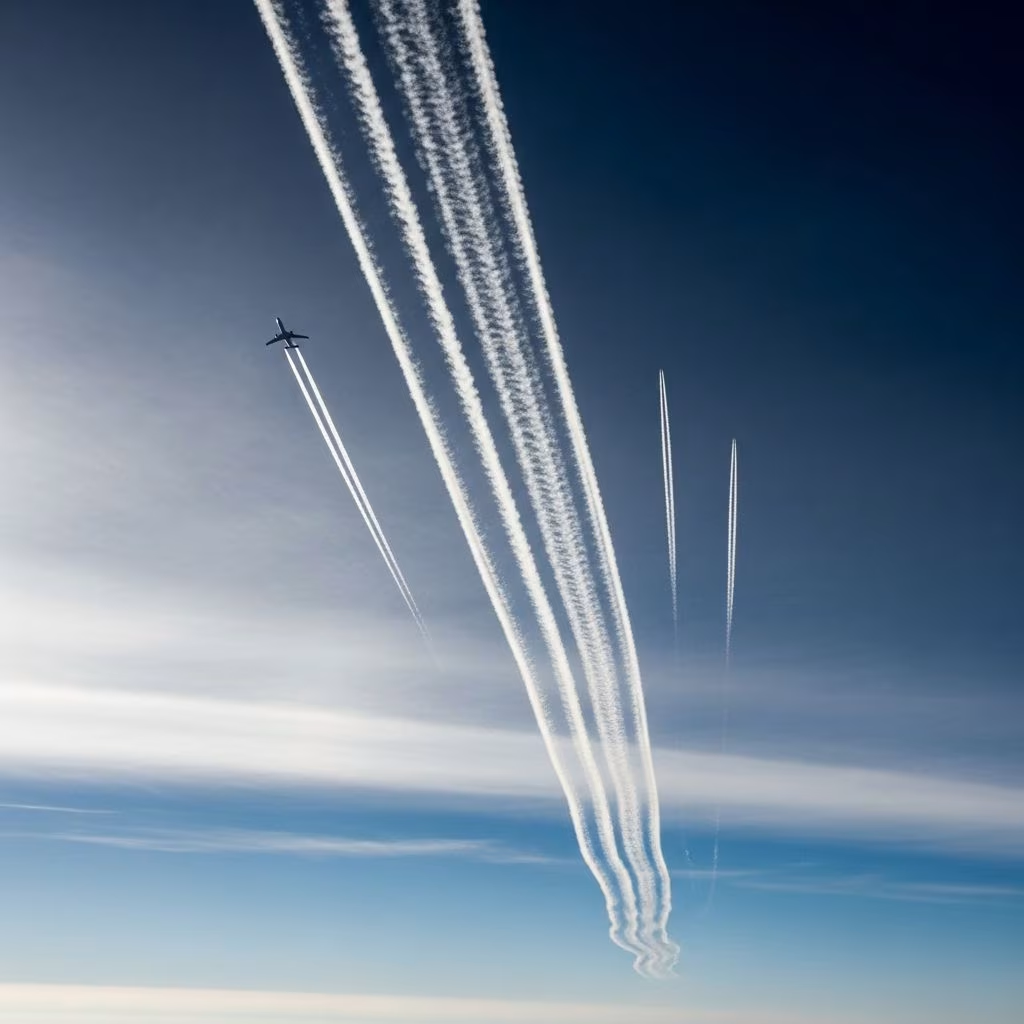
Contrails, short for “condensation trails,” are the line-shaped clouds often seen trailing behind high-flying aircraft. These long, white streaks cut across the sky, and while they may look picturesque, their formation and environmental impact are significant topics in scientific research and climate policy.
How Contrails Form
Contrails are essentially human-made clouds created when aircraft engines emit water vapor, carbon particles, and other gases into the cold, low-pressure upper atmosphere. The formation depends on several atmospheric conditions:
- High altitude – usually above 26,000 feet (8,000 meters)
- Low temperature – temperatures below about -40°F (-40°C)
- Low pressure – typical of the upper troposphere where jet aircraft operate
When hot engine exhaust meets the cold air, water vapor condenses and freezes around soot and other particles, forming tiny ice crystals that appear as streaks behind the plane. These streaks can last from seconds to hours depending on the surrounding humidity and wind conditions.
The Physics Behind Contrail Formation
- Engine combustion produces water vapor and tiny particles (soot, aerosols).
- As exhaust gases exit the engine, they rapidly cool and mix with ambient air.
- When the air is saturated or supersaturated (relative humidity is high), water vapor condenses onto particles, freezing into ice crystals.
- This process forms contrails, which may persist or dissipate based on environmental conditions.
Different Types of Contrails
Not all contrails are the same. Broadly, they fall into three main categories:
- Short-lived Contrails: These disappear within seconds or minutes due to dry air or turbulence.
- Persistent Non-spreading Contrails: These remain visible for longer, retaining their shape but not spreading out.
- Persistent Spreading Contrails: These can expand and blend with natural clouds, sometimes developing into contrail-induced cirrus clouds that cover large areas of the sky and contribute to climate warming.
| Contrail Type | Duration | Climate Impact |
|---|---|---|
| Short-lived | Seconds – minutes | Minimal |
| Persistent Non-spreading | Minutes – hours | Moderate |
| Persistent Spreading (Contrail Cirrus) | Hours | Significant (main contributor to warming) |
Contrails and the Atmosphere
Contrails act as artificial clouds, interacting with sunlight and atmospheric heat. Their main atmospheric effects include:
- Blocking sunlight: Contrails reflect sunlight, reducing the amount that reaches Earth’s surface.
- Insulating effect: At night, contrails trap outgoing infrared radiation, preventing heat from escaping, which can lead to warming of the lower atmosphere.
- Cloud formation: Persistent contrails can spread and form extensive cloud cover, often referred to as contrail cirrus.
This balance between reflecting sunlight and trapping infrared radiation determines their net climate impact. Most research indicates that the warming effect (heat retention) of persistent spreading contrails outweighs their cooling effect.
Chemical Components and Atmospheric Chemistry
- Emissions include water vapor (primary), soot, nitrogen oxides (NOx), and sulfur oxides (SOx).
- Water vapor emitted during combustion is responsible for contrail formation, while NOx and soot contribute to chemical reactions and serve as nuclei for ice crystals.
Note: While contrail chemistry is complex, water vapor is the central ingredient in their formation.
Contrails and Climate Change
The climate impact of contrails is an area of growing concern. Modern research finds that:
- Non-CO2 emissions—especially contrails—comprise about two thirds of aviation’s total climate impact, compared to just one third for CO2.
- Persistent contrails and contrail-induced cirrus clouds are responsible for approximately 50% of aviation’s warming effect[10].
- The effect is immediate: Contrail-induced warming occurs within hours, whereas CO2-induced warming takes decades to accumulate.
Contrail Hotspots and Flight Patterns
Research reveals that not all flights contribute equally to climate warming from contrails:
- About 2% of flights are responsible for 80% of the climate impact caused by contrails.
- Flights through certain regions—called Ice-Supersaturated Regions (ISSR)—are especially likely to produce persistent, spreading contrails.
Contrails vs. CO2: Impact Comparison
| Factor | CO2 | Contrails |
|---|---|---|
| Timescale | Decades to centuries | Hours to days |
| Reversibility | Possible via removal technologies (e.g., carbon capture) | Not reversible once formed |
| Contribution to aviation warming | About 1/3 | About 2/3 |
| Formation | All aviation activities | Only some flights under specific conditions |
Mitigation Challenges
- Climate impact depends on engine types, flight altitudes, and weather conditions.
- Changing a flight route to avoid contrail formation may paradoxically lead to more fuel use and higher CO2 emissions, posing complex trade-offs.
- Technological and operational solutions—such as new fuels, engines, and real-time flight planning—are under development.
Aviation Industry Response
The aviation industry has recognized contrail climate impact and is actively pursuing mitigation strategies:
- Net-zero CO2 emissions by 2050: This is a key global goal, with international coordination through bodies like the ICAO.
- Research and operational trials: Ongoing studies aim to better understand contrail formation, refine models, and develop solutions for real-world application.
- Technological innovation: Efforts to design engines and fuels that minimize soot/nox emissions, and use alternative energy sources.
- Operational changes: Pilots and airlines can adjust altitudes or timing to avoid ISSR zones likely to produce persistent contrails, though this requires further research for optimization.
- Balancing trade-offs: Any intervention must weigh the impact of contrail avoidance against potential increases in CO2 output due to longer routes.
In addition to climate initiatives, the industry emphasizes the need for:
- Collaboration among airlines, research institutions, and government agencies
- Coordinated operational trials to identify practical approaches to reducing contrail-induced warming effects
- Ongoing updates to flight planning systems integrating up-to-date atmospheric data
Contrail Mitigation: What’s Under Consideration?
| Approach | Advantages | Challenges |
|---|---|---|
| Flight Route Adjustment | Avoids ISSR regions, minimizes persistent contrail formation | Possible increase in CO2, operational complexity |
| Engine/Fuel Technology | Lower soot and NOx emissions, improved efficiency | High cost, long deployment timescales |
| Real-Time Atmospheric Monitoring | Optimizes in-flight decisions, targets highest-impact flights | Requires reliable global data, advanced infrastructure |
| Alternative Energies (Hydrogen, SAF) | Reduced emissions, supports decarbonization | Development, supply, and certification hurdles |
Frequently Asked Questions (FAQs)
Q: Do contrails pose health risks to humans on the ground?
A: There is no scientific evidence that contrails formed at high altitudes pose direct health risks to humans on the ground. The impact is primarily environmental, through their influence on climate, not immediate air quality at ground level.
Q: Are contrails a form of chemical spraying?
A: No. Contrails are mainly composed of water vapor that freezes into ice crystals around small particles from aircraft exhaust. They are not intentional chemical sprays or “chemtrails” and have been extensively studied and explained by atmospheric scientists.
Q: Why do some days have more contrails than others?
A: Contrail formation depends on atmospheric conditions—especially humidity, temperature, and wind. On days when the upper atmosphere is cold and humid, persistent contrails are more likely. This varies with weather patterns and flight paths.
Q: Can changing flight patterns reduce contrail impact?
A: Targeted changes, especially avoiding ISSR regions at the times most likely to trigger persistent contrails, can substantially reduce aviation’s climate effect. However, practical implementation requires weighing additional fuel use and CO2 emissions.
Q: Are new aircraft or fuels being developed to reduce contrail formation?
A: Yes. Engine manufacturers and fuel suppliers are working to lower soot and NOx emissions, while sustainable aviation fuels (SAF) and hydrogen technologies are advancing. These efforts aim to reduce the likelihood and potency of contrail formation along with improving overall environmental performance.
In Summary: The Road Ahead for Contrails and Climate
Contrails are more than fleeting streaks in the sky; they are a key aspect of aviation’s climate influence. Clear scientific consensus holds that persistent spreading contrails—especially those evolving into contrail cirrus—contribute significantly to global warming. As the aviation sector pursues ambitious decarbonization targets, holistic strategies addressing both CO2 and contrail-related impacts will be essential. Progress hinges on improved atmospheric models, technological breakthroughs, and carefully balanced operations that minimize overall environmental harm while keeping air travel sustainable for the future.
References
- https://rmi.org/aviation-contrails-what-we-know-and-what-we-dont-about-this-warming-phenomenon/
- https://www.iata.org/contentassets/726b8a2559ad48fe9decb6f2534549a6/aviation-contrails-climate-impact-report.pdf
- https://iee.psu.edu/news/podcast/growing-impact-contrails-and-climate-change
- https://acp.copernicus.org/articles/24/6071/2024/
- https://atag.org/media/wnqc3v41/fact-sheet_20_contrails_june-2024.pdf
- https://e360.yale.edu/features/how-airplane-contrails-are-helping-make-the-planet-warmer
- https://www.epa.gov/regulations-emissions-vehicles-and-engines/Contrails
- https://www.cirium.com/thoughtcloud/exploring-the-environmental-impact-of-contrails/
- https://www.transportenvironment.org/topics/planes/contrails
- https://www.imperial.ac.uk/news/255315/study-planet-warming-contrails-spanner-works-aviation/
- https://www.nasa.gov/centers-and-facilities/armstrong/nasa-partners-explore-sustainable-fuels-effects-on-aircraft-contrails/
- https://www.boeing.com/content/dam/boeing/boeingdotcom/principles/environment/pdf/Contrails-FactSheet.pdf
- https://www.faa.gov/contrails
- https://www.faa.gov/sites/faa.gov/files/regulations_policies/policy_guidance/envir_policy/contrails.pdf
- https://www.transportenvironment.org/articles/contrail-avoidance
- https://en.wikipedia.org/wiki/Environmental_impact_of_aviation
- https://zeroavia.com/blogs/the-contrails-and-tribulations-of-aviations-climate-impact/
- https://www.science.org/content/article/aviation-s-dirty-secret-airplane-contrails-are-surprisingly-potent-cause-global-warming
- https://acp.copernicus.org/articles/24/9219/2024/
- https://www.imperial.ac.uk/news/242017/clouds-created-aircraft-have-bigger-impact/