


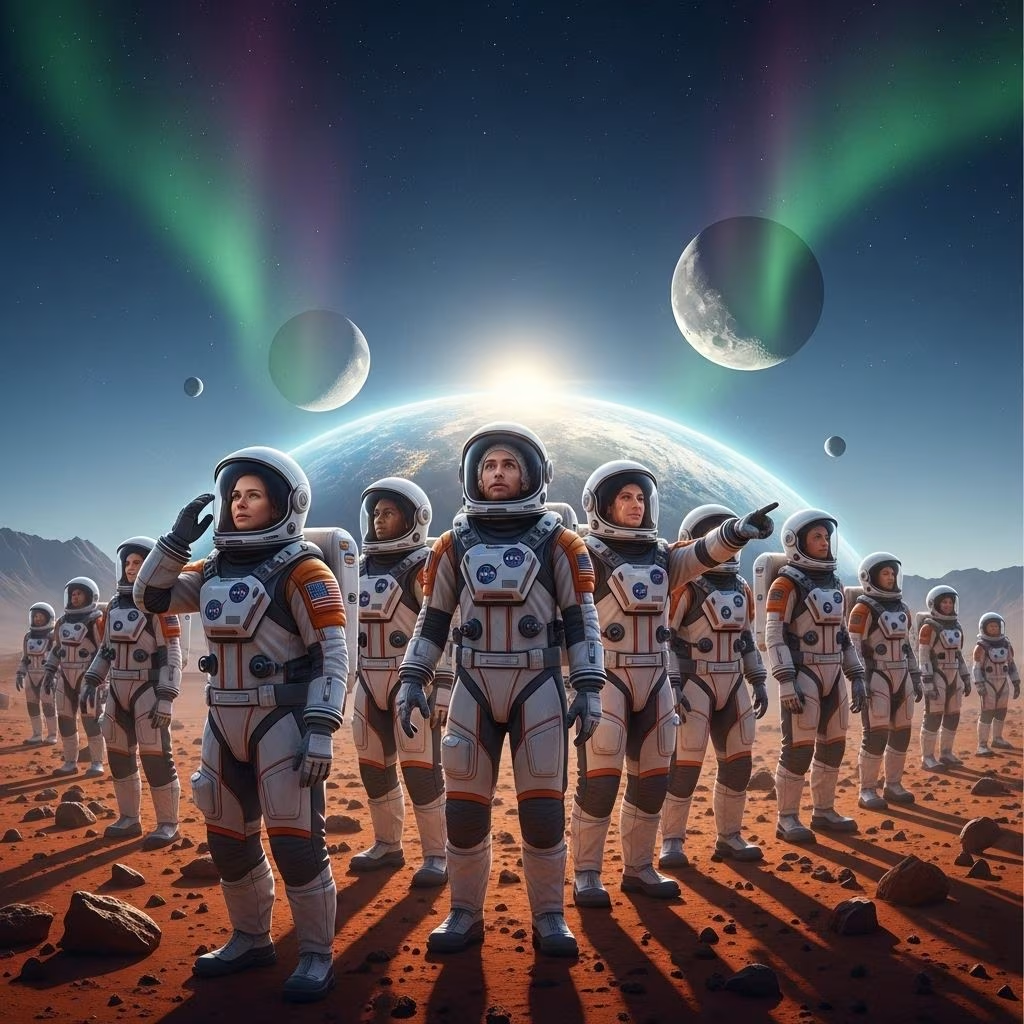
NASA’s 2025 Astronaut Class: Next-Generation Space Explorers
On September 22, 2025, NASA introduced its highly anticipated new astronaut class—the 24th in the agency’s history—marking the latest chapter in humanity’s push to explore beyond Earth. The 2025 astronaut candidates have been chosen from a pool of over 8,000 qualified applicants representing nearly every field of science, engineering, and piloting. This class reflects not only the diversity of the United States but also the ambition of a global effort to return to the Moon and set sights on Mars.
Announcement Event and Broadcast
The astronaut class unveiling was hosted at Houston’s Johnson Space Center and broadcast live across multiple platforms:
- NASA+
- NASA’s YouTube channel
- Amazon Prime and Netflix
- NASA’s official X (formerly Twitter) account
- Space.com simulcast (if available)
The excitement wasn’t limited to the selection—special media briefings were held on September 23 and 24, focused on NASA’s Artemis 2 mission and its historic crew makeup.
The Selection Process: 8,000+ Applicants, 10 Finalists
The newly announced class features ten astronaut candidates, handpicked through a rigorous multi-stage evaluation:
- Applicants came from every state and professional background, including test pilots, engineers, geologists, physicians, and physicists.
- Applicants were shortlisted and subjected to extensive interviews, medical screenings, and group assessments.
- Only those demonstrating exceptional physical fitness, leadership, adaptability, and teamwork advanced.
Acting NASA Administrator Sean Duffy observed that these men and women “embody the truth that in America, regardless of where you start, there is no limit to what a determined dreamer can achieve—even going to space.”
Snapshot: Who Are the 2025 Astronauts?
- Diverse backgrounds: The class includes six women and four men, reflecting broad demographic and professional representation.
- Previous spaceflight experience: One candidate, Anil Menon, has already orbited Earth during the historic Polaris Dawn mission in 2024, setting records for the farthest distance traveled by women and for participating in the first non-governmental spacewalk.
- Expertise matrix: Members have experience in high-stakes fields like test flight, geology, robotics, emergency medicine, and space engineering.
Training: Forging Astronauts for Deep Space
Upon selection, the new class reported to Johnson Space Center in September and began an intensive two-year training curriculum designed to prepare them for the toughest challenges in space. Key training areas include:
- Space Station Operations: Mastery of International Space Station (ISS) systems and protocols.
- Artemis Lunar Operations: Specialized training for lunar surface activities, including geology, suit operations, and EVA (spacewalk) preparation.
- Robotics: Proficiency with robotic arms, lunar rovers, and other advanced systems.
- Survival Skills: Land and water survival training for emergency scenarios during launch, landing, or splashdown.
- Language Skills: Russian language training to support ISS operations with international partners.
- Space Medicine and Physiology: In-depth knowledge to monitor crew health and respond to medical emergencies.
- Jet Training: Flying high-performance jets to hone reflexes, decision-making, and adaptability under pressure.
- Simulated Spacewalks: Practice in giant pools—Neutral Buoyancy Lab—to rehearse weightless tasks.
After this period, successful candidates are certified as full NASA astronauts, qualifying them for assignment to future missions.
Missions Ahead: From Low Earth Orbit to Mars
What lies ahead for this pioneering group? NASA’s astronauts will be central participants in missions with enormous implications for the future of science, technology, and our sense of cosmic place. Their deployment will focus on three overarching programs:
- International Space Station (ISS): Ongoing research in microgravity, biology, technology demonstration, and international cooperation.
- Artemis Lunar Missions: NASA’s Artemis Program aims to return humans to the moon for the first time since Apollo, land the first woman and the first person of color at the lunar south pole, and build a sustainable lunar outpost as a springboard to Mars.
- Missions to Mars: Preparations are underway for crewed Mars expeditions, ambitious undertakings that require robust astronaut training, stamina, ingenuity, and teamwork.
Upcoming Milestone: Artemis 2 Mission Briefings
Special attention has centered around Artemis 2, the first crewed Artemis mission slated for no earlier than April 2026. The prime crew consists of:
- Reid Wiseman, NASA Astronaut Commander
- Victor Glover, NASA Astronaut Pilot (first Black astronaut to fly to the Moon)
- Christina Koch, NASA Mission Specialist (first woman to fly to the Moon)
- Jeremy Hansen, Canadian Space Agency Mission Specialist (first non-American to participate in a lunar mission)
These ground-breaking assignments and diversity milestones are fueling anticipation for the new class’s participation in future Artemis missions.
Meet Some of the 2025 Astronaut Candidates
This class features men and women whose backgrounds exemplify technical prowess, resilience, and pioneering spirit. Representative profiles include:
- A Geologist: Candidates with field geology backgrounds are vital for lunar surface exploration and planetary science.
- A Commercial Astronaut: Experience from the private space sector, notably in missions like Polaris Dawn and time spent as SpaceX mission controllers.
- Test Pilots and Engineers: Proven excellence under pressure and mastery of complex, rapidly changing situations.
- Medical Doctors and Space Medicine Experts: Ensuring crew health on long-duration missions.
This diversity equips the cohort to address wide-ranging scientific, technical, and operational challenges.
Highlight: Anil Menon’s Remarkable Journey
Anil Menon, one of the new astronaut candidates, already has notable spaceflight credentials. As part of the Polaris Dawn mission’s private crew, Menon set historic records and brings a unique operational perspective to the NASA cadre. Menon and Sarah Gillis, both SpaceX veterans, achieved the farthest human distance from Earth for any woman and contributed to non-government EVAs, helping to bridge public-private spaceflight collaboration.
Historic Context and Vision: Unlocking a Golden Age
NASA’s astronaut selection comes at a pivotal moment. Decades after the last human mission to the lunar surface, the agency is revitalizing the nation’s astronaut core to answer the challenges of the 21st century.
- NASA’s astronaut classes date back to 1959, each group marked by technical achievement and social progression.
- The 2025 class is the first in four years, continuing the momentum of its 2021 predecessors.
Administrator Sean Duffy framed this moment as the dawn of a “Golden Age of exploration”, reiterating the agency’s commitment to pushing the frontier and inspiring the next generation of scientists, engineers, and dreamers.
Media Events and Public Engagement
NASA’s public engagement strategy for the astronaut announcement underscores its goal to inspire a new generation and kindle interest worldwide:
- Multi-platform broadcasts maximized audience reach and transparency.
- Interactive Q&A sessions allowed aspiring astronauts and youth to connect with the agency and ask questions about the selection process and future missions.
- Partnerships with educational media and documentaries highlighted the trajectory from application to astronaut.
Frequently Asked Questions (FAQs)
Q: How does NASA select its astronaut candidates?
A: NASA reviews thousands of applications, shortlists candidates with advanced degrees or military flight backgrounds, and subjects them to rigorous interviews, health checks, and simulated group tasks. Only those excelling in leadership, adaptability, and teamwork advance.
Q: What kind of training will the new astronauts undergo?
A: Their training covers spaceflight operations, robotics, survival skills, medicine, language, simulated lunar activities, ISS systems, and high-performance jet piloting.
Q: When will the 2025 astronaut class fly in space?
A: The candidates must first complete two years of training. Assignment to specific missions—including Artemis lunar flights or ISS rotations—will follow certification and depend on the agency’s evolving exploration schedule.
Q: Why is diversity in astronaut selection important?
A: Diverse skills, perspectives, and experiences enhance problem-solving and help NASA accomplish tasks across scientific, technical, and operational domains. Representation also ensures inspiration and opportunities extend to all Americans.
Looking Ahead: The Future of Human Spaceflight
The 2025 NASA astronaut class embodies the spirit of discovery. Their selection marks not only personal achievement but the promise of a nation advancing boldly to new frontiers. As they train, the world will be watching—awaiting their first steps on the Moon, experiments in orbit, and possibly paths beyond Mars. The choices made now will echo far into the Solar System and the future of humankind’s journey to the stars.
References
- https://www.nasa.gov/image-article/nasas-new-astronaut-candidates/
- https://www.nasa.gov/news-release/nasa-selects-all-american-2025-class-of-astronaut-candidates/
- https://spaceflightnow.com/2025/09/22/a-geologist-a-former-spacex-launch-director-and-a-commercial-astronaut-meet-nasas-10-new-astronaut-candidates/
- https://www.space.com/space-exploration/human-spaceflight/nasa-will-announce-its-new-astronaut-class-in-september
- https://www.usatoday.com/story/news/nation/2025/09/23/nasa-astronaut-class-moon-mars/86305915007/
- https://www.space.com/space-exploration/missions/nasa-unveils-10-new-astronauts-for-missions-to-the-moon-and-maybe-mars
- https://www.youtube.com/watch?v=frX3-5xuGQs
- https://techcrunch.com/2025/09/23/nasas-new-astronaut-class-includes-spacex-veterans-anna-menon-and-yuri-kubo/
- https://www.cbsnews.com/news/new-nasa-astronaut-class-candidates/
- https://www.youtube.com/watch?v=QuSwLeLoV-M
- https://en.wikipedia.org/wiki/NASA_Astronaut_Group_23
- http://www.collectspace.com/news/news-092225a-nasa-astronaut-candidate-class-2025.html
- https://spaceanddefense.io/new-astronaut-class-to-debut/
- https://news.mit.edu/2025/nasa-selects-adam-fuhrmann-astronaut-training-0923
- https://www.moaa.org/content/publications-and-media/news-articles/2025-news-articles/recommended-reads/current,-former-officers-spearhead-nasas-new-astronaut-class/
- https://www.spacelaunchschedule.com/space-events/nasa-astronaut-class-of-2025-introduction/


