James Webb Space Telescope Illuminates a Cosmic Enigma
The universe asks its own questions—and sometimes, it does so quite literally. The James Webb Space Telescope (JWST), the most advanced observatory ever placed in space, has released a remarkable image: an unmistakable question mark shape etched in the distant cosmos. This discovery, made possible through advanced instrumentation and physics, not only stirs cosmic curiosity but also advances our understanding of galactic evolution and the structure of the universe itself.
The Accidental Icon: A Question Mark in the Stars
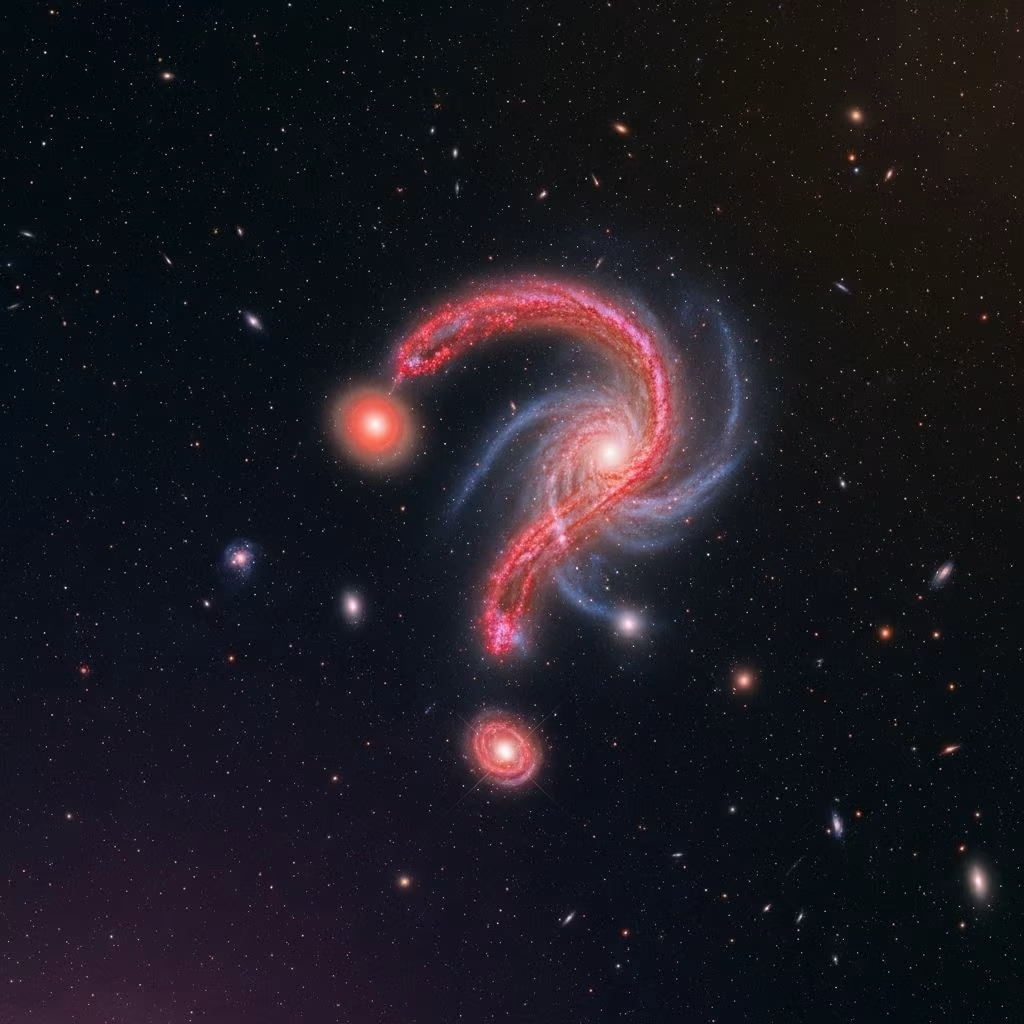
Amid JWST’s mission to peer further back in time and further across space than any previous telescope, its powerful Near-Infrared Imager and Slitless Spectrograph (NIRISS) captured a peculiar cosmic structure: a giant, glowing question mark set against the profound darkness of the universe.[10]
- Shape Origin: The shape is not a single object, but rather the product of light from two ancient, interacting galaxies that have been warped and multiplied by immense gravitational forces.
- Cosmic Address: The formation is situated in the field of view of the galaxy cluster MACS-J0417.5-1154, an enormous structure itself located approximately seven billion light-years away.
- Rarity: Astronomers estimate that only three or four similar question mark-shaped lensing phenomena have been observed in the entire visible universe.
What makes this question mark remarkable isn’t just its quirky form—but the scientifically rich circumstances that produced it.
The Science Behind the Cosmic Question Mark
Gravitational Lensing: Nature’s Magnifying Glass
The heart of this phenomenon is gravitational lensing—a spectacular effect predicted by Einstein’s general theory of relativity. When a massive object, such as a galaxy cluster, sits between an observer and more distant galaxies, its gravity bends and magnifies the light from those background objects, often creating arcs, rings, or, very rarely, shapes like the question mark.[10]
- Lens Structure: In this case, the foreground cluster MACS-J0417.5-1154 warps and enhances light from two remote galaxies, resulting in multiple images.
- Unique Pattern: Four bright images of the galaxy pair form the curved top of the question mark, while a fifth image is offset, creating the dot at the bottom.
- Special Geometry: Astronomers call this arrangement a hyperbolic umbilic gravitational lens, a rare geometric configuration where massive structures create unusual multiple images.
This gravitational lensing not only creates visually stunning phenomena but also provides powerful natural telescopes for studying galaxies that would otherwise be too faint or small to observe directly.
The Lensed Galaxies: Glimpses of the Early Universe
The background galaxies caught in this cosmic mirage date to an era when the universe was half its current age—about seven billion years ago.[10] This was a period of rapid galactic growth and intense star formation.
- Starburst Epoch: These galaxies, seen during the universe’s ‘adolescent’ stage, are comparable in mass to the Milky Way at that time, offering clues about our own galaxy’s formative years.
- Evolutionary Insight: By studying these amplified images, astronomers can reconstruct how galaxies evolve, grow, and merge over cosmic timescales.
- Ancient Light: The light reaching JWST began its journey long before humans existed or Earth formed, giving a direct view of galaxy assembly in the distant past.
This level of cosmic archeology is only possible with Webb’s unprecedented sensitivity and the random alignment of massive structures along our line of sight.
Decoding a Unique Gravitational Lens Configuration
While gravitational lensing is a common cosmic event, the specific form seen here—a question mark—results from an extremely rare alignment and lensing setup.
- Hyperbolic Umbilic Lensing: The ‘question mark’ is a textbook example of a hyperbolic umbilic gravitational lens. In this setup, the gravitational field of the galaxy cluster stretches, distorts, and multiplies the light from the background galaxies into a pattern reminiscent of a question mark.
- Sparse Examples: Only a handful of such configurations are known, underscoring the value of JWST’s wide-field, high-resolution imaging capabilities in uncovering these cosmic gems.
- Scientific Impact: Each rare lensing variety provides clues about dark matter distributions, galaxy cluster masses, and the nature of background sources.
Why This Image Matters: The Value of Discovery
While the question mark image is visually compelling, its scientific impact extends much further.
- Testing Cosmology: Studying these rare lens configurations challenges and refines models of gravity and mass distribution on the largest scales.
- Probing Dark Matter: The lensing effect is influenced by visible and invisible (dark) matter. Measuring the degree and manner of distortion helps astronomers map dark matter within the cluster.
- Tracing Galaxy Assembly: The galaxies’ lensed light provides a window into the epochs when the universe’s largest structures were forming, allowing comparisons with simulations and models of cosmic evolution.
- Showcasing Webb’s Power: The discovery highlights JWST’s role as a tool not just for planned science, but for serendipitous, curiosity-inspiring finds that fuel new lines of questioning.
Key Takeaways From JWST’s Wild Summer of Discovery
- JWST continues to exceed expectations, capturing high-impact images and datasets.
- Scientists using Webb have tackled questions about the composition of alien planets, the size of the earliest galaxies, and the ongoing mysteries of cosmic structure formation.
- This streak of discoveries underscores how each answer often leads to new, more profound questions—echoing the literal question mark found in the cosmos.
Astronomers Weigh in: The Thrill of the “Cosmic Question Mark”
Guillaume Desprez, an astronomer at Saint Mary’s University, remarked on the rarity and excitement of the find: “We know of only three or four occurrences of similar gravitational lens configurations in the observable universe. The scarcity of other objects like this makes this find exciting, and it speaks to JWST’s power to see what prior space telescopes could not.”
Marcin Sawicki, also from Saint Mary’s University, highlighted the broader scientific importance: “These galaxies, seen billions of years ago when star formation was at its peak, are similar in mass to the Milky Way at that time. Webb is allowing us to study what the teenage years of our own galaxy would have been like.”
Recent Discoveries Prompt New Questions
- Webb’s data is providing answers on topics such as:
– The chemical composition of distant planets
– The star-forming processes in the early universe
– Mysterious ‘red dot’ galaxies whose nature is not entirely understood - Yet, major unresolved questions remain, including whether our basic understanding of cosmology needs revision.
What Is Gravitational Lensing?
Gravitational lensing is a phenomenon where a massive object (like a cluster of galaxies) bends light from a more distant source. The higher the mass of the lensing object, the more significant the bending, which can create:
- Multiple images
- Magnification of background objects
- Distinctive arcs, rings, and unique shapes
This allows astronomers to study objects otherwise too faint or far away to observe, and to obtain natural ‘zoomed-in’ views of the early universe.[10]
Famous Examples of Gravitational Lensing
| Name/Description | Appearance | What It Reveals |
|---|---|---|
| Einstein Ring | Perfect or near-perfect circle of light | Indicates alignment of source, lens, and observer |
| Arcs & Multiple Images | Stretched, curved images | Shows mass distribution in lensing cluster |
| Cosmic Question Mark (JWST) | Arc and dot shape, resembling a question mark | Exceptional alignment, rare occurrence, background galaxy details |
Frequently Asked Questions (FAQs)
What did the James Webb Space Telescope discover?
The JWST observed a cosmic structure resembling a question mark — a result of two distant galaxies whose light has been gravitationally lensed and magnified by a massive foreground galaxy cluster.
How does gravitational lensing create such unique shapes?
Gravitational lensing occurs when a massive object bends and distorts the light from more distant objects. Depending on the mass distribution and alignment, this can create arcs, rings, or, in rare cases, unusual shapes like the cosmic question mark.
Why is the cosmic question mark important?
It is scientifically significant for studying galactic evolution, the mass and dark matter content of lensing clusters, and the early universe. The rarity of its configuration also tests and sharpens cosmological models.
What are hyperbolic umbilic gravitational lenses?
These represent an infrequent gravitational lensing configuration where the lensing mass bends the light in such a unique way that it produces rare multi-arched or question mark–like images. Few such lens systems have been documented.
Can JWST discover more phenomena like this?
Yes. With its high sensitivity, large mirror, and broad wavelength coverage, JWST is equipped to uncover more rare and spectacular gravitational lensing phenomena across the universe.
Looking Toward the Future: Unanswered Cosmic Questions
The discovery of the cosmic question mark is emblematic of JWST’s mission: to collect data that both answers known questions and exposes new mysteries. As astronomers dig deeper into its findings, critical questions await resolution:
- How common are such extreme gravitational lenses?
- What do these ancient galaxies reveal about the growth of cosmic structure?
- Does our theory of the universe’s fundamental nature need revision in light of new evidence?
Other Notable JWST Discoveries
- Detection of hundreds of ‘red dot’ galaxies – enigmatic, faint, and ancient objects not yet fully understood.
- Study of the Triangulum Galaxy, revealing crowded star fields and new insights into the life cycle of stars.
- Direct imaging of an alien planet—an achievement previously out of reach for optical telescopes of this kind.
Conclusion: An Invitation to Wonder
Peering billions of years into the past, the James Webb Space Telescope doesn’t just answer age-old mysteries—it asks new ones. The cosmic question mark serves as a lasting symbol of our quest to comprehend the universe, demonstrating that the more we discover, the more profound and fascinating our questions become.
References
- https://www.space.com/james-webb-space-telescope-question-mark-galaxy-photo
- https://www.space.com/james-webb-space-telescope-question-mark-interacting-galaxies
- https://www.livescience.com/space/james-webb-telescope-discovers-giant-question-mark-galaxy-in-deep-space
- https://www.youtube.com/watch?v=BwZYE64jPDk
- https://www.youtube.com/watch?v=OJD-OWvNxDU
- https://www.cbsnews.com/news/question-mark-deep-space-james-webb-telescope/
- https://webbtelescope.org/images
- https://www.livescience.com/space/astronomy/what-james-webb-telescope-finds-giant-question-mark-in-space
- https://www.smithsonianmag.com/smart-news/what-is-this-cosmic-question-mark-captured-by-the-james-webb-space-telescope-180982761/
- https://dailygalaxy.com/2024/09/james-webb-question-mark-distant-galaxies/
- https://universemagazine.com/en/cosmic-scale-question-james-webb-photographs-a-rare-gravitational-lens/
- https://www.siliconrepublic.com/innovation/james-webb-space-telescope-question-mark-galaxy-cluster
- https://scienceblog.com/webb-telescope-unveils-rare-cosmic-question-mark-in-distant-galaxy/
- https://www.businessinsider.com/nasa-james-webb-telescope-question-mark-space-galaxies-colliding-2023-8
- https://www.foxnews.com/science/webb-space-telescope-captures-mysterious-question-mark-shot-forming-stars
- https://www.orbitinside.com/cosmic-question-mark-webb-space-telescope/
- https://studyfinds.org/webb-telescope-cosmic-question-mark/