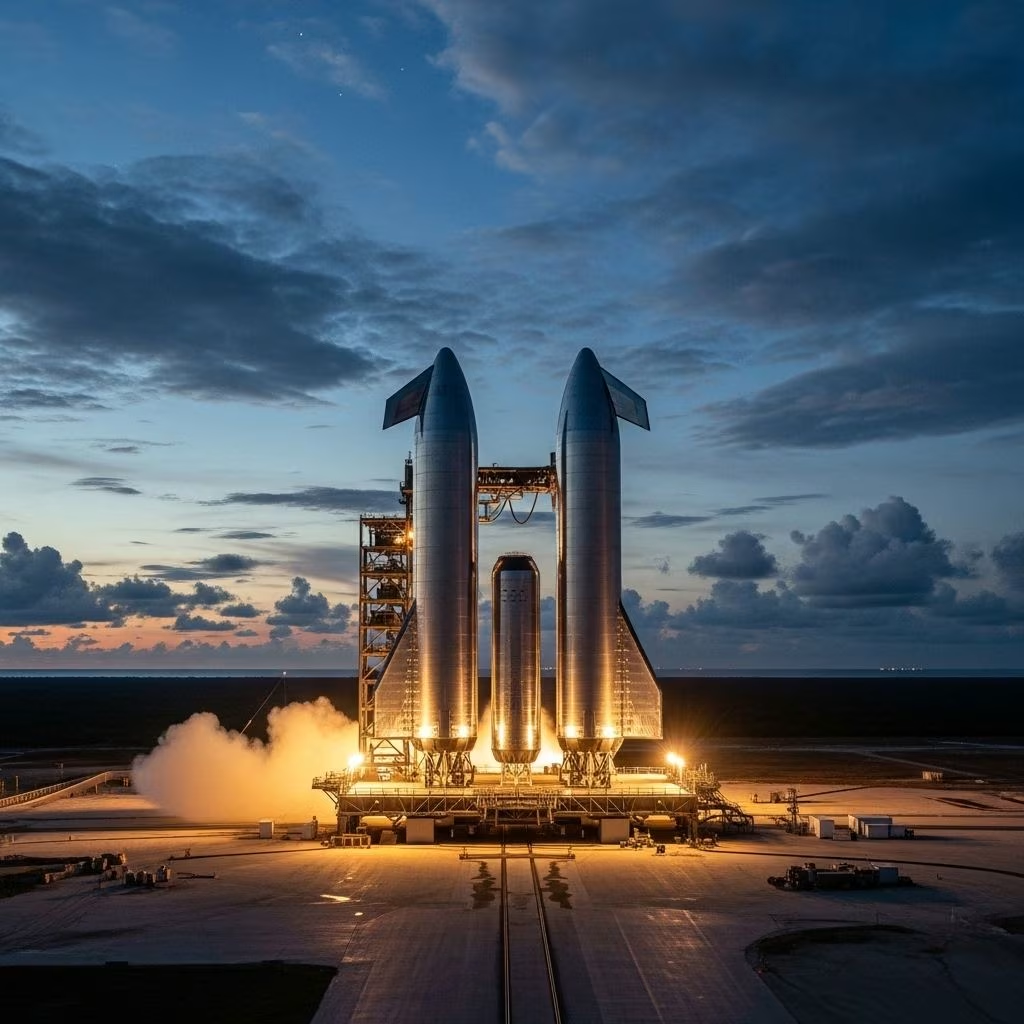
SpaceX Starship Flight 10 Launch: Live Coverage and Key Updates
SpaceX has entered a pivotal phase with the launch of its Starship Flight 10, signaling the next step in the evolution of reusable, heavy-lift rockets. This mission not only tests new hardware combinations and operational objectives but also has far-reaching consequences for NASA’s Artemis program and the broader commercial space sector.
Here, we break down the latest information, technical milestones, and critical questions shaping SpaceX’s Starship roadmap through 2025 and beyond[12].
Starship Flight 10 Launch Timeline and Objectives
Starship Flight 10 is scheduled for launch at 6:30 p.m. CDT (7:30 p.m. EDT / 2330 UTC) from SpaceX’s Starbase in southern Texas. The flight employs Ship 37 as the upper stage and Booster 16 as the Super Heavy first stage[12].
- Previous Incidents: This launch follows three months after Flight 9 encountered multiple issues and two months after a test stand explosion delayed the mission[12].
- Flight Objectives:
- Expand operational envelope for Super Heavy with multiple landing burn experiments.
- Starship’s first payload deployment: Eight large “Starlink simulators”—flat payloads replicating future third-generation satellites[12].
- Multiple reentry experiments targeted at returning the upper stage to the launch site for potential catch and reuse[12].
- Testing mid-flight relight capability for Raptor engines during the coast phase.
Why Is Flight 10 Important?
- It marks SpaceX’s first attempt to deploy a payload during Starship testing, foreshadowing rapid satellite delivery for Starlink and other customers.
- The reentry and landing tests refine the booster’s rapid reuse, which is central to reducing launch costs and supporting future lunar and Mars missions[10].
SpaceX Starship: Redesigns and Technical Innovations
For Flight 10, SpaceX rolled out several key hardware modifications and operational upgrades:
- Booster 16: Enhanced with improved systems for multi-burn landings, essential for safe, precise recovery and rapid turnaround.
- Ship 37: Outfitted for payload deployment and advanced thermal protection to support ambitious atmospheric reentry targets[12].
- Starlink Simulator Payloads: Eight demonstration payloads, each resembling future Starlink satellites—testing new deployment mechanisms for the coming Gen 3 Starlink constellation[12].
- Raptor Engine Improvements: Focused on mid-flight restarts and reliability under demanding conditions.
SpaceX also introduced small but critical adjustments to avionics, grid fins, and interfaces, based on lessons learned from prior test flights and pad incidents. Each iteration aims to drive down costs, improve resilience, and meet NASA and commercial standards for deep space flight[12].
Recent Setbacks and Recovery Efforts
- A June 2025 test stand explosion destroyed the ship originally intended for Flight 10, forcing teams to adapt the manifest and accelerate Ship 37 modifications.
- Flight 9 exposed issues around stage separation and engine relighting; data from those flights direct ongoing upgrades to ship and booster systems[12].
Key Artemis Milestones: NASA Partnerships and Propellant Transfer
The Starship program’s pace directly affects NASA’s lunar ambitions, most pressingly the Artemis Human Landing System (HLS) for Artemis 3. Recent delays have forced both NASA and SpaceX to recalibrate expectations regarding crucial milestones:
- Ship-to-Ship Cryogenic Propellant Transfer: Required for lunar and future Mars rendezvous missions, this technology must be demonstrated before Artemis 3 proceeds. NASA originally targeted the demo for early 2025; new projections place it in Fiscal Year 2026.
- Lunar Flight Hardware Readiness: Starship Version 3—critical for deeper space—is now expected to debut closer to the end of 2025, after multiple missed deadlines.
- Artemis 3 Launch Date: Currently scheduled for mid-2027, with 18–24 months needed for uncrewed lander testing and operational architecture setup once the Florida launch site activates[11].
- NASA’s Watchful Eye: NASA’s Exploration Systems leadership has flagged propellant transfer as the “key milestone,” calling its delay a challenge but part of expected iterative development.
Quote: “As we know, this is a very challenging thing to do and we were anticipating that would be completed by this year. Clearly that is slipping, so we are anxiously watching for their next launch to see if they—how they’re making progress towards achieving that particular milestone.” — Lori Glaze, NASA Acting Associate Administrator for Exploration Systems.
Starship’s Expanding Role in Deep Space Missions
- Mars Colonization: Reusable hardware and propellant transfer demonstrations are prerequisite for crewed Mars missions targeted this decade[10].
- Rapid Satellite Deployment: Large payload capacity and flight frequency can accelerate deployment of commercial and science assets to low Earth orbit, lunar space, and beyond.
Commercial Flights & Launchpad Expansion
SpaceX is preparing for its first Starship launch from Florida’s LC-39A in late 2025, pending regulatory and environmental milestones[11]. This expansion supports both government and private customers:
- Florida Site Importance:
- Strategic location for higher flight rates.
- Up to 44 Starship launches per year proposed after completion of environmental review.
- Infrastructure upgrades underway, including launch tower completion in 2022 and ongoing pad readiness for both Starship and Super Heavy.
- Blue Origin Partnership: Blue Origin plans an uncrewed “Blue Moon” fuel transporter mission to refuel its lunar lander, increasing the pace and intensity of the lunar race[11].
Impacts on the Artemis and Lunar Race
- SpaceX and Blue Origin each play pivotal roles in NASA’s lunar strategy, and both have made significant technical advances in the first half of 2025.
- Confidence among stakeholders is rising as hardware milestones are achieved, despite persistent timeline uncertainties.
Starship Flight History and Future Outlook
| Flight Number | Date | Key Milestone | Outcome |
|---|---|---|---|
| Flight 9 | May 2025 | Stage separation, engine relight | Partial success with issues |
| Flight 10 | August 24, 2025 (planned) | First payload deploy, landing burns | Pending launch |
Looking Ahead: Each Starship launch iteration not only advances hardware readiness but also brings the company and its partners closer to regular lunar, Mars, and commercial deployments.
Frequently Asked Questions (FAQs)
Q: What is the main goal of Starship Flight 10?
A: Flight 10 aims to expand landing capabilities for Super Heavy, perform Starship’s first payload deployment, and test advanced reentry procedures[12].
Q: What payloads are on board Flight 10?
A: The spacecraft will carry eight Starlink simulator payloads, designed to test mechanisms for deploying future third-generation satellites.
Q: How have recent setbacks affected the Starship timeline?
A: Test stand explosions and engineering delays have pushed key milestones, especially NASA’s cryogenic propellant transfer demo, into 2026 or later, but SpaceX continues to accelerate upgrades and infrastructure work[12].
Q: When will SpaceX launch Starship from Florida?
A: SpaceX targets its first Starship launch from LC-39A in late 2025, which is critical for Artemis 3 and future commercial missions[11].
Q: How does Starship contribute to Artemis and Mars missions?
A: Starship’s large payload capacity, reusable boosters, and future propellant transfer capability are essential for delivering the Human Landing System for Artemis 3 and establishing the infrastructure for crewed Mars flight[10].
Conclusion: Flight 10 as the Gateway to Future Space Ambitions
Starship Flight 10 is more than a launch—it is a benchmark for what’s possible in rapid hardware development, operational risk-taking, and partnership between government and private industry. Every milestone—whether successful or requiring revision—moves the vision for lunar, Mars, and commercial dominance forward.
With launchpad expansion in Florida, deeper NASA involvement, and competitive momentum from Blue Origin, SpaceX remains a central force shaping the next era of space exploration.
References
- https://www.spacex.com/updates
- https://www.spacex.com/updates/
- https://en.wikipedia.org/wiki/List_of_Starship_launches
- https://nextspaceflight.com/starship/
- https://spaceflightnow.com/2025/08/16/spacex-schedules-starship-flight-10-details-recent-setbacks/
- https://www.space.com/news/live/spacex-starship-missions-updates
- https://www.youtube.com/watch?v=y9Rv-Q20zRE
- https://spaceflightnow.com/2025/06/19/next-starship-explodes-on-test-stand/
- https://en.wikipedia.org/wiki/SpaceX_Starship
- https://www.space.com/space-exploration/private-spaceflight/spacex-launches-starship-flight-10-critical-test-flight-video
- https://www.youtube.com/watch?v=k3y0C9dSDx0
- https://www.usatoday.com/story/news/nation/2025/08/18/starship-flight-10-spacex-launch/85677490007/
- https://www.humanmars.net/2025/05/spacex-starship-mars-mission-update-2025.html
- https://techcrunch.com/2025/06/19/spacexs-starship-blows-up-ahead-of-10th-test-flight/
- https://rocketlaunch.org/launch-schedule/spacex/starship
- https://www.usatoday.com/story/news/nation/2025/09/20/elon-musk-spacex-starship-flight-11/86236773007/
- https://nextspaceflight.com/launches/agency/upcoming/1/