


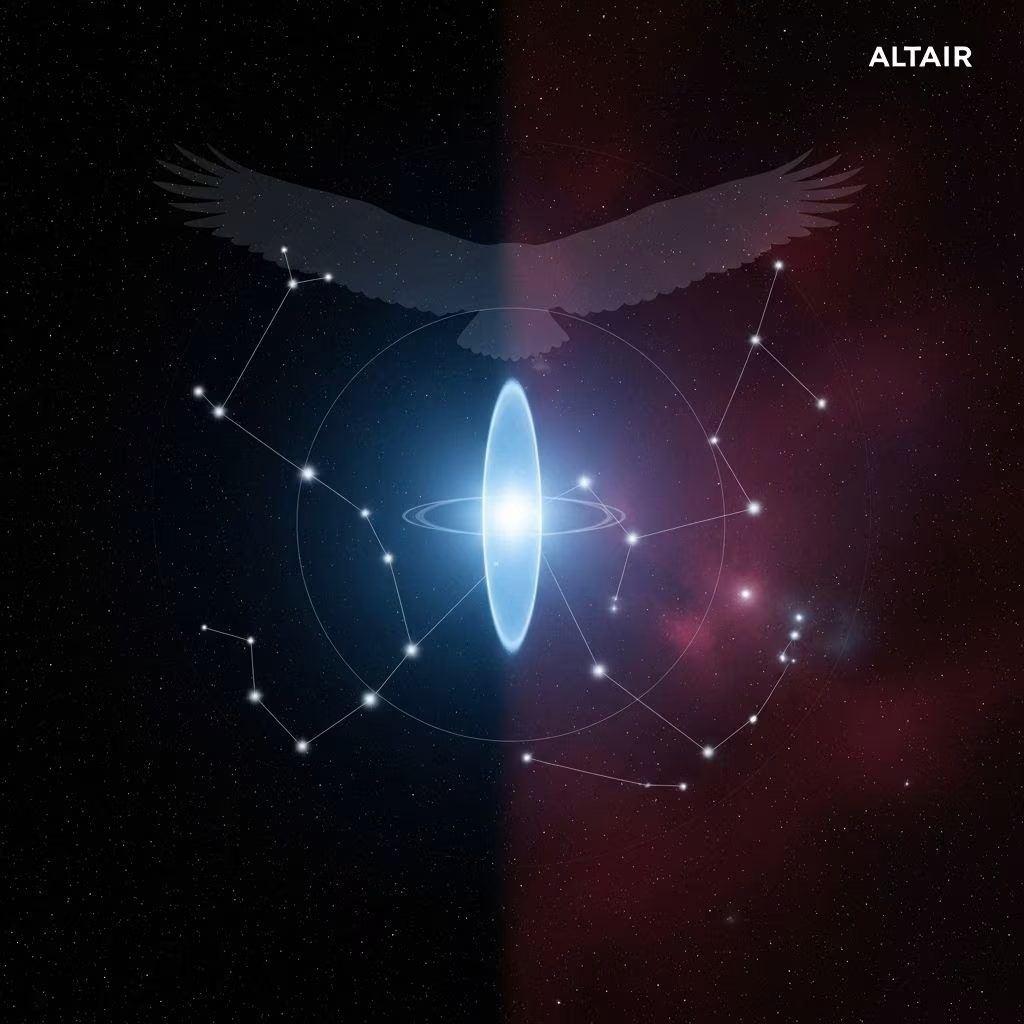
Altair: The Brilliant Heart of Aquila
Altair, the brightest star in the constellation Aquila, glows as one of the most prominent celestial bodies in the summer night sky of the Northern Hemisphere. With its ancient connections to mythology, its importance in modern astronomy, and its unique astrophysical properties, Altair stands as a fascinating subject for stargazers, historians, and scientists alike.
Quick Facts About Altair
- Stellar Classification: A-type main-sequence star (A7V)
- Apparent Magnitude: 0.77
- Distance from Earth: 16.7 light-years
- Diameter: Approximately 1.8 times that of the Sun
- Mass: 1.7 times that of the Sun
- Rotation Period: Less than 10 hours
- Other Designations: Alpha Aquilae
The Location and Visibility of Altair
Altair marks the southern point of the iconic Summer Triangle, a prominent seasonal asterism that includes the bright stars Vega in Lyra and Deneb in Cygnus. It is particularly easy to spot because of its high visibility:
- Visible from both Northern and Southern Hemispheres, though best seen in the north.
- Located in the constellation Aquila, the Eagle, near the celestial equator.
- Forms a line in the sky with Vega (to the northwest) and Deneb (to the northeast).
Altair’s proximity to Earth makes it the twelfth-brightest star in the night sky. Its brightness (magnitude 0.77) and location just above the celestial equator ensure it rises high overhead for mid-latitude observers during summer months.
Physical Properties of Altair
Altair’s brightness and color hint at its exceptional attributes. Astronomers have scrutinized this star and found several key characteristics:
- A Spectral Type A7V star: This classification means Altair is a white, hydrogen-burning dwarf star.
- Mass and Size: 1.7 times the Sun’s mass and about 1.8 times its diameter.
- Rapid Rotation: One of Altair’s most notable features is its extremely rapid rotation, with a period under 10 hours (compared to the Sun’s 25 days at the equator).
- Oblate Shape: Its fast spin causes it to bulge along the equator—an effect known as “oblateness.” Altair is about 20% wider at its equator than pole-to-pole.
This rapid rotation has several astrophysical consequences, including equator-to-pole temperature differences and possible atmospheric turbulence.
Table: Altair Compared to the Sun
| Property | Altair | Sun |
|---|---|---|
| Type | A7V (Main Sequence) | G2V (Main Sequence) |
| Mass | 1.7 solar masses | 1.0 |
| Diameter | 1.8 solar diameters | 1.0 |
| Temperature | ~7,700 K | ~5,800 K |
| Approx. Age | About 1.2 billion years | About 4.6 billion years |
| Rotation Period | < 10 hours | ~25 days |
| Apparent Magnitude | 0.77 | -26.74 (as seen from Earth) |
| Distance from Earth | 16.7 light-years | ~0 |
The Summer Triangle and Altair’s Role
The so-called Summer Triangle is an important navigation aid and a favorite asterism among stargazers. Its vertices are marked by three first-magnitude stars—Vega, Deneb, and Altair—each corresponding to a different constellation:
- Vega – Lyra
- Deneb – Cygnus
- Altair – Aquila
The Summer Triangle is visible from dusk to dawn in summer and early autumn in the Northern Hemisphere. Altair, sitting at the southern point, is distinctive for several reasons:
- It stands out as the closest of the trio to Earth.
- Its rapid movement across the sky mirrors the “flight” of its mythological eagle.
- Altair, together with the stars Tarazed and Alshain, forms another prominent triangle in Aquila, sometimes called the “bird constellation’s wings.”
Altair in World Mythology
Through millennia, Altair has inspired countless stories and legends:
Greco-Roman Mythology
In Greek myth, Aquila represents the eagle of Zeus (Jupiter in Roman mythology). The eagle was said to carry Zeus’s thunderbolts or, alternately, to ferry Ganymede up to Mount Olympus to serve as cupbearer of the gods. Altair, as the brightest star, marks the heart or head of the celestial eagle.
Chinese and Japanese Lore
- In Chinese mythology, Altair is known as Niulang (the Cowherd). The tale tells of the star’s annual reunion with Zhinü (the star Vega, the Weaver Girl), separated each year by the “Heavenly River” (the Milky Way) except for the seventh day of the seventh lunar month—this reunion is celebrated as the Qixi Festival.
- In Japanese tradition, this meeting is celebrated as the Tanabata Festival, featuring wishes written on colored strips and hung from bamboo.
These star-crossed lovers’ tale is an enduring symbol of love, longing, and fate in East Asia.
Arab and Islamic Tradition
The name “Altair” derives from the Arabic phrase al-Nasr al-Tair—”the flying eagle.” The star’s companion stars in Aquila, Tarazed and Alshain, also bear Arabic names and together form the eagle’s body and wings as visualized by early Arab astronomers.
Scientific Investigations of Altair
Altair occupies a special place in astrophysics:
- Interferometric Imaging: Altair’s rapid spin and resulting oblateness have made it a primary subject of study for high-resolution imaging—one of the first stars whose surface has been imaged directly using optical interferometry.
- Differential Rotation Studies: Scientists have observed temperature differences between the poles and equator, as the equator spins faster and is less gravitationally compressed, leading to a cooler, dimmer equatorial band.
- Exoplanet Surveys: Though no confirmed exoplanets orbit Altair, its rapid rotation and peculiar characteristics make the environment around it an area of ongoing investigation.
Research on Altair helps astronomers develop models of stellar evolution and internal dynamics, especially for fast-spinning stars.
Observing Altair: When and Where
Altair is easy to find for much of the year. Here is how you can spot it:
- Best view: July through September, during northern summer nights.
- Look for the Summer Triangle high overhead around midnight.
- Altair is often the lowest and southernmost of the three triangle stars, often twinkling less than others due to its brightness and relative closeness.
- Use binoculars to observe Altair’s subtle, blue-white hue and the nearby stars Tarazed and Alshain.
What to Expect with the Naked Eye and Equipment
- To the unaided eye: Altair appears as a bright, steady white point of light.
- Through binoculars or a small telescope: No disk or features can be seen directly, but the star’s color and its alignment with the “wings” of the eagle become clearer.
- Astrophotography: Altair’s brilliance makes it easy to image in wide-field photos of the Summer Triangle or Milky Way.
Altair and Modern Astronomy
Altair’s nearness to Earth, combined with its peculiar properties, have made it a favorite target for both professional and amateur astronomers. Its proximity means its light takes only about 17 years to reach us, allowing relatively detailed study with modern telescopes and instruments. Notable topics of current research include:
- Surface imaging: Direct imaging of Altair’s oblate shape using optical interferometry arrays.
- Rotation effects: Studying how quick spins affect stellar evolution and structure.
- Stellar oscillations: Examining subtle changes in the star’s brightness and spectral lines.
Astrophysics Insights
Altair is considered a “natural laboratory” for investigating how rotation influences stars’ forms and lifecycles. The intensity differences between Altair’s poles and equator, for example, help confirm predictions from advanced stellar modeling. Its study enhances our understanding of stars more massive than the Sun, particularly those in their hydrogen-burning, main-sequence phase.
Fun Facts and Trivia About Altair
- Altair spins so quickly that a day on Altair lasts only about 9 hours.
- If Altair rotated just a bit faster, it might break apart due to centrifugal forces at the equator.
- Altair’s light is so bright because of its closeness—just 16.7 light-years away.
- The name “Aquila” means “eagle” in Latin, reinforcing the connection to both its appearance and mythological significance.
- In science fiction, “Altair IV” was the location of the alien planet in the 1956 movie “Forbidden Planet.”
Frequently Asked Questions (FAQs)
Q: What constellation is Altair in?
A: Altair marks the brightest point in the constellation Aquila, the Eagle.
Q: How can I find Altair in the night sky?
A: Look for the Summer Triangle asterism. Altair is the southernmost and lowest “corner” of the triangle, best seen during July to September in the northern hemisphere.
Q: Why is Altair spinning so quickly?
A: Altair’s rapid spin is due to its relatively young age and mass. Fast rotation is more common among early-type stars. Its short rotation period (under 10 hours) leads to noticeable bulging at the equator.
Q: Does Altair have any known exoplanets?
A: As of now, no confirmed exoplanets have been discovered around Altair, though it remains under observation due to its proximity and unique properties.
Q: What is the significance of Altair in Asian mythology?
A: In Chinese and Japanese mythology, Altair (Niulang or Hikoboshi) is the star-crossed lover of Vega (Zhinü or Orihime), separated by the Milky Way. This story is honored in the Qixi and Tanabata festivals.
Conclusion: Why Altair Matters
Altair is astronomically important and culturally rich—one of the anchoring stars of our night sky, a source of scientific breakthroughs, and the inspiration for centuries of myth and art. Whether you are an amateur astronomer, a lover of legends, or just someone who enjoys a clear summer night, Altair offers a window into both our universe and the ways humanity has sought to understand it.
References
- https://www.space.com/stargazing/astronomy-kit/altair-hypercam-26c-aps-c-colour-tec-astronomy-camera-review
- https://altairspace.com
- https://altair.com/blog/articles/from-ai-to-orbit-five-initiatives-shaping-the-future-of-aerospace
- https://www.spacedaily.com/reports/Millennium_Space_Systems_Completes_Successful_ALTAIR_Pathfinder_Mission_999.html
- https://www.space.com/16149-night-sky.html
- https://altair.com/aerospace
- https://ntrs.nasa.gov/api/citations/20090040378/downloads/20090040378.pdf
- https://www.spacedaily.com/news/software-99b.html
- https://altair.com/aerospace-startup-acceleration-program
- https://en.wikipedia.org/wiki/Altair
- https://orionsarm.com/eg-article/45f0c3797f2fa
- https://www.engineering.com/altair-talks-eus-space-industry-and-its-ai-cae-and-hpc-plans-for-dominance/
- https://altair.vanillastaging.com
- https://digitalcommons.usu.edu/cgi/viewcontent.cgi?article=3028&context=smallsat
- https://www.orionsarm.com/eg-article/45f0c3797f2fa
- https://www.altairastronomy.com/project-altair
- https://www.youtube.com/watch?v=NSXjEuvag9s
- https://www.emergingtechbrew.com/stories/2024/02/27/Altair-meet-the-company-at-the-center-of-rocket-science-and-data-science
- https://www.britannica.com/place/Altair-star
- https://skyandtelescope.org/observing/meet-altair-eagle/


