What Is a Spiral Galaxy?
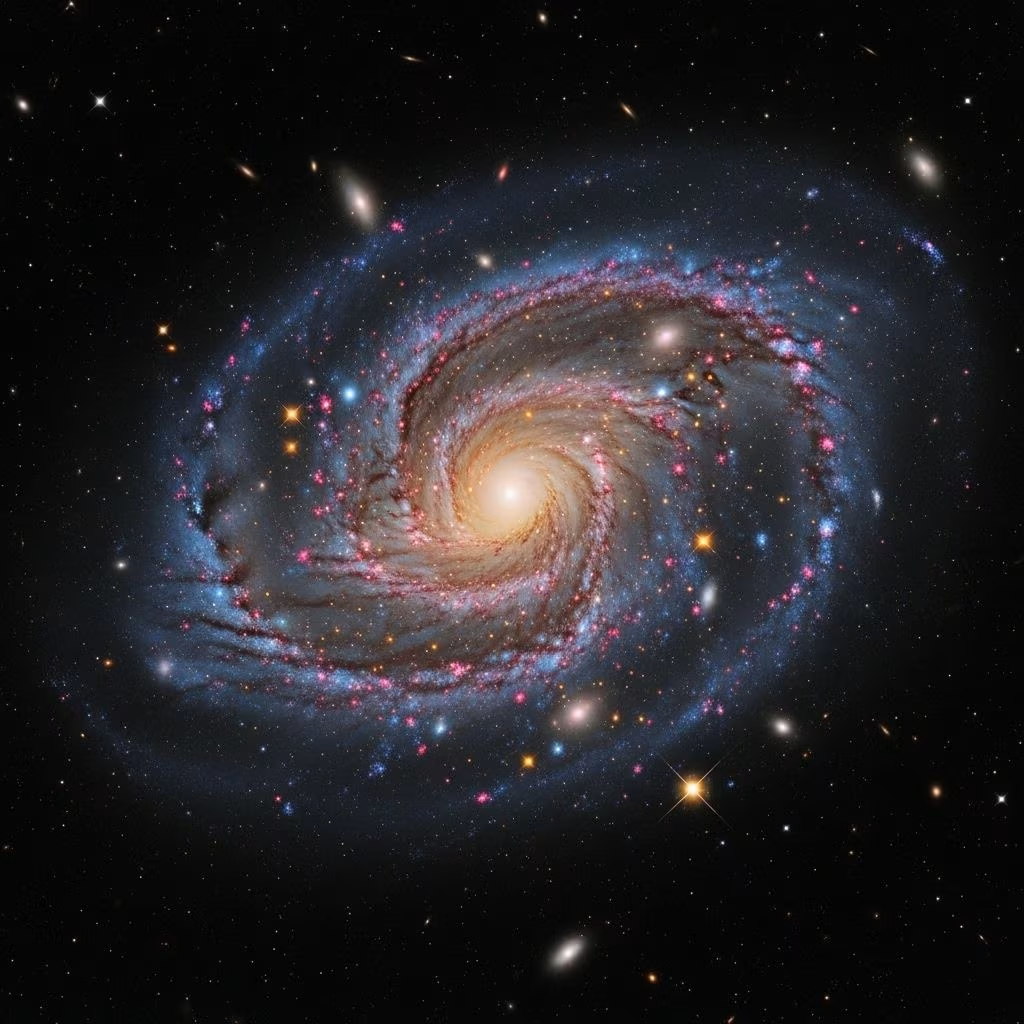
Spiral galaxies are among the most visually striking and scientifically significant structures in the cosmos. Characterized by their sweeping, pinwheel-shaped arms and glowing central bulges, these stellar systems are home to the majority of stars in the universe—including our own Sun, nestled within the Milky Way. Understanding spiral galaxies unlocks key insights into galactic evolution, star formation, and the large-scale structure of the universe.
Defining Spiral Galaxies: Structure and Main Features
A spiral galaxy is a vast, rotating aggregation of stars, gas, and dust, highlighted by distinctive spiral arms that wind outward from a dense central hub. These arms are sites of active star formation and are often rich in young, hot, blue stars. Spiral galaxies typically comprise several key components:
- Central Bulge: A densely packed spherical region of older stars at the core.
- Spiral Arms: Bright, curved extensions emerging from the central bulge—home to new stars, nebulae, and clusters.
- Rotating Disk: A flat region containing most of the galaxy’s mass, including stars, stellar remnants, gas, and dust.
- Galactic Halo: A roughly spherical volume surrounding the disk, containing faint stars and globular clusters.
Most spiral galaxies also possess a bar-shaped region of stars cutting through the central bulge. These galaxies are known as barred spiral galaxies, a feature evident in the Milky Way itself.
The Hubble Sequence and Classification of Spiral Galaxies
Astronomers classify galaxies using the Hubble sequence, which divides them into several broad types based on their appearance:
- Spiral Galaxies (S): Possess curved arms and a prominent disk.
- Barred Spiral Galaxies (SB): Feature a central bar structure through the bulge; arms extend from the ends of the bar.
- Elliptical Galaxies (E): Appear as round or elongated collections of stars, without arms or disks.
- Irregular Galaxies (Irr): Lack any defined shape or structure.
Spiral galaxies are further subdivided according to how tightly their arms are wound and the size of their central bulge, e.g., “Sa”, “Sb”, and “Sc” types. “Sa” galaxies have tightly wound arms and a large bulge, while “Sc” galaxies display looser arms and a smaller bulge.
Table 1: Main Structural Components of Spiral Galaxies
| Component | Description |
|---|---|
| Central Bulge | Dense, spherical cluster of older stars at the galaxy’s heart |
| Spiral Arms | Curving regions rich in gas, dust, and young, hot stars |
| Bar (if present) | Linear band of stars passing through the bulge |
| Disk | Flat, rotating subsystem containing the bulk of the stars and interstellar material |
| Halo | Faint, roughly spherical region with old stars and globular clusters |
Types of Spiral Galaxies
The spiral galaxy category is rich and varied, reflecting different physical properties and evolutionary stages. Two main types are recognized:
- Normal Spiral Galaxies (S): Featuring arms that emerge directly from the central bulge and wind around the disk.
- Barred Spiral Galaxies (SB): Defined by a prominent linear bar of stars through the core; spiral arms extend from the bar’s ends. Around two-thirds of all spiral galaxies exhibit bars, including the Milky Way.
Within these, further subdivisions are denoted with letters (a–c):
- Sa / SBa: Tightly wound arms, large central bulge.
- Sb / SBb: Moderately wound arms, medium-size bulge.
- Sc / SBc: Loosely wound arms, small bulge, more apparent star-forming regions.
How Do Spiral Galaxies Form?
The formation of spiral galaxies is a subject of ongoing astronomical research and debate. The leading theories suggest:
- Initial Disk Formation: Protogalactic clouds collapse under gravity to form rotating disks of stars and gas.
- Density Waves: The classic spiral pattern arises as density waves—regions of higher density—sweep through the galactic disk, compressing gas and spurring new star formation along the arms.
- Gravitational Interactions: Encounters with neighboring galaxies can enhance or distort the spiral structure, contributing to the observed diversity among spirals.
Spiral galaxies tend to be relatively young compared to ellipticals, with ongoing star formation and abundant interstellar material, bringing dynamism and color to their appearance.
Appearance of Spiral Galaxies: Face-on vs. Edge-on
The observed shape of a spiral galaxy depends on its orientation relative to Earth:
- Face-on View: The brilliant spiral arms and central bulge are fully visible, showcasing the iconic pinwheel pattern.
- Edge-on View: Only the thin edge of the disk is seen, sometimes bisected by dark bands of dust. Examples include the Sombrero Galaxy and NGC 891.
Orientation plays a crucial role in how astronomers classify and study spiral galaxies, as many details can be hidden in edge-on systems.
Major Examples of Spiral Galaxies
- Milky Way: Our own galaxy, a classic barred spiral.
- Andromeda Galaxy (M31): The nearest spiral galaxy to the Milky Way, notable for its size and proximity.
- Whirlpool Galaxy (M51): A spectacular face-on spiral, famous for its well-defined arms.
- Pinwheel Galaxy (M101): Renowned for its large, loosely wound spiral arms.
- Triangulum Galaxy (M33): A small, nearby spiral exhibiting prominent star-forming regions.
The Role and Importance of Spiral Galaxies in the Universe
- Cosmic Habitats: Around 60% of all galaxies are spiral, making them the predominant stellar hosts in the universe.
- Star Formation: Their spiral arms are hubs of active star creation, making them vital laboratories for studying stellar evolution.
- Galactic Evolution: Current models suggest spirals may evolve into elliptical galaxies through mergers and other cosmic events.
- Probing the Dark: The rotation curves of spiral galaxies provided some of the earliest evidence for the existence of dark matter.
The Mystery of Spiral Structure
The persistence of spiral arms is a continuing puzzle in astrophysics. Simple rotation models suggest arms should wind up and fade over time. However, density wave theory proposes that spiral arms are not material arms, but patterns of higher density moving through the disk, organizing stars and gas into the familiar spiral shape.
Ongoing research with powerful telescopes such as the Hubble Space Telescope and the James Webb Space Telescope aims to further unravel these mysteries, offering sharp views of spiral structures in our own galaxy and beyond.
Images and Observations
The splendor of spiral galaxies is matched only by the detail revealed in modern astronomical imagery. Stellar surveys and deep exposures have cataloged billions of stars within sweeping spiral arms, major dust lanes, and glowing star-forming knots. The Andromeda Galaxy, for example, has been imaged in such detail that individual stars can be observed in its arms.
- Hubble Space Telescope and ESA observatories have produced unprecedented views of spiral galaxies like NGC 1300 and the Andromeda Galaxy.
- These images aid in understanding star formation, galactic dynamics, and evolutionary history.
Spiral Galaxies vs. Other Galaxy Types
| Property | Spiral Galaxy | Elliptical Galaxy | Irregular Galaxy |
|---|---|---|---|
| Shape | Flat disk with spiral arms | Round to elongated; no arms | No defined shape |
| Star Population | Mostly young, hot stars with old stars in bulge | Mainly older, red stars | Mixed, often young |
| Star Formation | High, especially in arms | Low or none | Varies; often high |
| Gas & Dust Content | Abundant | Low | Irregular; can be high |
| Rotation | Significant; organized motion | Random motion | Varies |
Frequently Asked Questions (FAQs)
Q: What is the Milky Way’s galaxy type?
A: The Milky Way is classified as a barred spiral galaxy, with a prominent central bar and well-defined spiral arms.
Q: Why do spiral galaxies have arms?
A: Spiral arms are explained by density wave theory; they are regions of higher density within the galactic disk that spark ongoing star formation and shape the iconic spiral pattern.
Q: What percentage of galaxies are spiral?
A: Around 60% of all observable galaxies are spiral or barred spiral, making them the most common galaxy type in the universe.
Q: What makes spiral galaxies important for astronomers?
A: Spiral galaxies are active sites for star formation, contain significant interstellar material, and help probe cosmic mysteries like dark matter and galactic evolution.
Q: Can spiral galaxies evolve into other types?
A: Yes, interactions and mergers can transform spiral galaxies into ellipticals, especially as star formation slows and galaxies merge or lose material.
References
- https://en.wikipedia.org/wiki/Spiral_galaxy
- https://esahubble.org/wordbank/spiral-galaxy/
- https://esawebb.org/wordbank/spiral-galaxy/
- https://science.nasa.gov/universe/galaxies/types/
- https://www.amnh.org/exhibitions/permanent/the-universe/galaxies/spiral-galaxies
- https://www.space.com/22382-spiral-galaxy.html
- https://astronomy.swin.edu.au/cosmos/I/Spiral+Galaxy
- https://www.vedantu.com/physics/spiral-galaxy
- https://study.com/academy/lesson/spiral-galaxy-definition-facts-quiz.html
- https://en.wikipedia.org/wiki/Spiral_galaxies
- https://www.astro.umd.edu/~richard/ASTRO620/A421_Spirals_Lec16.pdf
- https://www.analyticssteps.com/blogs/spiral-galaxy-types-and-features
- https://ned.ipac.caltech.edu/level5/ESSAYS/Elmgreen/elmgreen.html
- https://www.britannica.com/science/spiral-galaxy
- https://byjus.com/physics/galaxies/
- https://courses.lumenlearning.com/suny-astronomy/chapter/spiral-structure/
- https://study.com/academy/lesson/types-of-spiral-galaxies.html
- https://coolcosmos.ipac.caltech.edu/ask/217-What-is-a-spiral-galaxy-
- https://nineplanets.org/spiral-galaxies/
- https://courses.lumenlearning.com/suny-astronomy/chapter/types-of-galaxies/