


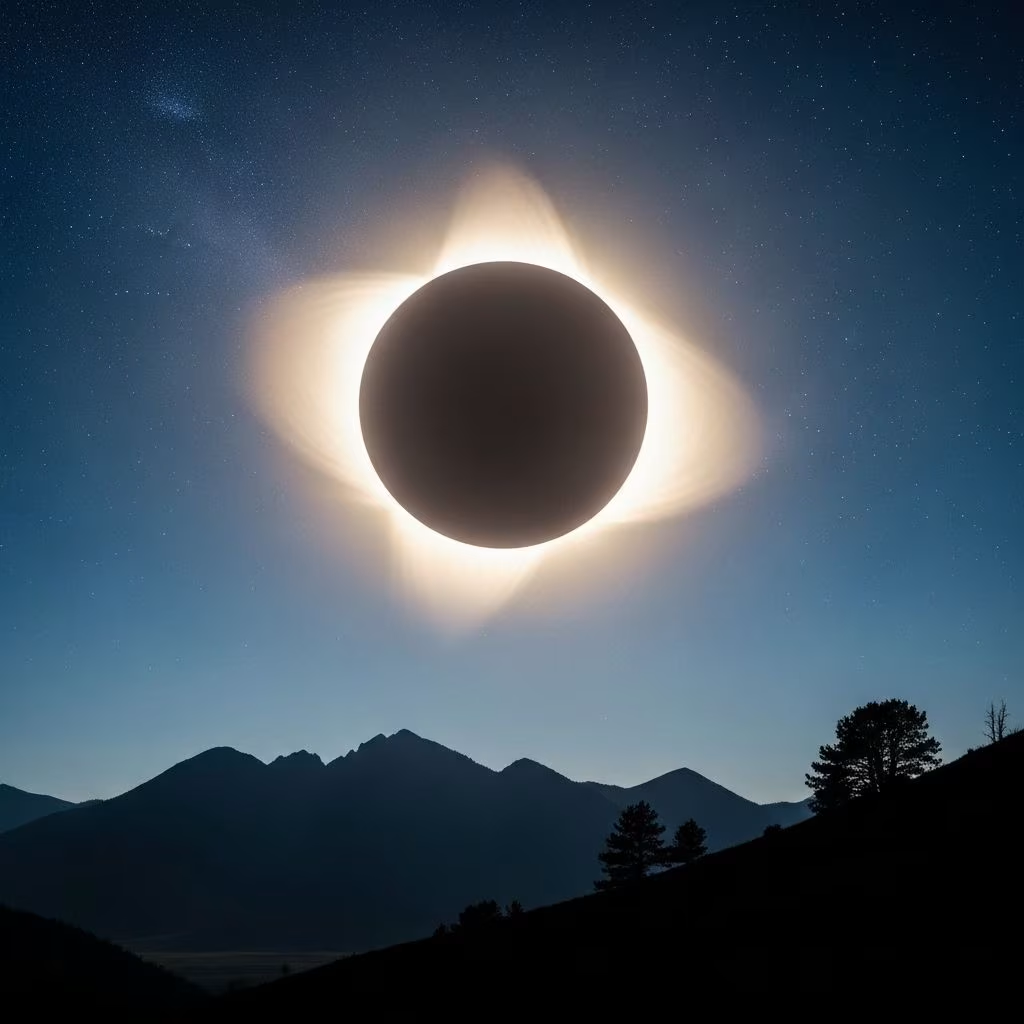
No, The World Won’t Go Dark on August 2: Debunking the Blackout Myth
Viral rumors and persistent social media claims have recently suggested that the entire world will be plunged into darkness for six minutes on August 2 due to a rare solar eclipse. This alarming notion has captured the imagination of millions—yet it is entirely false. There will be no global blackout on August 2, 2025, nor any other date in the near future. The real story is rooted in astronomical fact: a truly remarkable total solar eclipse is indeed approaching, but not in 2025 and not for all corners of the globe. Instead, the “eclipse of the century” is set to occur on August 2, 2027, and its unique characteristics are already capturing the interest of astronomers and the public alike.
Separating Fact From Fiction: Viral Claims vs. Reality
The myth of a worldwide blackout on August 2, 2025, has been fueled by misleading viral posts and edited videos, often making unverified or sensational claims. According to NASA and international observatories:
- There is no major solar eclipse on August 2, 2025.
- The rumor of a “six-minute global blackout” is a hoax. Astronomical records do not support this claim.
- The next truly remarkable total solar eclipse occurs on August 2, 2027—not 2025.
- No solar or lunar event can create a global blackout; eclipses only affect localized areas on Earth’s surface.
What will actually happen is far more scientifically fascinating—if you’re in the right place at the right time.
The Eclipse of the Century: August 2, 2027
The total solar eclipse on August 2, 2027, is earning its title as the “eclipse of the century” for several reasons:
- Longest duration of totality in the 21st century on land, reaching up to 6 minutes and 22 seconds at its peak—almost twice as long as the average total eclipse.
- Widespread visibility: the path of totality crosses densely populated regions in Europe, North Africa, and the Middle East, allowing millions to experience it firsthand.
- This will be the longest total solar eclipse since 1991 and the longest until 2114.
What Really Happens During a Total Solar Eclipse?
A total solar eclipse occurs when the Moon passes directly between the Earth and the Sun, perfectly aligning so the Sun’s disk is completely blocked from view for observers along a narrow path called the path of totality. Here’s what viewers may experience:
- The sky rapidly darkens, resembling twilight even during midday.
- Temperatures drop noticeably as sunlight vanishes.
- The Sun’s corona—its outermost atmosphere—becomes visible to the naked eye as a ghostly, glowing wreath.
- Stars and planets may appear in the daytime sky.
Path of Totality
The total eclipse is observable only within a narrow band—typically around 100–160 miles (about 160–260 km) wide—traced by the Moon’s shadow. Areas outside this path see only a partial eclipse, with the Sun partially covered and twilight effects muted.
What Makes the 2027 Eclipse So Long and Rare?
The duration of a total eclipse depends on several unique celestial conditions. On August 2, 2027:
- The Moon will be at perigee—its closest approach to Earth—making it appear larger and enabling it to cover the Sun for longer.
- The Earth will be at aphelion—its farthest point from the Sun—making the Sun appear slightly smaller in our sky.
- The eclipse path passes near the equator, where the Moon’s shadow travels more slowly across the surface, further increasing the maximum duration of totality.
This cosmic alignment allows for an exceptional totality lasting over 6 minutes at its peak—an astronomical rarity.
When and Where Will the August 2, 2027 Eclipse Be Visible?
The 2027 total solar eclipse will trace a path of totality over eleven countries in southern Europe, North Africa, and the Middle East. The experience of totality and the duration will vary depending on location.
| Country/Region | Totality Duration (approx.) | Notable Cities/Areas |
|---|---|---|
| Spain | Up to 4 minutes | Cádiz, Tarifa |
| Gibraltar | ~4 minutes | |
| Morocco | Up to 5.5 minutes | Northern and central regions |
| Algeria | Up to 6 minutes | – |
| Tunisia | ~6 minutes | – |
| Libya, Egypt, Sudan | 6+ minutes | Some areas near the maximum duration |
| Saudi Arabia, Yemen, Oman, Somalia | Up to 5 minutes | – |
Major cities such as Luxor (Egypt) and Mecca (Saudi Arabia) will also experience significant periods of darkness. In other regions of the world, only a partial eclipse—or no eclipse at all—will be visible.
What About India?
For those in India, the August 2, 2027 eclipse will be partial only. Western and northwestern states such as Rajasthan, Gujarat, Maharashtra, and Goa will see the Sun obscured between 10% and 30% during the late afternoon (around 4-6 PM IST). Visibility in some areas, especially coastal cities, may be limited by sunset. To safely observe even a partial eclipse, eclipse glasses or indirect viewing methods will be required at all times.
Global Coverage: Who Will Miss the Show?
The shadow of totality is narrow and exclusive. The 2027 eclipse will not be visible as total or even significant partial phases in:
- North America
- Eastern and southern Asia
- Large portions of Australia
- Most of South America
For observers in these regions, the event can be enjoyed vicariously through online livestreams and broadcasts organized by observatories and space agencies across the world.
Why Does the Path of Totality Vary?
Eclipses result from the specific geometric alignment of the Moon, Earth, and Sun. The Moon’s shadow traces a limited pathway across the Earth, creating a so-called “eclipse track.” Key factors influencing this path include:
- The tilt of the Moon’s orbit
- The Earth’s tilt and orbit around the Sun
- The point at which the Moon’s shadow intersects the Earth
Consequently, only people located within the narrow corridor of totality will witness the Sun’s complete cover. Others will experience a partial eclipse or none at all.
Why Is This Eclipse Important to Scientists?
Total solar eclipses like the one in 2027 offer rare and invaluable opportunities for scientific research, especially given its extended totality:
- Detailed study of the solar corona: Astronomers can capture high-resolution images and spectra of the Sun’s outer atmosphere, usually hidden by intense sunlight.
- Tracking solar flares and coronal mass ejections: Longer totality gives more time to monitor solar activity and its impact on space weather.
- Atmospheric and environmental observations: Scientists can measure rapid changes in temperature, wind patterns, and even animal behavior.
- Education and public engagement: Eclipses inspire interest in science and are occasions for mass educational outreach.
Preparing to Watch the Eclipse: Safety and Viewing Tips
- Never look directly at the Sun (even during a partial eclipse) without proper protection, such as ISO-certified eclipse glasses.
- Pin-hole projectors and solar film filters are safe indirect viewing methods.
- If in the path of totality: it is only safe to view with the naked eye during totality—when the Sun is fully blocked by the Moon. Put protection back on immediately as the first rays reappear.
- Check local timing and weather conditions to optimize viewing chances.
- Participate in events organized by observatories, astronomical societies, or educational institutions for guided and safe viewing.
Common Questions and Answers
Q: Will the entire world really experience darkness on August 2?
A: No. Solar eclipses, even at their most dramatic, cast shadows only on specific paths covering a tiny strip of Earth. The 2027 eclipse’s totality will affect only certain regions in southern Europe, North Africa, and the Middle East.
Q: Is there any solar eclipse on August 2, 2025?
A: No solar or lunar eclipses will darken the world on August 2, 2025. Claims suggesting a global blackout on this date are not rooted in any astronomical predictions or data.
Q: What causes the ‘eclipse of the century’ to be so special?
A: The duration of totality (over six minutes), the proximity of the Moon (perigee), the Sun’s position (aphelion), and the large number of people directly in the path of totality make this eclipse a once-in-a-century event.
Q: Can I see the eclipse from the United States or Australia?
A: No. The path of totality does not cross North America or Australia. Viewers in these areas may enjoy online coverage or plan travel to locations within the path.
Q: How often do total solar eclipses happen?
A: Total solar eclipses occur somewhere on Earth every 18 to 24 months. However, any given location will experience totality only once every 375 years on average.
Q: Are there organized events for the 2027 eclipse?
A: Yes. National space agencies, observatories, and astronomical societies are planning public viewing events and live broadcasts accessible globally, especially in countries along the path of totality.
Q: What’s the difference between a total and partial solar eclipse?
A: In a total solar eclipse, the Moon completely covers the Sun, resulting in total darkness for a short period. In a partial eclipse, only part of the Sun is covered, so the sky dims but the Sun remains visible (and dangerous to view directly).
Key Takeaways for Stargazers and the Curious
- The August 2, 2027, eclipse will be the longest and most dramatic total solar eclipse of the 21st century visible from land.
- Only a narrow part of the world will experience totality; there is no threat of global darkness.
- Stay informed with reliable sources—NASA, major observatories, and scientific outlets—to avoid misinformation as the event approaches.
- Plan ahead for safe and unforgettable viewing opportunities if you are near the path of totality.
Further Resources
- NASA Eclipse Web Portal
- Timeanddate.com Eclipse Explorer
- Local astronomy clubs and observatories
Remember: never rely on social media rumors for astronomical events. Rely on trusted astronomical institutions for updates and safety guidelines.
References
- https://www.space.com/stargazing/solar-eclipses/no-the-whole-world-wont-go-dark-on-aug-2-but-a-once-in-a-century-eclipse-is-coming
- https://www.timeanddate.com/eclipse/solar/2027-august-2
- https://www.ndtv.com/offbeat/solar-eclipse-on-august-2-2025-know-truth-behind-viral-claims-next-total-solar-eclipse-is-on-8994522
- https://economictimes.com/news/new-updates/the-longest-solar-eclipse-of-the-century-is-coming-on-august-2-six-minutes-of-darkness-in-the-afternoon-whats-really-happening/articleshow/122931568.cms
- https://www.jagranjosh.com/general-knowledge/will-there-be-a-solar-eclipse-on-august-2-2025-will-it-be-visible-from-india-1820001151-1
- https://economictimes.com/news/international/us/solar-eclipse-august-2-will-usa-go-dark-for-6-minutes-when-and-where-to-watch/articleshow/122954803.cms
- https://science.nasa.gov/eclipses/future-eclipses/
- https://www.usatoday.com/story/news/nation/2025/08/01/solar-eclipse-august-2-2027/85441432007/
- https://timesofindia.indiatimes.com/astrology/planets-transits/solar-eclipse-on-august-2-real-or-fake-lets-know-the-truth/articleshow/122850159.cms
- https://timesofindia.indiatimes.com/technology/tech-news/solar-eclipse-on-august-2-nasa-update-on-entire-world-going-in-6-minutes-of-complete-darkness/articleshow/123057869.cms
- https://en.wikipedia.org/wiki/Solar_eclipse_of_August_2,_2027
- https://www.outlooktraveller.com/News/fact-check-no-total-solar-eclipse-on-august-2-2025-heres-when-it-actually-happens
- https://www.timeanddate.com/eclipse/2025
- https://www.northjersey.com/story/news/2025/08/02/solar-eclipse-2025-will-there-be-a-solar-eclipse-today-is-there-a-solar-eclipse-today-time-aug-2/85479695007/
- https://www.hindustantimes.com/world-news/is-there-a-total-solar-eclipse-today-august-2-and-six-minutes-of-darkness-across-world-what-nasa-said-not-true-101754095046556.html
- https://www.youtube.com/watch?v=VyrazdV1JpM
- https://www.youtube.com/watch?v=50WPe5mz7x8
- https://www.skyatnightmagazine.com/news/august-2-2027-solar-eclipse
- https://orbitaltoday.com/2025/07/22/will-the-skies-darken-rumours-swirl-over-august-2025-eclipse/


