Jupiter’s Temperature: Unraveling the Mysteries of a Giant’s Extreme Climate
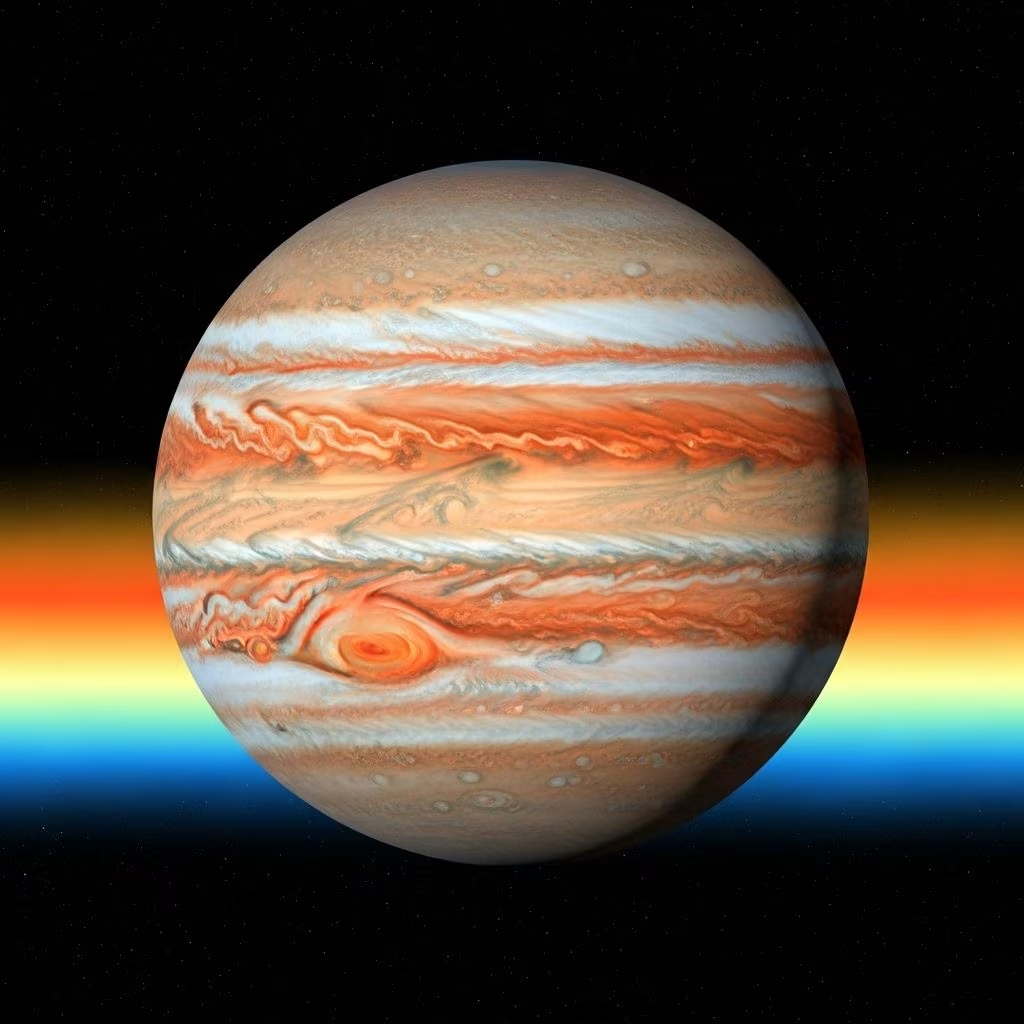
Jupiter, the largest planet in our solar system, harbors some of the most dramatic temperature extremes known, ranging from unfathomably frigid cloud tops to a searing, energetic interior. Unlike terrestrial planets, Jupiter’s temperature profile is shaped by its composition, distance from the Sun, and unique atmospheric and magnetic phenomena. This article explores how temperatures shift among Jupiter’s atmospheric layers, what heats the planet, and how its powerful auroras play a surprising role in global climate dynamics.
The Basics: Jupiter’s Average Temperatures
Jupiter is overwhelmingly cold at the level equivalent to Earth’s surface pressure: the average temperature at this benchmark ‘surface’ is about -234°F (-145°C) (or roughly -110°C/-160°F as cited by other reputable sources). This corresponds to an altitude where Jupiter’s atmospheric pressure is 1 bar, the same as Earth’s atmospheric pressure at sea level. It’s critical to remember that there is no solid surface on Jupiter—this ‘surface’ is simply a conventional reference point for planetary scientists.
- Jupiter’s average equilibrium temperature at the pressure level matching Earth’s surface: -234°F (-145°C).
- Some sources cite values near -110°C (-166°F) or -160°F (-110°C).
- The planet’s distance from the Sun is about 484 million miles (778 million kilometers), more than five times farther than Earth’s orbit. Consequently, solar heating is very weak.
What Determines Jupiter’s Temperature?
Unlike Earth, Jupiter’s temperature profile is less influenced by latitude and more by altitude (height above or below the reference ‘surface’). The Sun has some effect, but it is Jupiter’s own internal heat that dominates the temperature structure. This internal heat is left over from the planet’s formation and maintained by ongoing gravitational contraction and complex physical interactions inside the giant.
Key Heating Sources:
- Internal Convection: Intense heat rises from the interior, produced by contraction (Kelvin–Helmholtz mechanism) and possibly by helium rain falling through the hydrogen layers.
- Residual Formation Energy: Some heat is leftover from Jupiter’s initial collapse and formation over 4.5 billion years ago.
- Solar Radiation: Despite the distance, a small amount of sunlight still reaches the cloud tops, but it is not the dominant energy source.
- Auroral Energy: High-energy auroras at the poles inject tremendous heat into the upper atmosphere, leading to unexpected temperature enhancements.
The Layered Atmosphere: How Temperature Varies with Depth
Jupiter’s structure is not like Earth’s. Rather than a solid surface, Jupiter is enveloped by deep, thick layers of gas and liquid, transitioning further in to plasma and finally a rocky or metallic core. Atmospheric temperature varies significantly by altitude and depth. Scientists use several key reference points to describe this:
Major Atmospheric Layers and Temperature Benchmarks
| Layer/Altitude | Approximate Temperature | Notes |
|---|---|---|
| Cloud Tops (Upper Atmosphere; ~600 miles or 1,000 km above 1-bar) | Up to 1,340°F (725°C) | Heated by auroras and energetic processes |
| Upper Atmosphere (overlying clouds, 50-1,000 km above 1-bar) | Variable, can rise above 700 K (420°C) | Aurora and global heating; intense temperature gradients |
| Reference ‘Surface’ (1 bar pressure) | -234°F (−145°C), or -110°C (-160°F) | Atmospheric pressure equals that at Earth’s surface |
| Deeper Atmosphere/Beneath the Clouds | Temperature steadily increases; Earth-like (20°C to 50°C) at high pressures | Becomes increasingly inhospitable as pressure rises dramatically |
| Near/at Core | Estimated to reach 43,000°F (24,000°C) or higher | Extreme pressures convert hydrogen to metallic form; heat radiates outward |
Layer-by-Layer: Jupiter’s Atmospheric Temperature Changes
- From 1-bar (reference ‘surface’) up to ~50 km: Temperature drops dramatically upward, reaching as low as -260°F (-160°C).
- Above this region: In the next layer, temperature unexpectedly begins to rise with altitude, often returning to the warmer –150°F range and much more in auroral zones.
- At the topmost atmosphere/thermosphere: Temperatures can climb to 1,340°F (725°C) due to auroral and solar activity.
- Moving downward, deeper into Jupiter: Temperature and pressure both rise, with the immense internal heat raising temperatures greatly in the planet’s deep interior, well beyond anything seen on Earth.
Jupiter’s Composition: Why Temperatures Vary
Jupiter is mostly made of hydrogen (about 90%), with helium accounting for roughly 10%. Small traces of methane, ammonia, water vapor, and other compounds contribute to the atmospheric makeup.
Because there’s no solid surface, as you descend through the atmosphere:
- Gases gradually become denser with depth, eventually forming a layer where hydrogen acts as a liquid.
- Deeper still, at extreme pressures and temperatures, hydrogen transitions into a metallic state, behaving more like an electrically conductive liquid metal.
- All the energy and churning within these layers helps generate Jupiter’s powerful magnetic field and contributes vastly to the planet’s heat budget.
The Enigma of Jupiter’s Hot Upper Atmosphere
Given Jupiter’s huge distance from the Sun, scientists expected its cloud tops and upper atmosphere to be extremely cold—at least where sunlight was the main energy input. Conventional calculations suggested the average temperature in the upper atmosphere should be about -73°C (200 K). In reality, however, measured temperatures are as high as 700 K (420°C) on average—and can reach much higher values in localized regions, especially near the poles.
The ‘Energy Crisis’ of Jupiter’s Upper Atmosphere
This dramatic discrepancy between expected and observed temperatures—a problem scientists have called an ‘energy crisis’—has puzzled planetary scientists for decades. Recent studies now suggest a compelling explanation: Jupiter’s powerful auroras inject vast amounts of energy into the upper atmosphere, which does not remain trapped at the poles but instead gets circulated planet-wide by strong equatorward winds.
- Jupiter’s auroras are not just beautiful light displays; they are the most powerful auroras in the Solar System, driven primarily by material ejected from the volcanic moon Io and the planet’s immense magnetic field.
- The energy released by auroral activity heats the upper atmosphere, creating large temperature gradients from the poles to the equator.
- Winds transport this heat toward lower latitudes, challenging previous models that suggested westward winds would trap this heat near the poles.
How Auroras Heat Jupiter’s Atmosphere
Auroras occur when charged particles spiral along magnetic field lines and collide with atmospheric gases. On Jupiter, these processes:
- Are intensified by material escaping from the moon Io, injecting electromagnetic energy into Jupiter’s magnetic environment.
- Result in violent, large-scale energy deposition at the poles—causing temperatures to soar much higher than would be possible from sunlight alone.
- Set Jupiter apart from planets like Earth, where solar heating plays a much larger role.
Frequently Asked Questions about Jupiter’s Temperature
Q: Is there anywhere on Jupiter that is warm?
A: Deep in Jupiter’s atmosphere, the temperature does approach and even exceed Earth-like levels. However, the corresponding pressure is so extreme (hundreds to thousands of times Earth’s atmospheric pressure) that no human or probe could easily survive there.
Q: Why is Jupiter so much hotter at its core?
A: Jupiter’s core is heated by gravitational compression (from the planet’s own mass) and ongoing contraction, alongside the release of leftover energy from formation. This heat radiates outward through the dense lower atmosphere, eventually escaping as infrared radiation.
Q: Does Jupiter ever experience weather like Earth’s seasons?
A: Jupiter’s orbit is nearly circular and its axial tilt is small, so it does not have pronounced seasons like Earth. However, its turbulent atmosphere is shaped by strong jet streams, storms (like the Great Red Spot), and banded cloud structures that create dynamic and often violent weather patterns.
Q: Can sunlight warm Jupiter’s surface?
A: Sunlight does reach Jupiter’s upper cloud layers and provides some limited heating, but its effect is minor compared to the internal heat and auroral energy sources. This is due to Jupiter’s vast distance from the Sun (over five times farther than Earth).
Q: Could Jupiter’s heat support life as we know it?
A: Jupiter’s extreme temperatures and pressures, lack of a solid surface, and intense radiation environment make it an inhospitable place for life as we know it. Some scientists speculate that potential microbes could exist in upper atmospheric layers, but there is no direct evidence currently supporting this.
Key Takeaways & Fast Facts
- Jupiter’s average upper atmosphere temperature is about -234°F (-145°C).
- Temperature increases dramatically with depth, reaching levels higher than the hottest places on Earth deeper within the planet.
- Auroras heat Jupiter’s upper atmosphere to much higher than expected, solving a long-standing planetary science puzzle.
- The Sun’s energy is a minor contributor to Jupiter’s temperature structure; internal heat and auroras dominate.
- No solid surface exists: All temperature measurements are referenced to atmospheric pressure levels equivalent to those of Earth.
Further Reading & References
- For a closer look at Jupiter’s atmospheric mysteries: See findings from JAXA, NASA, and recent ground-based telescopic studies.
- NASA’s Juno mission continues to send back data on Jupiter’s deep atmosphere, magnetic field, and thermal variations.
- Learn more about planetary atmospheres in comparison to Jupiter by exploring studies on Saturn, Uranus, Neptune, and exoplanets.
This overview synthesizes current research and ongoing discoveries about Jupiter’s unique thermal environment – a realm of frigid clouds, boiling interiors, and planet-wide auroral storms. As spacecraft like Juno continue to probe Jupiter, each new discovery helps explain why this massive world is so much more than a simple gas giant.
References
- https://www.space.com/18391-jupiter-temperature.html
- https://www.skyatnightmagazine.com/space-science/how-hot-is-jupiter
- https://study.com/academy/lesson/facts-about-jupiter-atmosphere-temperature-mass.html
- https://www.isas.jaxa.jp/en/topics/002678.html
- https://www.space.com/7-jupiter-largest-planet-solar-system.html
- https://science.nasa.gov/jupiter/jupiter-facts/
- https://en.wikipedia.org/wiki/Jupiter
- https://science.nasa.gov/solar-system/temperatures-across-our-solar-system/